Grab Iron Posts

Eastside Get-Together Report for November

JJ Johnston

Thirty-two attended the Eastside Get-Together. We had the normal introductions of JJ’s VIPs and three new attendees introduced: Jack Hunter from Bellevue with American Flyer S gauge; Paul Koren, recently moved from Portland to Mount Vernon, in HO; and Aaron Hunt, getting started in HOn3. Aaron also became a door prize winner later in the meeting!

Announcements included: an update on Pacific Science Center show activities from David Yadock; Rob Jones is now working at Eastside Trains and offers a discount to NMRA members; Russ Segner commented that the 2014 PNR convention already has about 25 registrations, three prototype tours available, and the website up and running, including online registration; Russ also mentioned he was doing a model railroad presentation at the Newcastle Library on this weekend at the request of the library. As new 4D Superintendent, Russ said that he’s looking for way to improve communication among the 4th Division members and is setting up a small committee to look at ways to do it.

As usual at this time of year, the group took up a collection to help repay the Church where we meet for their great hospitality in providing the room and kitchen facilities for us. Our donation goes to help several needy members of the Church, especially at Christmas time.

JJ also reminded us that next month would be the Dirty Santa gift exchange and to bring our “gift” wrapped and marked as to category: N, HO, S, O, any or whatever.

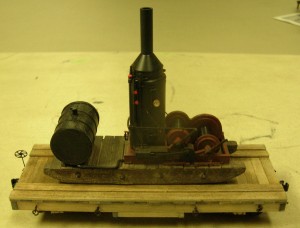
George Chambers, MotM Winner

The contest had three entries: David Yadock with a modified HO Proto-Lifelike flat car with a corrugated pipe load made of aluminum foil wrapped around a carriage both and very carefully “unscrewed”; George Chambers with a modified Bachman On3 steam donkey mounted on a modified Rio Grande Models flat car; and Bob Rorabaugh with a UP switcher that needed a lot of work to get it working – hand-made handrails, clean wheels, rewiring, etc. The winner was George Chambers.

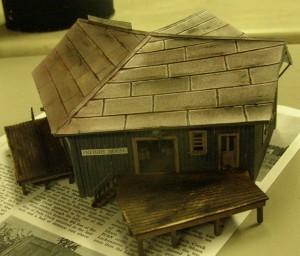
David Yaddock's scratchbuilt freight station

David Yaddock’s scratchbuilt freight station

David Yadock also brought in a scratchbuilt freight station model for AP assessment and earned a Merit Award after Di Voss, MMR, and Max Maginness, MMR, evaluated it. Congratulations, David!

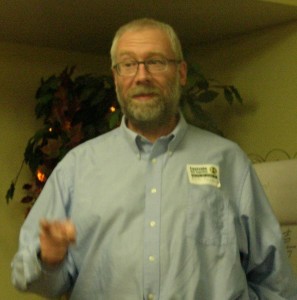
Brian Pickering, Decoder Pro Expert

Brian Pickering, Decoder Pro Expert

Our clinic was “Decoder Pro How To,” presented by Brian Pickering. He explained that Decoder Pro was a free program designed to take the mystery out of programming decoders. It translates Configuration Variables (CV’s) into English and uses various screens for the programming. An interface box of some kind (depending on your DCC system) is required to connect your computer to your DCC system. He used the example of assigning or changing the address of an engine. Using the computer and projector, we could see the Decoder Pro screen and the ease of making the change. He also demonstrated the changing the direction of the engine in case the wiring on the motor was reversed without having to rewire the engine by letting the decoder handle it. Brian answered any questions as they came up and also showed how the lighting on engines could be programmed using Decoder Pro. He emphasized that once the changes are done on Decoder Pro, they are saved in the program so you always have that record. There was more Brian wanted to demonstrate, but we ran out of time so he will reschedule a date in the next several months to continue.

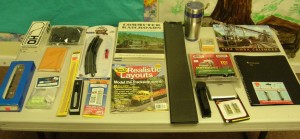
Door Prizes

Door Prizes

Here’s a picture of our door prize selection for the evening. Something for almost anyone!

Next Eastside Get-Together will be on December 19! Don’t forget your “Dirty Santa” gift!

Seattle-North Discusses Decoder Installation on December 5, 2013

By Jeff Moorman

Please join us for our next meeting, this Thursday, December 5, when our topic will be DCC decoder installations.

Last meeting Tom K took on the subject of track planning software. He was going to just cover free track planning programs, but since there only appear to be three contenders in this category he branched out a bit.

Tom started with the three freeware offerings he found: SCARM (www.scarm.info/index_en.html), TrainCad (www.traincad.com), and XTrackCAD (www.xtrkcad.org).

SCARM, which stands for Simple Computer Aided Railway Modeller, is the one Tom has spent the most time with. He used it for demonstrating the typical features one can expect in these programs. The very basic drawing features seem about the same, but there is quite a bit of variety in the how they are implemented. But more detailed features, such as the ability to do 3-D drawings, add structures and scenery, or run animated trains over the track plans you create, are not universally available.

And, although the developers of these programs may disagree, none of the features in any program seemed intuitive. You are going to have to dedicate some time to learning whichever automated track planning tool you choose. And, what you learn about one program may not necessarily carry over to another. For example, I personally have a couple of hours into XTrackCAD and do not feel I can really use it to design anything yet.

On the plus side, at least for these three, the price is right. You don’t have to invest any money to give them a whirl.

Tom then briefly covered some of the track planning programs that are for sale. Most of this was based on a MR article, entitled “Guide to Track-Planning Software”, that appeared a few years ago. It covered 3rd PlanIt from El Dorado Software, CadRail from Sandia Software, and AnyRail from DRail Modelspoor Software.

All three of these products have demo versions that allow you to “play” with the product before making a purchase decision. These versions are either limited in size of the layout depicted or in the ability to save results.

There is also another commercial program Tom found that apparently wasn’t available when the MR article was written. It is called WINTRACK (www.wintrack.de/usa.html). It was created in Germany, but there is now an English version.

The MR article was not a comparison or review, merely a “guide.” Therefore, there was no clear winner. In fact, the general impressions seemed about the same as for freeware offerings: (1) they do not all implement functions the same way: (2) they do not all have the same specialty features; and (3) you need to invest some time to learn to use them.

Sorry, we couldn’t tell you to just go get a single “magic bullet” track planning package that will do everything. You will need to invest some time analyzing your needs and what the market is offering. It some ways it might be like deciding on a DCC system. They all work, but just what features do you need, at what price,  and is there anyone around that can help you with it? Note that Tom’s research was not exhaustive, so you may find other programs out there.

For Show and Tell Chris F brought some used HO passenger cars he had acquired. They looked as if the previous owner had gotten half way through a truck replacement project before giving up. Chris’ challenge will be to complete the truck replacements and apply a UP paint scheme.

Dennis T brought an N scale Scottish train. There was a locomotive, a passenger car, and a small good wagon. The hobby store clerk in Edinburgh, Scotland, where Dennis got the models, assured him it was a typical contemporary consist in some parts of that country.

We meet at the Ronald United Methodist Church, 17839 Aurora Avenue North, Shoreline, WA. That is on the west side of Aurora (State Route 99) between 175th and 185th Streets and more specifically, between the Cadillac dealer on the south and Deseret Industries to the north. Going southbound on Aurora, make a right-hand turn into the church driveway immediately after passing the Deseret location. The parking lot is at the rear of the church. For regular meetings enter the lower, left side of the church from the rear lot.

Meetings are the first Thursday of each month, September through June. However in June we often do something different, like a layout tour. Doors open around 7:00 PM and the program starts at 7:30.

Remember the next meeting is December 5 and the clinic topic is decoder installation. The meeting after that is January 2. Hope to see you on December 5 or at least sometime on down the line.
November Tacoma Clinic Report

Al Babinsky

MMR Gene Swanson opened the clinic on time and paid honor to the Veterans for their services in WWII, Korea, Vietnam, and in the Gulf and Afghanistan. Our annual collection for the Northwest Food Network was presented to their representative in the amount of $1,250.00.

We had 44 modelers attend, including one new modeler, Bill Sandstorm, who models in HO.

Ed Liesse announced that Ken Liesse resigned as 4D Superintendent due to school conflict and Russ Segner will take over his position. Mike Highsmith will take over Russ’s position as Assistant Superintendent. The 2014 convention tours are filling up. The convention dates are June 18-21 and the registration is $59 and after March 1 it will be $79. PNR is looking for volunteers to fill in the president position.

The December clinic will be “Dirty Santa,” but remember to bring your “Bring and Brag.” The date is Dec. 12th.

George Bourcier from Tacoma Trains presented what’s new at the hobby shop with his new helper Bill who will take over for him at the clinic. His display had models from Lionel, Walthers, Atlas, BLMA, Athearn, and Accurail.

We had a great number of “Bring and Brag,” scratchbuilt building, weathered cars, scratchbuilt trees, and a scratchbuilt rail storage building from the Wenatchee Apple yard around 1922.

The winner this month is James Jeffrey with his railroad storage facility in the Wenatchee Appleyard.

This month clinic was presented by MMR Gene Swanson, Mike Shaw and Bob Stumpf and pertained to making a working switch stand target. You can download the PowerPoint slide show in PDF format here. These switch stands were built for the PSMRE layout in the Washington History Museum.

Next month’s clinic will be December 12th at our usual place: the Pierce County Library Administration Building at the corner of 112th Street and Waller Road. The start time is 7:30 PM and, as always, we will have food and drink. Hope to see you there. Have a Happy Thanksgiving.

Tacoma Clinic 11.14.2013.1

Presentation Available Online for Eastside Get-Together Clinic

Brian Pickering

At the last Eastside Get-Together Clinic I didn’t have time to complete the presentation on Decoder Pro, so I’m making it available online (it has been online before when I presented it for the HO Modular Group).

If you have questions, feel free to e-mail me (Brian) at bpickeri@gmail.com.

The presentation (in PDF format) is available by clicking here.

Eastside Get-Together this Thursday

JJ Johnston

We collect donations at our November meeting to give to needy members of the Church where we meet in recognition of the Church allowing us to use the room at no charge for our monthly clinic meetings, use their kitchen and their donation of coffee and condiments at no charge, and provide a young man to set  up the room each meeting with our tables and chairs and then clean the room and return it to a classroom for the school which uses the rooms daily.

Each year we work with the Church to identify a family or an individual who can benefit from a financial boost. The stories we have shared about the amazing things we have been able to do with our modest amount is significant. I’m always asked what is a good amount to donate. Last year, our donations amounted to an average of almost $20 per person who attended the November meeting. It would be meaningful if we could do that again this year. Of course donations are tax deductible and checks can be made payable to Bellevue Foursquare Church. We appreciate your consideration. See you this Thursday for a great DCC clinic and more.

November Skagit Valley & Whidbey NMRA Clinic

Tom Buckingham / Photos by Al Frasch

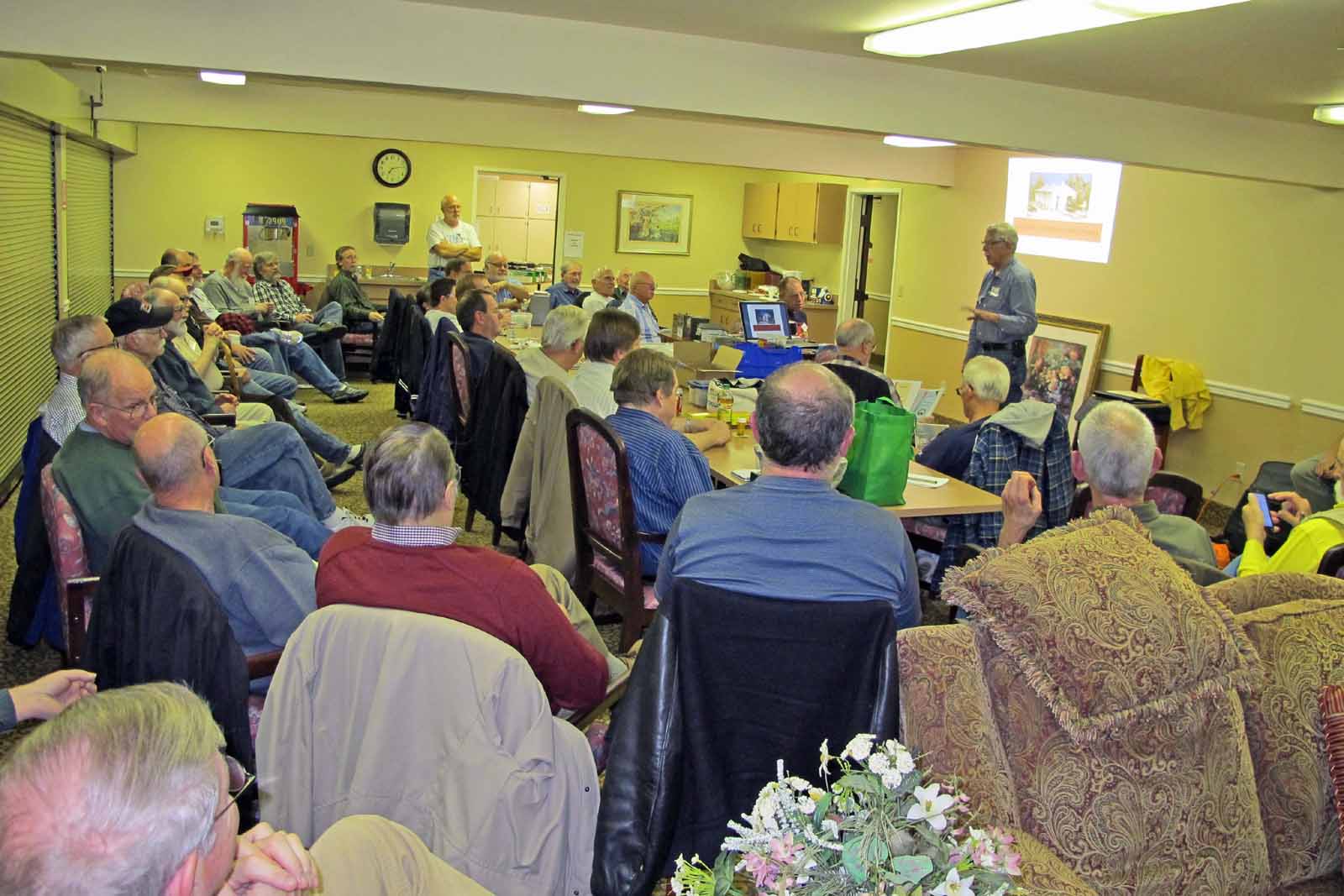
Rich Blake started the meeting to a new record in attendance—43. This month’s feature Clinic was by Al Carter. Al had just returned from a Seattle to Australia repositioning cruise with his wife Nona. His comment: “hot, humid and fabulous!”

Record Crowd

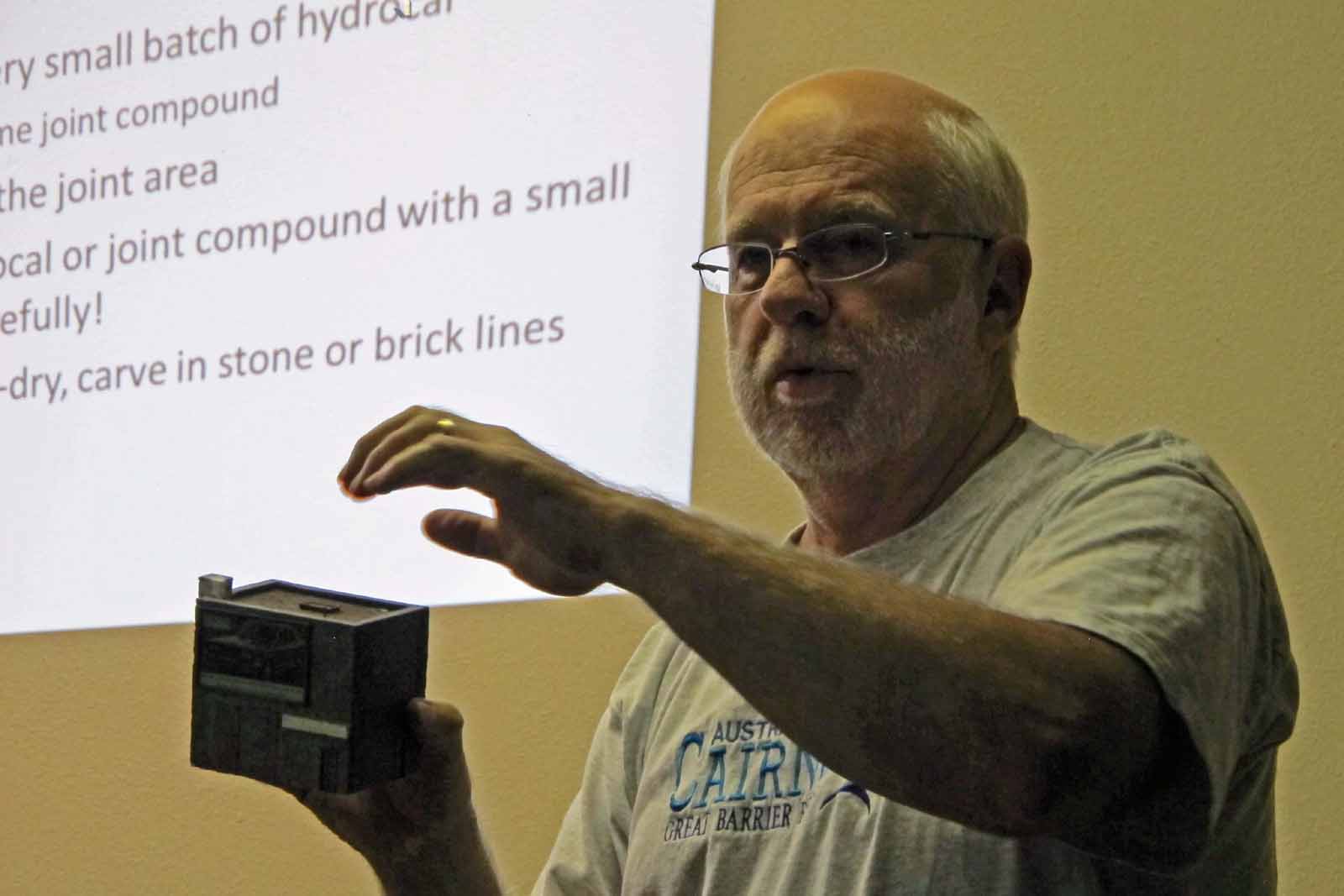
Al’s clinic was on building hydrocal structures. Al feels that there is a stigma about hydrocal structures that is not deserved. There are any number of sources for excellent hydrocal structures and in Al’s opinion the finished kit is oftentimes more realistic that it’s wood or plastic counterpart, especially stone and brickwork. It is easy to get good sharp details. Hydrocal is also easily kitbashed. On the negative side hydrocal is more easily breakable and does have significant weight—particularly if you are intending to use one or several in a module! (Plaster, like plaster of Paris, is much like hydrocal but is softer.)

Al Carter on a roll

The tools one needs to work with hydrocal are 220 grit sandpaper and a flat surface to mount it on; flat files, sanding sticks and emery boards; a scribing tool and/or a dull hobby knife; bar clamps; weights; a small square, steel straight edges—both 6- and 12-inch lengths; yellow carpenter’s glue or epoxy; 1/4″ square stripwood for corner bracing, spray primer; and spackle.

When beginning construction dry fit the pieces first. It will most likely be necessary to remove “flashing”; use your flat files to make the edges straight and flat. Cut corner braces or gussets and test fit one more time before beginning the gluing process. Have your bar clamps ready, glue one corner together and add strip wood for strength. Next, add the other walls and strip wood. Finally use your bar clamps to hold it firmly together, making sure the structure is square.

Once the structure is complete you will need to fix the joints. Mix a small amount of hydrocal or use joint compound. Mist the joint carefully. Apply the mixture with  a small spatula. When the mixture is semi-dry, carve in the stone or brick lines at the corners.

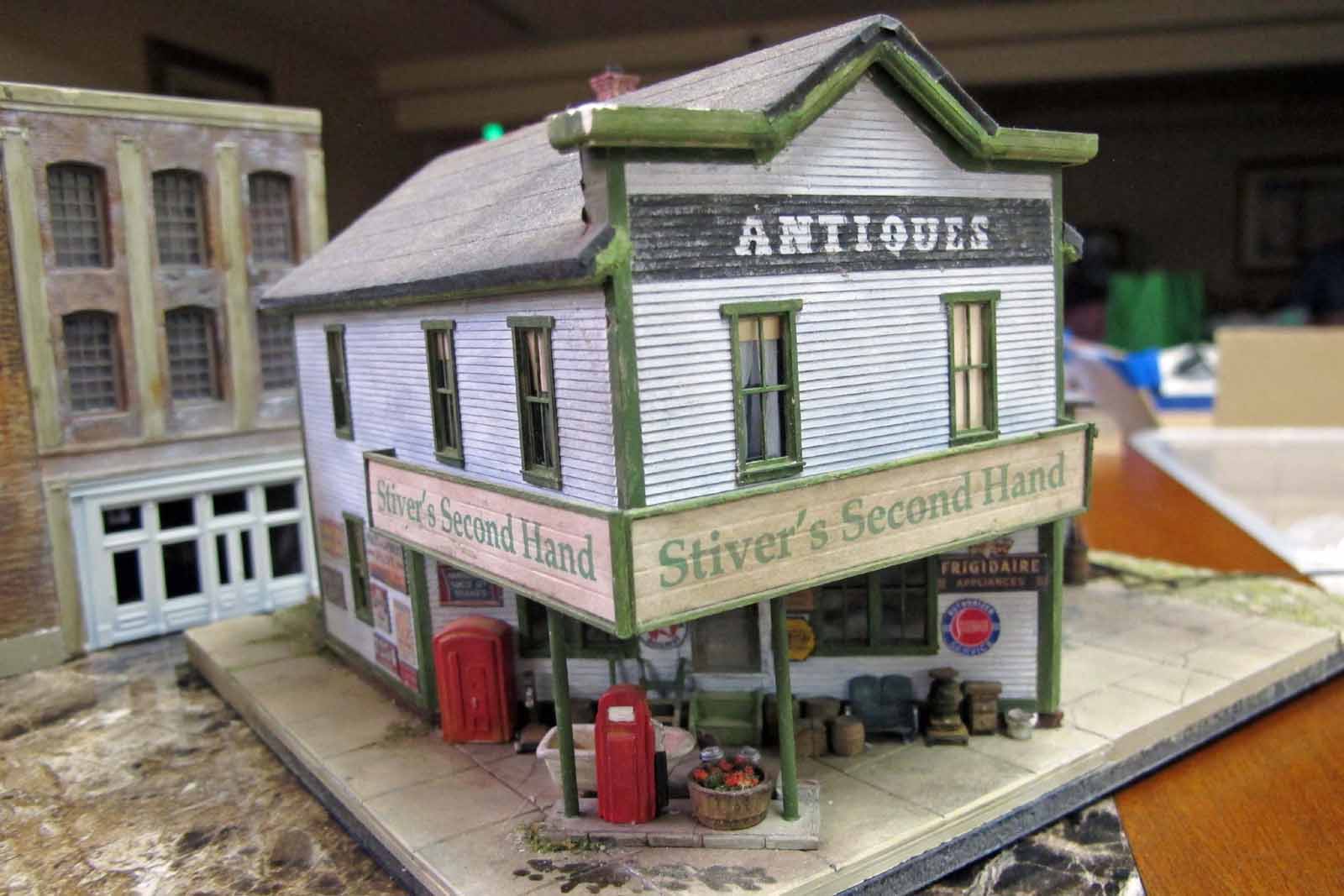
Stiver's Second Hand Store

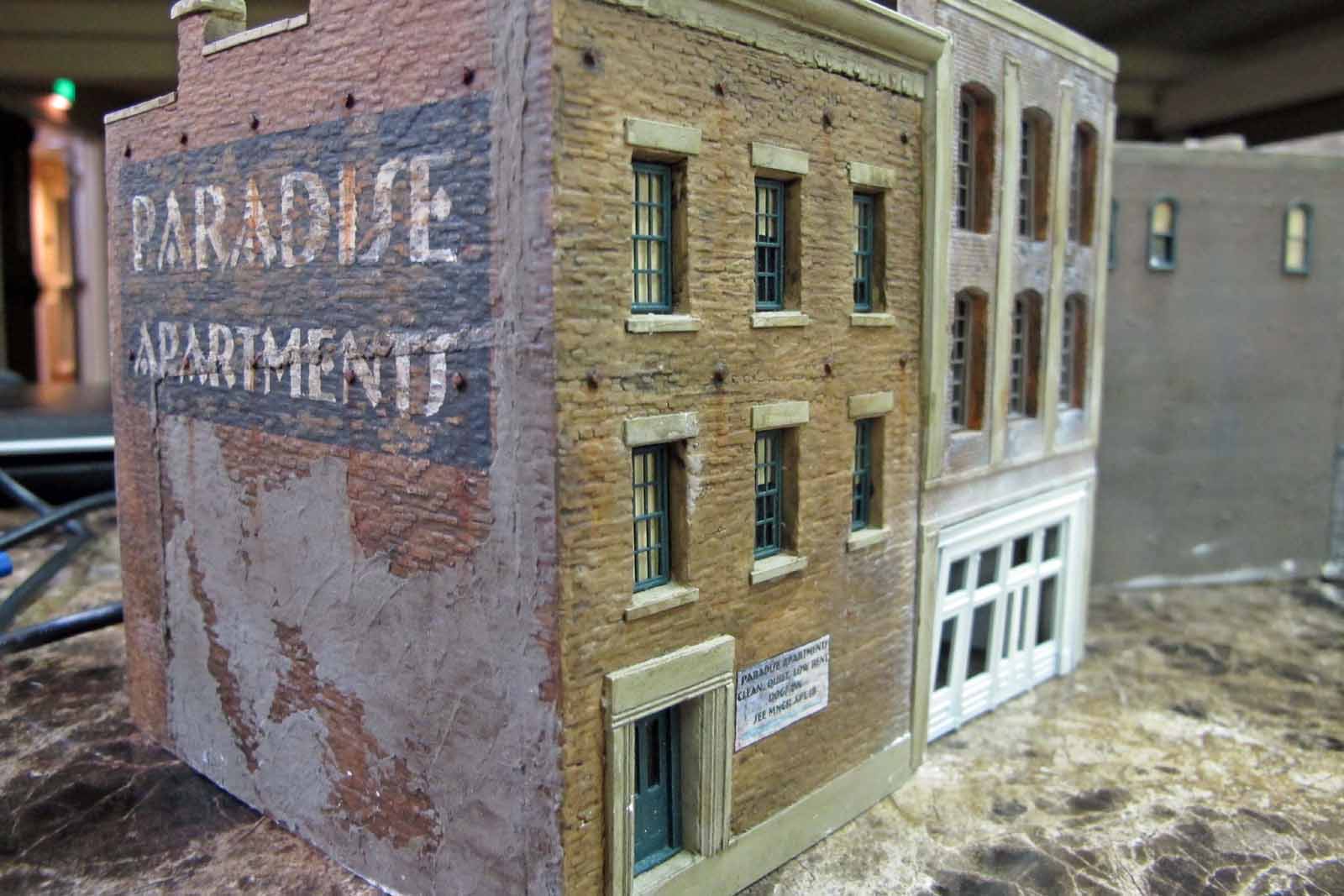
Next, add the mortar. Several methods work—use a light grey paint, use slightly diluted joint compound or use your underlying primer color as the mortar color. Finally drybrush on the color of the bricks.

If by chance you break a piece, don’t pull your hair out (not an option I have). First check with the manufacturer. Many replace parts at no charge. If that is not an option use yellow glue sparingly and brace the back side thoroughly.

Paradise Apartments

There are different schools of thought on priming before painting. CC Crow and Downtown Deco recommend priming first, while others do not. Al showed two test pieces that he had done. On each he had primed half of the piece and left the other half unprimed. It was difficult to see any difference in the two. If you do prime, Al suggested using Wal-Mart’s “Color Place” primer. It is about $.96 per can.

There are several sources of hydrocal kits and many of the sources have online help and tutorials:

Downtown Deco http://www.downtowndeco.com/

C.C. Crow http://www.cccrow.com/

Guts, Gravel & Glory

Morse Productions http://morseproductionsproducts.blogspot.com/;

Thomas Yorke http://trevorcreek.tripod.com/

Cibolo Crossing; Motrak Models https://www.facebook.com/pages/Motrak-Models/134023453307135

Railroad Kits (Ed Fulasz) http://www.railroadkits.com/

South River Model Works http://www.southrivermodelworks.com/

Other sources include: Mike McNamara http://mainecentral.blogspot.com/2011/03/hydrocal-structure-kits.html

and Dioramas Plus http://www.dioramasplus.com/site/

A very informative clinic by Al and one that will encourage me to dig out some as yet unbuilt Ed Fulasz hydrocal kits!


Finally, Bob Farley had a couple of  interesting items to share. First he showed us a Proto 87 turnout that he had constructed and automated. And then he showed us his HO scale locomotive that runs on an RC battery. He says he gets about 30-45 minutes out of each battery. The best part is there are no reverse loops or shorts. And it is all run by his wireless Digitrax system. He was even willing to run the train across the floor for us! Thanks, Bob.

Why You Should Attend PSX2014, part 1

Jack Hamilton, MMR

PSX2014 LogoI have been attending model railroad conventions at the division, region, and national level for about 20 years. Obviously, I find something in them or I would not keep going back.

First and foremost are the friends I have made over the years. Convention is our time to catch-up and share experiences. Second is the ability to learn in a very concentrated time period. I go to plenty of local clinics and, as an AP Evaluator, I get to visit a fair number of layouts. At conventions, I get to attend clinics from very knowledgeable people, many of whom I have not previously met, presenting subject matter I always wanted to know more about. I also get a chance to visit local industries and rail facilities as well as some really great layouts.

In the end, in a concentrated period, I spend time with old friends, make new friends, learn more about the hobby, expand my skill set, and get to visit facilities and layouts that I would otherwise never even know existed. How could I pass up that opportunity?

I really would like to see you in Tacoma in June so we can share together. Register now at http://www.PSX2014/


4D to Host 2014 PNR Regional Convention

Russ Segner

Let’s assume you have raked up all the leaves and stowed all the lawn furniture and have moved back inside for the winter. While you were busy all summer and fall, a bunch of your fellow modelers have been busy putting together a really BIG SHOW.

Next June 18 through 21 we will host the Pacific Northwest Region’s Annual Convention. We will meet at the Tacoma La Quinta Inn for three days of clinics and tours of local rail sites. Over forty clinic sessions are planned and at least a dozen local layouts and clubs will be open. Several of these are new to the model railroad tours. Three special excursions are planned to Tacoma Rail, the NorthwestRailwayMuseum, and the Mt. Rainier Scenic Railway. These are ticketed events with limited seating. You must be registered to get a ticket.

Registration is only $59 through December. In 2014, it will rise to $79. You can register and get more detailed information at PNR2014.com.

Here are your fellow model railroaders who are putting this all together: Mike Highsmith, Sherman Stevens, Dave Liesse, Kurt Laidlaw, Kevin Klettke, Alex Brikoff, Tina Brikoff, Al Lowe, Russ Segner, Gay Liesse, JJ Johnston, Jeannie Melvin, Ken Liesse, Walt Huston, Barry Dupler, Robin Peel, Jack Hamilton, and Ed Liesse.

Want to Operate on a 4,000 sq ft Layout?

Thomas Dye

Click for larger image

Click for larger image

The 4D’s NTRAK group is joining with the Mt. Rainier N Scale club to create a 76’x54′ combined modular layout at the Great Train Expo this weekend, November 16-17, in Puyallup. Besides each club’s NTRAK loop with circling trains to entertain visitors, we will also run operations. Saturday we’ll run full operations, complete with car cards. Sunday will be light ops, with freight movement along routes to and from yards.

If you’d like to run with us, even for an hour, email me to reserve a time. We’ll have plenty of modules, locos and rolling stock, but if you have a Digitrax throttle (of almost any type), bring it. If you’d enjoy running your own N scale equipment, bring it, too (locos must be equipped for DCC).

Even if you just want to loop a train, come and join us. We’ve got a lot of open track and rolling stock that needs moving!

See you Saturday?

Seattle-North Discusses Track Planning Software on November 7, 2013

By Jeff Moorman

Please join us for our next meeting, this Thursday, November 7, when our topic will be track planning software.

We’d all like to extend our thanks to Jim Sabol who came up from the Tacoma area at the last minute to be our clinician last month. Jim’s topic was “Freight Yard Design.”

What I appreciated about Jim’s approach, as opposed to many yard design presentations I have seen over the years, is that he stuck with the basics. This was information any model railroader can use, not just those who have a basement full of track and freight cars to organize. And he kept coming back to the fact that real railroads used yards to help them operate more efficiently, and model railroads should too.

Operations was another theme that kept occurring during the clinic. Jim claims everyone has space for some type of model railroad and any type of model railroad should include some aspect of operations. His basic example was a plain, wooden plank with a couple of turnouts where one could sort cars (just like a real railroad).

Jim’s next example was a long length of track with a single passing siding in the middle. He explained how this could be operated like a real railroad, moving a commodity from one end to the other. Jim reminded us that real railroads don’t move freight cars to make money – they move freight. The cars in Jim’s example were used to move beer, so he instantly had the attendees’ attention.

Of course, once you get beyond a couple of freight cars, moving beer is more efficient if you have a place to store cars that aren’t immediately in use or that cannot be loaded/unloaded right away. That’s where the freight yard starts to come in handy. And it becomes handier still if you have to move more than just one commodity, like food stuffs, building materials, petroleum, and etc. to fulfill the needs and wants of all those workers making the beer you ship.

So, once the need for a freight yard arises, there are a few basic questions to ask:

  • Is it in a convenient location? Prototypically the yard needs to be near the industries and railroad facilities it services. From a model standpoint it needs to be “viewable” and “reachable.”
  • Is there room to work? Typically yards are used to store and sort freight cars. If it needs to handle an average of 15 cars, then it also needs way more than 15 spot to put them in. Generally it is a good idea to leave at least one dedicated track free. This is where trains coming off the mainline can park and where trains getting ready to depart the yard can be assembled. And you’ll need a little free space on the other tracks to facilitate breaking down and assembling trains. Of course, if there are lots of trains coming and going, then you need space to put them until they can be dealt with.
  • Can operations in the yard proceed without tying up the mainline? It is not very efficient to overall operations if the mainline is used every time you pull a length of cars out of a yard track. If at all possible, you need a way to work cars back and forth in the yard without using the mainline. This feature is often called a drill track or yard lead.
  • Is there a way to get the locomotive back in service? Motive power is relatively expensive, so real railroads don’t like to have it “blocked in” by freight cars in the yard. You need a way to get incoming locomotives separated from their train and “back to work”.

Of course, getting all these questions answered affirmatively can be difficult on a model layout. Perhaps there is a way to get a single track feature to do double duty. For example, a run around track designed to get a locomotive off of its arriving train might also be used as the yard lead. Or perhaps a nearby industrial siding can be used to temporarily park a few cars to make more room for sorting in the yard.

Again, thanks to Jim for providing the clinic. It was quite informative.

Oct13 Clinician

For show and tell Dennis T brought a couple of HO box cars custom lettered for the “Shoreline & Puget Sound”. He found them at an estate sale, but no one seemed to know much about them. If you know anything about their history, please add a comment to this entry or drop me an email.

Oct13 Dennis HO

Also, Tom K brought a Maarklin HO model of a German electric locomotive. He indicated he had once actually ridden behind a locomotive like this, and it was definitely not a fast, express train like experience.

Oct13 Tom German Elect

We meet at the Ronald United Methodist Church, 17839 Aurora Avenue North, Shoreline, WA. That is on the west side of Aurora (State Route 99) between 175th and 185th Streets and more specifically, between the Cadillac dealer on the south and Deseret Industries to the north. Going southbound on Aurora, make a right-hand turn into the church driveway immediately after passing the Deseret location. The parking lot is at the rear of the church. For regular meetings enter the lower, left side of the church from the rear lot.

Meetings are the first Thursday of each month, September through June. However in June we often do something different, like a layout tour. Doors open around 7:00 PM and the program starts at 7:30.

Remember the next meeting is November 7 and the clinic topic is track planning software. The meeting after that is December 5 where the scheduled topic will be N scale decoder installation. Hey, if you can install it there, you can install it anywhere! Hope to see you November 7 or at least sometime on down the line.