Grab Iron Posts

Seattle-North Discusses Track Planning Software on November 7, 2013

By Jeff Moorman

Please join us for our next meeting, this Thursday, November 7, when our topic will be track planning software.

We’d all like to extend our thanks to Jim Sabol who came up from the Tacoma area at the last minute to be our clinician last month. Jim’s topic was “Freight Yard Design.”

What I appreciated about Jim’s approach, as opposed to many yard design presentations I have seen over the years, is that he stuck with the basics. This was information any model railroader can use, not just those who have a basement full of track and freight cars to organize. And he kept coming back to the fact that real railroads used yards to help them operate more efficiently, and model railroads should too.

Operations was another theme that kept occurring during the clinic. Jim claims everyone has space for some type of model railroad and any type of model railroad should include some aspect of operations. His basic example was a plain, wooden plank with a couple of turnouts where one could sort cars (just like a real railroad).

Jim’s next example was a long length of track with a single passing siding in the middle. He explained how this could be operated like a real railroad, moving a commodity from one end to the other. Jim reminded us that real railroads don’t move freight cars to make money – they move freight. The cars in Jim’s example were used to move beer, so he instantly had the attendees’ attention.

Of course, once you get beyond a couple of freight cars, moving beer is more efficient if you have a place to store cars that aren’t immediately in use or that cannot be loaded/unloaded right away. That’s where the freight yard starts to come in handy. And it becomes handier still if you have to move more than just one commodity, like food stuffs, building materials, petroleum, and etc. to fulfill the needs and wants of all those workers making the beer you ship.

So, once the need for a freight yard arises, there are a few basic questions to ask:

  • Is it in a convenient location? Prototypically the yard needs to be near the industries and railroad facilities it services. From a model standpoint it needs to be “viewable” and “reachable.”
  • Is there room to work? Typically yards are used to store and sort freight cars. If it needs to handle an average of 15 cars, then it also needs way more than 15 spot to put them in. Generally it is a good idea to leave at least one dedicated track free. This is where trains coming off the mainline can park and where trains getting ready to depart the yard can be assembled. And you’ll need a little free space on the other tracks to facilitate breaking down and assembling trains. Of course, if there are lots of trains coming and going, then you need space to put them until they can be dealt with.
  • Can operations in the yard proceed without tying up the mainline? It is not very efficient to overall operations if the mainline is used every time you pull a length of cars out of a yard track. If at all possible, you need a way to work cars back and forth in the yard without using the mainline. This feature is often called a drill track or yard lead.
  • Is there a way to get the locomotive back in service? Motive power is relatively expensive, so real railroads don’t like to have it “blocked in” by freight cars in the yard. You need a way to get incoming locomotives separated from their train and “back to work”.

Of course, getting all these questions answered affirmatively can be difficult on a model layout. Perhaps there is a way to get a single track feature to do double duty. For example, a run around track designed to get a locomotive off of its arriving train might also be used as the yard lead. Or perhaps a nearby industrial siding can be used to temporarily park a few cars to make more room for sorting in the yard.

Again, thanks to Jim for providing the clinic. It was quite informative.
Oct13 Clinician

For show and tell Dennis T brought a couple of HO box cars custom lettered for the “Shoreline & Puget Sound”. He found them at an estate sale, but no one seemed to know much about them. If you know anything about their history, please add a comment to this entry or drop me an email.
Oct13 Dennis HO

Also, Tom K brought a Maarklin HO model of a German electric locomotive. He indicated he had once actually ridden behind a locomotive like this, and it was definitely not a fast, express train like experience.
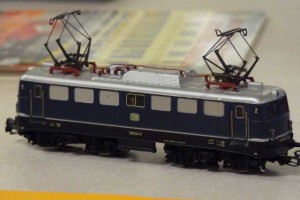
Oct13 Tom German Elect

We meet at the Ronald United Methodist Church, 17839 Aurora Avenue North, Shoreline, WA. That is on the west side of Aurora (State Route 99) between 175th and 185th Streets and more specifically, between the Cadillac dealer on the south and Deseret Industries to the north. Going southbound on Aurora, make a right-hand turn into the church driveway immediately after passing the Deseret location. The parking lot is at the rear of the church. For regular meetings enter the lower, left side of the church from the rear lot.

Meetings are the first Thursday of each month, September through June. However in June we often do something different, like a layout tour. Doors open around 7:00 PM and the program starts at 7:30.

Remember the next meeting is November 7 and the clinic topic is track planning software. The meeting after that is December 5 where the scheduled topic will be N scale decoder installation. Hey, if you can install it there, you can install it anywhere! Hope to see you November 7 or at least sometime on down the line.
“Build a Memory” postponed a year

Walt Huston

The NMRA’s national “Build a Memory” program, which was announced here recently for November, has been postponed a year because of a problem obtaining the necessary materials.

However, Jack Hamilton and I will still be at the Great Train Expo in Puyallup on November 16-17 using donated materials to build an N scale starter layout. We call our program “How To Build A Small Layout.” In addition, we will hold “How to Solder” demonstrations that will include “solder it yourself” workstations to give people some personal experience. We will be assisted in all this by other 4D members, including Al Babinski and Russ Segner. We plan to have a completed layout there as well.

So I hope you’ll stop by, say hello, and maybe do a little hands-on teaching yourself. See you in Puyallup!


The Passing of an Ntrak Pioneer

Bruce Alcock

It is with great sadness that we must announce the passing of Jim FitzGerald, an early pioneer, President and newsletter editor of NTRAK.

For 40 years, Jim FitzGerald ensured that every other month, NTRAK members received their newsletter with updates on Ntrak standards, activities, events and organizational notices as well as news and information about N scale in general. For many years, Jim FitzGerald was a coordinator for the NTRAK layout at the National Train Show, the public event of the NMRA national convention and that is how many people had a chance to meet him, face-to-face. Jim worked with his wife Lee to help get T-Trak going as an alternative modular standard and today T-Trak continues to grow and thrive as it is used at shows as well as for home layouts.

When Jim first started with NTRAK, N scale was in its infancy and a very small part of model railroading. It was through NTRAK layouts that model railroading and specifically N scale was introduced to the public at shopping malls, hospital and museum shows as well as at train shows. It was NTRAK that took model railroading from the private basement to the pubic venue and it was Jim FitzGerald who helped guide, organize, publicize and encourage the NTRAK clubs that sprung up across the country.

Jim will be sorely missed by all.

Module Teachers Wanted

Ken Liesse

Have you seen the article in the NMRA Magazine about Build A Memory? The NMRA instituted it with Lowe’s Hardware for helping people get started in model railroading by giving instruction on how to build a module. Where does 4D come in? We are one of the first divisions to participate in the program.

Our first BAM session will be November 16 at the Great Train Expo in Puyallup. However, we need some folks to help with the process. 4D has always been a hotbed for modular construction, so there is a lot of available talent. Some of you are probably planning on going to GTE anyway, so this is the perfect opportunity to help the division while you’re there.

If you have module building experience, or teaching experience, or both, please donate a couple of hours to this effort. This is a great way to give back to the hobby as well as promote our great hobby by showing the general public how easy it is to actually build a layout.

Walt Huston and Jack Hamilton will be spearheading this effort, but they can’t do it alone. If you’d like to help, contact Walt (walthuston@earthlink.net) and let him know you’re available.

Board Meeting Set

Ken Liesse

The next meeting of the 4D Board of Directors has been set for Saturday, November 2nd. It will take place at the Mitzel’s Restaurant on 84th in Kent at 1:00 pm. All 4D members are invited to attend the meeting.

If anyone has agenda items for the meeting, please get them to Secretary Jean Melvin no later than Wednesday, October 30.

Eastside Get Together This Thursday

JJ Johnston

This Thursday, October 17th, at 7:30 PM at the Bellevue Foursquare Church, join your fellow modelers and local celebrity instructor Jim Sabol for his acclaimed clinic on the nuances of proper soldering techniques. Jim’s legendary humor, insight and always entertaining graphic displays make this a “don’t miss” evening. Find out how to do it correctly. Find out why there is an “L” in solder. Find out much more, too!

Of course, all the usual stuff will happen, including some very expensive door prizes donated by the Inside Gateway and Steve Depolo. Coffee, donuts, special event notices, stuff for sale, and the always-welcome Model of the Month displays. Congrats to last month’s winner Geoff Stippes for his 1:20 caboose and to Rob Jones, Ted Becker and Mike Kavanaugh for their excellent entries. Maybe even the video library will be there too. Weather looks good, Seahawks are on the NFL channel which most of us can’t see it, so let’s make this another well-attended get together. See you all down the track at church on Thursday.

October Skagit Valley & Whidbey NMRA Clinic

Tom Buckingham & Al Frasch / Photos by Al Frasch

Rich Blake kicked off the October Skagit Valley & Whidbey NMRA Clinic to more than 30 eager model railroaders by reminding everyone of the full slate of fall swap meets, expo’s  and clinics. Of note were the Pacific Northwest Railroad Prototype Modelers Meet “Rail By the Bay” on October 26th,  The Anacortes & Fidalgo Model Railroad Club’s 18th Annual Open House on November 2nd and 3rd,  The Boeing Employees Model Railroad Club Swap Meet on November 9th and finally the Burnaby, British Columbia  2013 Model Train Show & Meet November 9th & 10th.

The feature presentation was the much heralded Four Mini-Clinic Clinicfest. The first presenter was John White discussing “Dry Print Lettering for Rolling Stock and Buildings.” John had a nice handout of all the tools and materials required to do a professional-looking job. He started by the choices in fonts and colours (the spelling is out of respect to John). Though there are two good “railroady” font choices—Gothic and Roman, John urged us to choose only one or “inevitably a Gothic letter will end up in a line of Roman print.” Although the fonts are available in White, Black, Red, Yellow, Silver and Gold, John said he had had no luck with Gold with very high wastage. John WhitePerhaps the most valuable part of John’s comments were his tips that only experience can bring: Choose the name of your pike carefully—there are only two “V’s” per sheet; write down what you intend to decal—sometimes you have to spell backwards (try spelling Skagit backwards quickly without looking!); use a piece of blue or white masking tape to mark the edge of the lettering but be sure to cut off about ¼” so no “hairy” bits stick out on the original tape edge; don’t miss space between words; use a clean (preferably white) piece of paper towel to place on your workbench to prevent the decal sheet from picking up dirt form your workbench; and lastly check your work before burnishing the letters. John closed by discussing difficult locations and repairs.

The second presenter was Rich Thom with “Having Fun in a Cramped Space”  Rich talked about some problems encountered when he tried to cram too much operation—and too much track—in a small room: lots and lots of no. 4 turnouts; wye turnouts; tracks too close to layout edges; 4.5% grades, etc. Lack of planning also placed L-girders directly beneath a series of turnouts, so when he decided to use Tortoises to throw them rather than oversize ground throws, he had to make a number of simple brackets to extend the “reach” of the switch motors. They are simple and versatile and can be used in any situation where one needs to locate a switch motor some distance away from what it is moving. Rich wrote an article for the April 2013 Model Railroader on construction of the brackets (page 60).

Cliff Aaker

Our third mini-clinic was by Cliff Aaker on “Making Hemlock Trees.” Using bamboo skewers for tree trunks, Cliff first runs a bead of glue along the skewer where he wants the branches to be. Next he takes fibers that he has separated from a hank of manila rope and cut to approximate limb length and sprinkles them randomly on the  now sticky tree trunk. After that dries, he trims the limbs to a reasonable and appropriate length and dips the entire skewer in a dark walnut furniture stain. When the stain has dried he rotates the tree branches in glue and then sprinkles them with his favorite tree foliage. Cliff had samples at the various stages in the process with him and it took an unbelievably short time to produce a very realistic hemlock.

Rich Blake

Finally, what do the following items have in common: the foil from wine bottles, aluminum cut from pop cans, coffee stir sticks from your favorite barista, plastic bottles, dog toy stuffing, pencil shavings, used guitar strings, short lengths of solder, rhododendron cuttings, and rotted wood? We found out when Rich Blake showed us how he does “Scratchbuilding with Common Materials.” Rich told us how as a young modeler he had little financial resources to buy the “proper” materials so he used his imagination and commonly available materials to get the job done—always at a cheaper price and often better looking that the “real McCoy.” One example was to make door hinges complete with bolt heads using the foil from wine bottles and a dulled map pin. Another was using pencil shavings colored with acrylic paint to make clumps of flaking foliage. Finally he showed how he used an old dead Walkman to scavenge parts that can be used on models.

All-in-all a fun night in Oak Harbor.

John Salzetti Status Report

Ed Ives

I spoke with John Salzetti today. He sounds well and alert. He is currently being checked out in a hospital in Birmingham, Alabama. He expects to be there another ten days or so. (I don’t know the name of the facility.) Upon his release, he plans to either live with his daughter or in an assisted living facility in that area. I assume John will not be returning to this area soon if ever.

You can call John on his cell phone 206-920-6344 or email him. I’m sure he’d love to hear from you.