Grab Iron Posts

Tacoma Clinic

Al Babinsky

Click for larger image

MMR Gene Swanson opened the clinic in his usual manner and asks if any newcomers were present. Patrick Smith introduced himself as a newcomer to the hobby. We had 47 modelers attending the clinic. Under announcements, TNW presented a YouTube video advertising their swap meet at the Tacoma Freighthouse Square on May 14–15.

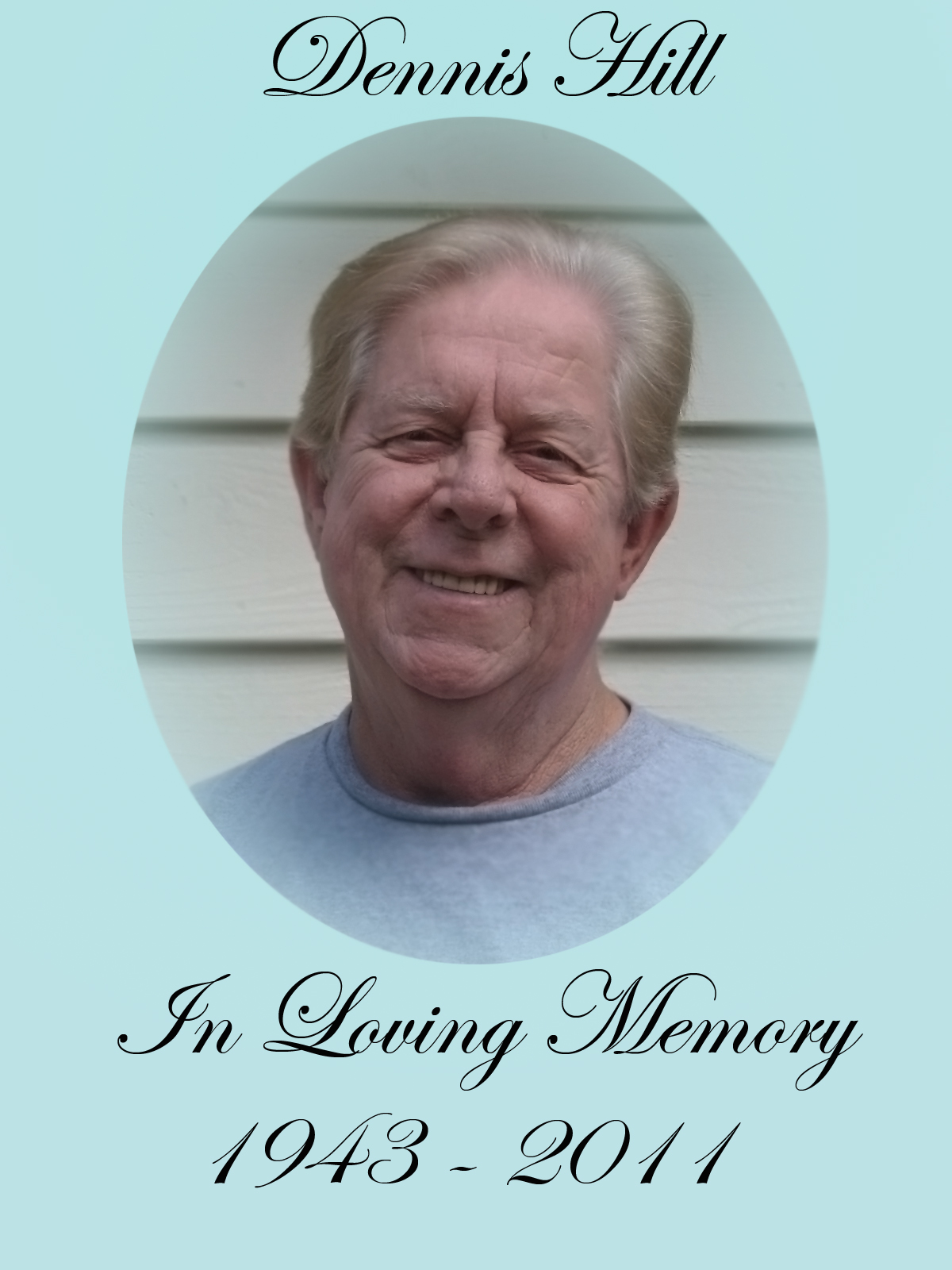
A moment of silence was held for our 4D superintendent Dennis Hill who passed away on Tuesday the 12th of April.

Mike Shaw announced that there will be a 100th Anniversary celebration for the Tacoma Union Station on May 1st.

George Bourcier from Tacoma Trains presented what’s new at the Hobby Shop which included a N scale 11-car UP city train consist, box cars with graffiti applied and many other items.

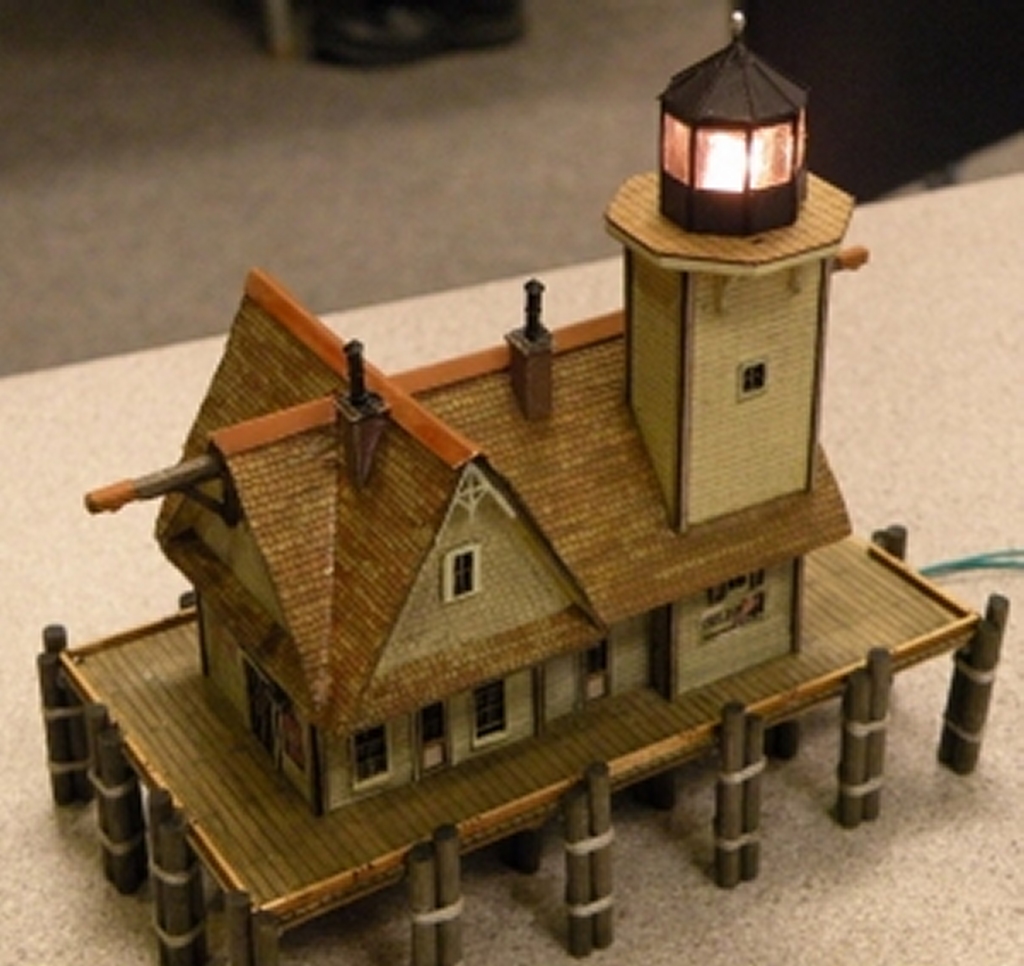
The Bring and Brag (Model of the Month) had many fine entries including a scratchbuilt log car; a gondola with a river rock load; a 2-story outhouse marked U.S. Army; an N scale Donovan’s Transfer Co. dockside building with lighthouse; an U.S. Army caustic liquid tank car in DB markings; three geared logging locomotives, Shay, Climax, and Heisler (the Shay and Climax included sound); a Lincoln-style cabin printed on paper and then assembled; a scratchbuilt static grass applicator; a Jordan miniatures chain drive Mack dump truck; N scale box cars weathered with chalk; O scale brass Milwaukee Road Bipolar re-motored, with re-manufactured gear boxes for all drive axles; a Sierra West kit of a tractor repair shop with LED lighting and a forge with flickering fire; and, last but not least, what the owner called his dinner train: a set of boxcars with advertisements for various food and beverage products. The winner of the Model of the Month was Dennis Reeves’s N scale Donovan’s Transfer Co and Lighthouse.

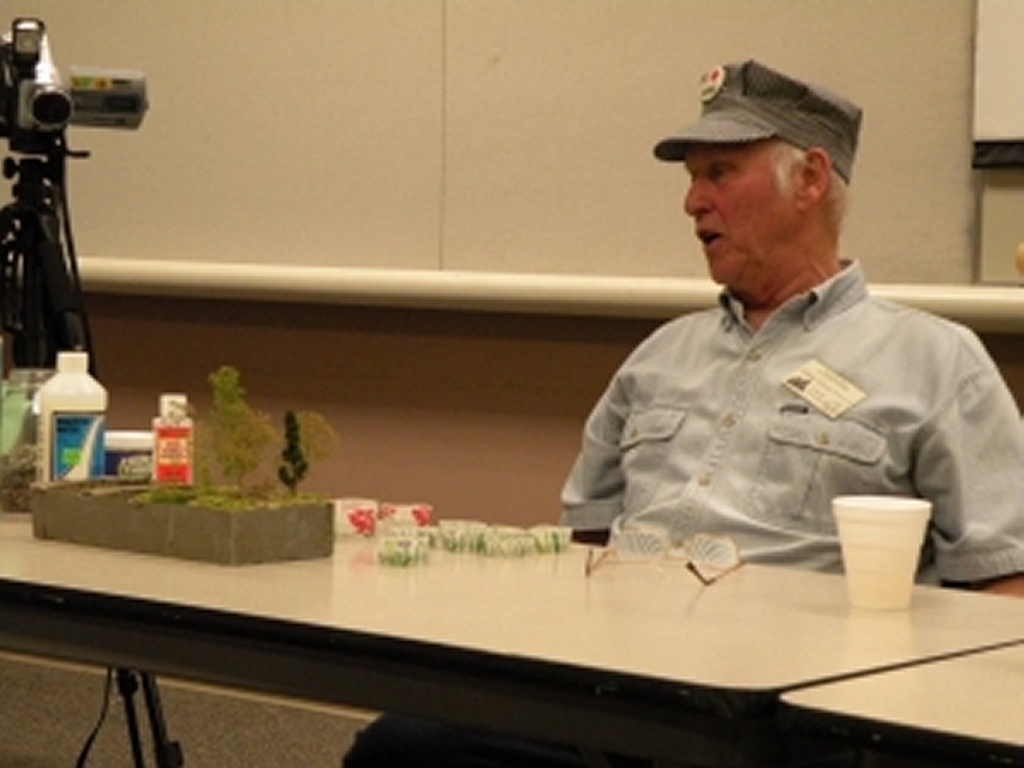
The clinic, “About Water,” was presented by MMR Gene Swanson. Gene wanted a shallow, slow, clear river flowing over a smooth rock bed. He experimented with various products such as Modge Podge, Triple Thick, Realistic Water, and Magic Water. He also tried combinations of different products and found that Triple Thick and Realistic Water gave him a somewhat cloudy mixture which looked a lot like water with sediment in it. The combination that satisfied him was Triple Thick and Realistic Water, which dried clear and did not wick up. Again a great clinic and thanks to Gene for sharing this with us.

Next month’s clinic will be May 12th at our usual location, the Pierce County Public Library Admin. Bldg. at the corner of 112th Street and Waller Road at 7:30 PM. The clinic presenter will be Duane Damgaard speaking on “Mines.” Hope to see you there. Bring some of your modeling friends or potential modelers. Photos of the Model of the Month should be published soon.

Eastside Get-Together Thursday, April 21st

By JJ Johnston

Don’t forget the Eastside Get-Together, next week, Thursday, April 21, 7:30 PM at the Bellevue Four Square Church in Bellevue. Our group sends condolences to the Hill family and will take a moment of prayer to remember our friend Dennis.

TOPIC: Join legendary modeler C.J. Riley, MMR, for his clinic “Layout Planning On A Prototype Theme.” He will feature a slide presentation
illustrating the concept of modeling from the prototype to create a more believable model railroad. We’ll see prototype and model slides illustrating the concept of CJ Riley’s Kanawha & Western Allegheny RR. Further info is available in Allen Keller’s Great Model RRs Vol. 3, available from the video library. Video Librarian Stu Rogers will be there, so maybe he will bring some copies of this early video.

Of course, we will offer all the usual stuff that makes the Eastside group so popular; Stuff like free coffee, fresh donuts, the Mart with great prices on railroad items (bring some of your own to sell too), super door prizes donated by Steve Depolo, the red-hot Model of the Month competition and a great venue with convenient parking. See ya.

Skagit Valley and Whidbey Clinic

Gordon Garnhart

There were 27 people gathered at the Summer Hill Retirement Community conference room on Wednesday, April 13th. The mini swap meet brought some HO locomotives, some rolling stock, both freight and passenger, and a few buildings.

The meeting was opened by John White leading a discussion on recent progress in the project to furnish modeling kits to hospitalized veterans. We may even be able to provide coaching to help a veteran get started in his project.

An informal survey was conducted to determine what programs for next year might be of greatest interest to the group. A lively discussion followed.

For the main event of the evening, Dick Haines offered a very interesting, comprehensive and thought provoking presentation on modeling water on a model railroad layout. He talked about the various forms that water takes in a landscape, such as streams, rivers, lakes, ponds, rapids, falls and surf. He suggested gathering photographs or taking your own photographs of examples of the kind of water situation one intends to model. We should try to make our water look as realistic as we can and yet, the water should not be a focal point in itself but should point to some aspect of the layout related to operations such as a bridge, a pier or a sawmill. And don’t just think about the water, but also consider the adjacent land features, so that the surrounding landscape looks logical. Make the water surface appropriate to its circumstances; should it be smooth rippled or wavy. Ripples and waves are in motion in real life, but are static in a model and only suggest motion. But there are some ways to create the illusion of motion. He then showed a sketch of a revolving screen covering ceiling lights that cause rippled or wavy water to sparkle. He followed that with a demonstration of a waterfall made of a silica or acrylic sheet with an irregularly shaped surface and back lighted with a small light bulb mounted within a revolving motor driven perforated drum that gave the illusion of falling water. He talked about, and showed examples of various materials applied to glass, showing different smooth and rough surfaces  He distributed copies of a very comprehensive list of products that are available, together with cost information and comments on effectiveness and ease of use. The program was well received.

We look forward to Wednesday, May 11th, when Craig Williams will talk about “The South Whidbey Logging Railroad”, a real narrow gauge railroad that existed on Whidbey Island at one time.

Dennis Hill Passes

Ken Liesse

Click for larger image

It is with deep sadness that I report the passing of 4D Superintendent, Dennis Hill. Dennis was stricken with an aneurysm in his abdomen earlier today and rushed to the hospital. Unfortunately, he had lost a lot of blood before his first surgery at 11:00 and the doctors could do nothing else for him. Dennis passed away at 5:50 this evening.

Please keep Dennis and his wife Diana in your thoughts and prayers. Diana plans a memorial service this summer, during warmer weather.

Tacoma Union Station 100th Anniversary May 1st

Al Lowe

George Northcroft, Regional Administrator of the United States General Services Administration Northwest/Arctic Region invites you to the 100th Anniversary Ceremony for Tacoma Union Station, 1717 Pacific Ave, Tacoma on Sunday, May 1st from 1:00 pm to 2:00 pm. You need to register by April 22. Click Here to register or call Ross Buffington, 253-931-7085.

Panel Discussions in the Washington State History Museum next door will follow from 2:30 pm to 3:30 pm on:

  1. Diversity in the City of Destiny: Tacoma’s Untold Cultural History
  2. History of the railroads and Union Station in Tacoma.
  3. Efforts to save the station and construct the courthouse and the resulting impact on the revitalization of downtown Tacoma.

A Government Photo ID is required to enter the building. Please arrive early for security.

Seattle-North Clinic Meets April 7th

By Jeff Moorman

After introductions and announcements the first topic at the March meeting was operation, specifically operation on modules. The 4D NTRAK experience at the Monroe show was cited as an example. Instead of setting up in a big circle and running laps, they set up end-to-end and ran back and forth. Everyone, including the spectators, seemed to enjoy it. Of course, without DCC, it would have been less interesting.

So, we shouldn’t automatically think continuous loops in our own module plans. For example, just 2 standard banquet tables end-to-end would provide a 16-foot long run. And, of course, L and U shaped arrangements are easily possible.

In order to make point-to-point running interesting you would need at least one passing siding (or runaround track) and some spurs for switching. Therefore we should give that type of trackage consideration as we build more modules.

Next up we talked about ways to find out what color things were, if you are modeling an era before the widespread use of color film. Generally that’s any time before the second half of the 20th century. Here are some of the items suggested:

  • Paintings are usually in color and can contain a wealth of information about what things looked like and what color they are. Luckily the Internet provides relatively easy access to artwork.
  • Contemporary literature, including newspapers and magazines, can have references to the color of things, even though there might be no illustrations at all. National Geographic was mentioned as having color pictures before most others.
  • Costume reference books as used for theater and costume design are a super reference as to what people wore at various times in history.
  • Advertising posters and signs where done in color long before color photography. There are online and published collections of this material which can be very, very useful.
  • Museums seem an obvious choice. And don’t overlook hobby groups, such as farm equipment or automobile enthusiasts. They can be as dedicated to and knowledgeable of the object of their passions as we can be about model railroading.

I have again failed to get the photos ready on time for this posting. So perhaps I shall do a special photo gallery posting sometime soon.

Right now there are 2 things planned for the April meeting. First, we will do the track planning exercise, scheduled for last time that we never got around to. And second, the module kits should be here. So, if you ordered one, come prepared to pay. They are $9.25 for straights and $16.60 for corners regardless of scale. A few are unspoken for, so if you didn’t pre-order, bring your money anyway.

Remember the next meeting is April 7 and the one after that is May 5.

We meet at the Ronald United Methodist Church, 17839 Aurora Avenue North, Shoreline, WA. That is on the west side of Aurora (State Route 99) just north of 175th Street, between the Cadillac dealer and Deseret Industries. Note that there is still a lot of construction along this stretch of Aurora. Therefore, it might be best to be going southbound so you can make a right-hand turn into the church driveway immediately after passing the Deseret location.

Meetings are the first Thursday of each month, except July and August. Enter the lower level of the church from the parking lot at the rear. Doors open around 7:00 PM, announcements at 7:15, and the program starts about 7:30. Hope to see you there or at least sometime on down the line.

Eastside Get-Together Report

Article and photos by Ken Liesse

Thirty-nine members and one guest were in attendance as JJ Johnston presided over the St. Patrick’s Day version of the Eastside Get-Together Thursday evening. Most members were dressed for the occasion by wearing something green, especially Bobj Berger and Jim Easley. Bobj sported huge, bright green glasses while Jim brought some class to the event with a green bow tie (yes, it coordinated with the rest of his outfit).

Several people had announcements for the good of the order, starting with JJ’s reminder of the upcoming Olympia layout open houses. Ed Liesse let everyone know that if they change their email address, to make sure the new address is given to the NMRA headquarters with Ed copied in, or just sent to Ed and he will forward the new information to National. (eeliesse@aol.com) Please pass this information on to others, as those who have changed their addresses may not be receiving the information.

Bobj Berger announced that Rev. Roger Ferris suffered a stroke on March 15. Roger is still in the hospital and Bobj was not sure when he would be going home. Bobj brought several estate sales for the mart, augmented by some items Russ Segner supplied from Earl Mann’s estate.

Mark Anderson let everyone know that he will again be heading up the train show in Issaquah, which is now set for August 13th from 10 to 4. Russ reminded everyone of the upcoming NRHS convention in Tacoma and its accompanying steam trains, including Daylight 4449. He also mentioned the upcoming steam special at the Mt. Rainier Scenic Railway on May 21st. Bobj said that NMRA members could get a discount for this trip by purchasing tickets from RailsNW.com (www.railsnw.com).

JJ announced the passing of long-time Eastside participant Paul Miller. Paul had recently been diagnosed with cancer and entered the hospital shortly after last month’s clinic. Peter Ormiston brought a card for members to sign and will present it to Paul’s family. We then held a moment of silence for Paul, Roger and the victims of the recent earthquake in Japan.

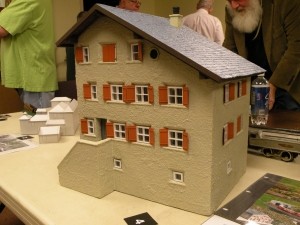
Bring and brag had six great entries this month. Jim Easley won with a G scale model of a building at Bernina Hospiz in Switzerland. Jim’s building was made mostly from Styrofoam and was a lot lighter than it looked. Other entries included Di Voss’ mockup for a brewery he’s building for his Everett & Monte Cristo, Bob Biese’s loaded gondola, a 1935 American Flyer train brought in by Jim Martin, and a Campbell fire station from David Yadock. The field was rounded out by John Socha-Leialoha’s latest creation, an HO scale model of a slag cart. Additional pictures of these models can be seen at https://picasaweb.google.com/ken.liesse/EastsideClinic31711#.

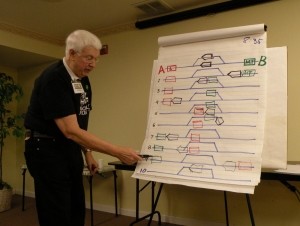
After the break, Jim Sabol presented a brand new clinic on the nuances of how real railroads move cars from A to B, including a look at why they would want to in the first place. The focus was the importance of freight yards to the real railroads and how we can use them in our modeling. Jim showed how it was possible to have realistic operations with a yard made up of just two tracks. As was appropriate for the day, the featured load in Jim’s clinic was a boxcar full of beer. We all assume it was green fro St. Patrick’s Day.

Jim then passed out plans for the yard on his own layout; a 10’ x 55’ monster built in O scale. Even though the tracks are not complete, Jim already has the operation of the yard mapped out and is ready to implement operations on his layout from the first day of “power on.” We thanked Jim’s wife, Mary, for bringing Jim with her to the meeting to present a wonderful clinic.

The program for April’s meeting has not been determined, but JJ is looking into the possibility of having the June meeting at Chooch Industries in Maple Valley. More information on this will be forthcoming.

Skagit Valley and Whidbey Clinic

Gordon Garnhart / photo by Rich Thom

There were 29 people gathered at the Summer Hill Retirement Community conference room on Wednesday, March 9th. The mini swap meet brought some diesel engines, a variety of rolling stock, both freight and passenger, and a few buildings.

For the main event of the evening, Rich Thom showed some excellent slides and a fine video of Narrow Gauge Steam! In this program, Rich took us on a video tour of two of America’s favorite–and arguably finest–surviving narrow gauge steam railroads, central Pennsylvania’s East Broad Top Railroad and, in southern Colorado and northern New Mexico, the Cumbres & Toltec Scenic Railroad, which is the longest surviving remnant of the Denver and Rio Grande Western Railroad’s once vast 36” narrow gauge system. Although the same gauge, the two railroads are worlds apart in character. We were shown these railroads as they were 14 years ago and, although both survive, they offer today nothing like the activity captured in this program. On the EBT, all four of their then-operable 2-8-2 Mikados were in action for one of their last Fall Spectaculars. (Today only one EBT steam loco is serviceable.)

Opening the line in May 1997 for the summer operating season

On the C&TS, we rode the Cumbres Pass for the very last run of the last surviving D&RGW steam driven rotary snowplow, ALCO-built (1923) plow OY, as it cleared the winter’s snow on the 4-percent grade out of Chama east to Cumbres and beyond. Three of the railroad’s hefty Class K-36 Mikes were needed to push the plow slowly up the hill. We had an inside look at plow OY, as well as a ride in the cab of the lead K-36 as it cleared deep snow around Tanglefoot Curve. All during the slides and the video, Rich provided a running commentary on what we were seeing, including dates, places, and fascinating historical details. The video was complete with stereo sound for the steam enthusiast, and showed many details to inspire modelers. Most of the video and a great majority of the photographs were taken by Rich.

We look forward to Wednesday, April 13th, when Dick Haines will discuss various water effects that will enhance the scenery aspects of our layouts.

Chehalis Model Railroad Swap Meet

By Ken Liesse

On March 12th & 13th, the Olympia Capitol City Lions Club will put on their 26th Annual All Scales Model Railroad Swap Meet. The show will be held at the Yard Birds Event Center, 2100 North National Ave., Chehalis WA. Admission is $6.00 for adults and $4.00 for seniors and students. Children 12 and under are free with a paid adult. If you’re interested in a table ($27/day) or want more information about the show, contact Bill Zidel, 5143 Blacktail Ct. NE, Olympia WA 98516, ZidelRCSD@aol.com or call (360) 438-3503.

All proceeds (after rental charges) directly support Olympia Capitol City Lions Community Service Projects and is the clubs most significant fund raising event for the year. All labor is voluntary and is supplied by the club.