Grab Iron Posts

Last Chance for the Spring Meet

Russ Segner

123 of you have registered in time for the low fare to the Spring Meet. There is still a little room, but not much. And, we are sorry, but the price is now $30. Lunches will be ordered Tuesday, so this is the very last time to get on board.

All who have registered should have received an email about getting there and where to park. There is plenty of parking, especially at the rear of the hotel. There is an entrance from that parking lot into the lobby which will take you directly to the registration desk.

Coffee and rolls will be available at 8:00 AM. There will be lots of us in attendance, so check in and pay and pick up your badge.  Please make room for those coming later to pick up their badges.

You will need your badge to get into the clinics and to the layouts Sunday.

Over twenty of your fellow model railroaders have given their time to put together some excellent clinics. Thank them for their efforts on your behalf.

A special thanks to Kevin Klettke who put together and maintains our website for the event.

Tacoma Clinic

By Al Babinsky / Photos by Chip

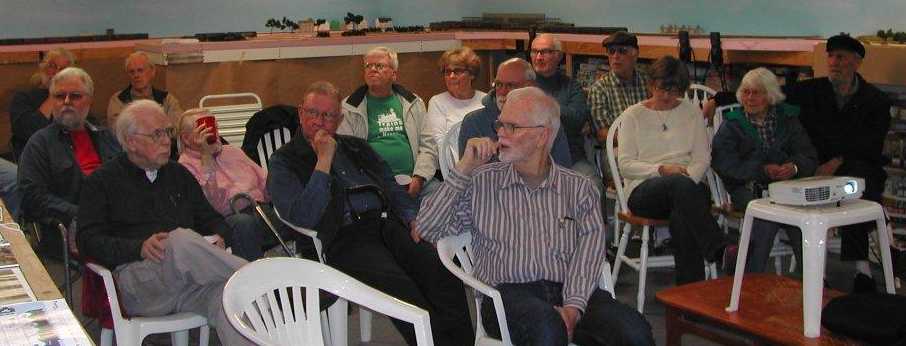
MMR Gene Swanson opened the clinic on time as always. We had 43 attendees including Paul Vaughn’s grandson Gaylon as guest.

Under the announcements Ed Liesse read a portion of the Museum Of Flight newsletter which stated that Scott Taylor became the 737 crew chief. The 4D spring meet will be at the Embassy Suites in Tukwila Saturday May 18 with layout tours on Sunday May 19. He also announced that the 4D is sponsoring the PNR convention in 2014; the dates are April 23 – 26 with location to be announced later. Mike Highsmith is the clinic coordinator and asked for clinicians. Jim Sabol said that the south sound GOPHERS to look at 1:1 scale operations and a possible carbide on a switcher.

Due to some other commitment George Boucier from Tacoma Trains could not present the What’s New at the Hobby Shop segment and we proceeded to do the Model of the Month or as we like to call it; Bring and Brag.

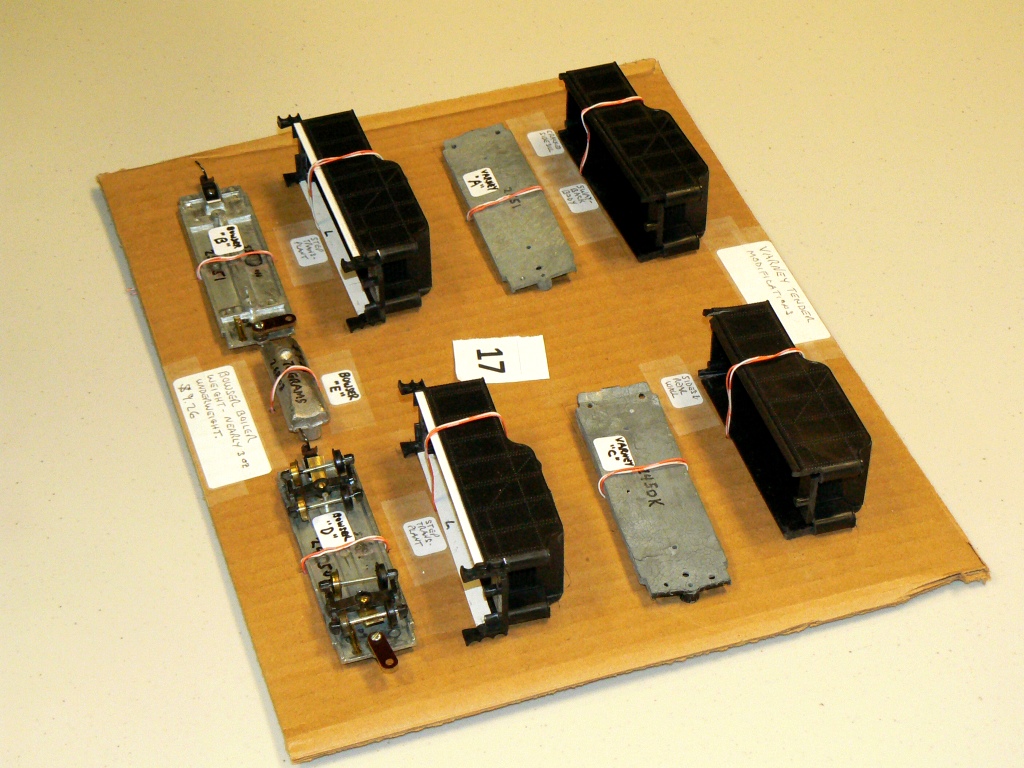
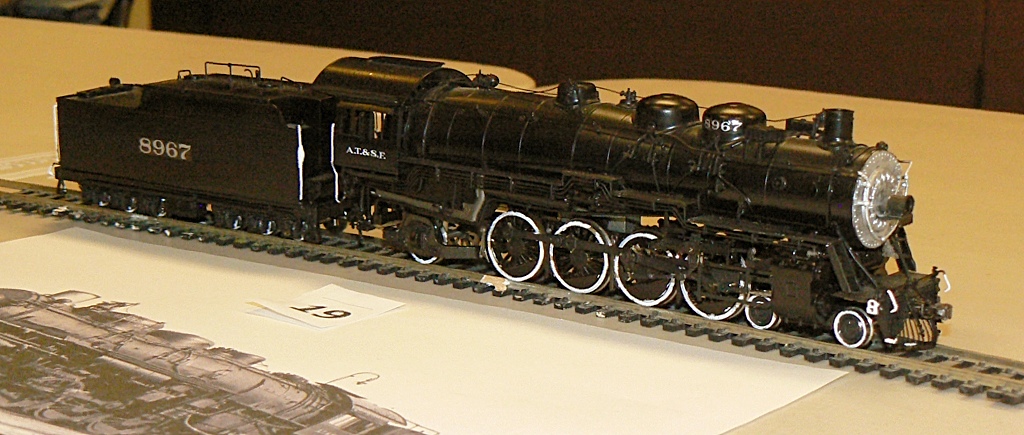
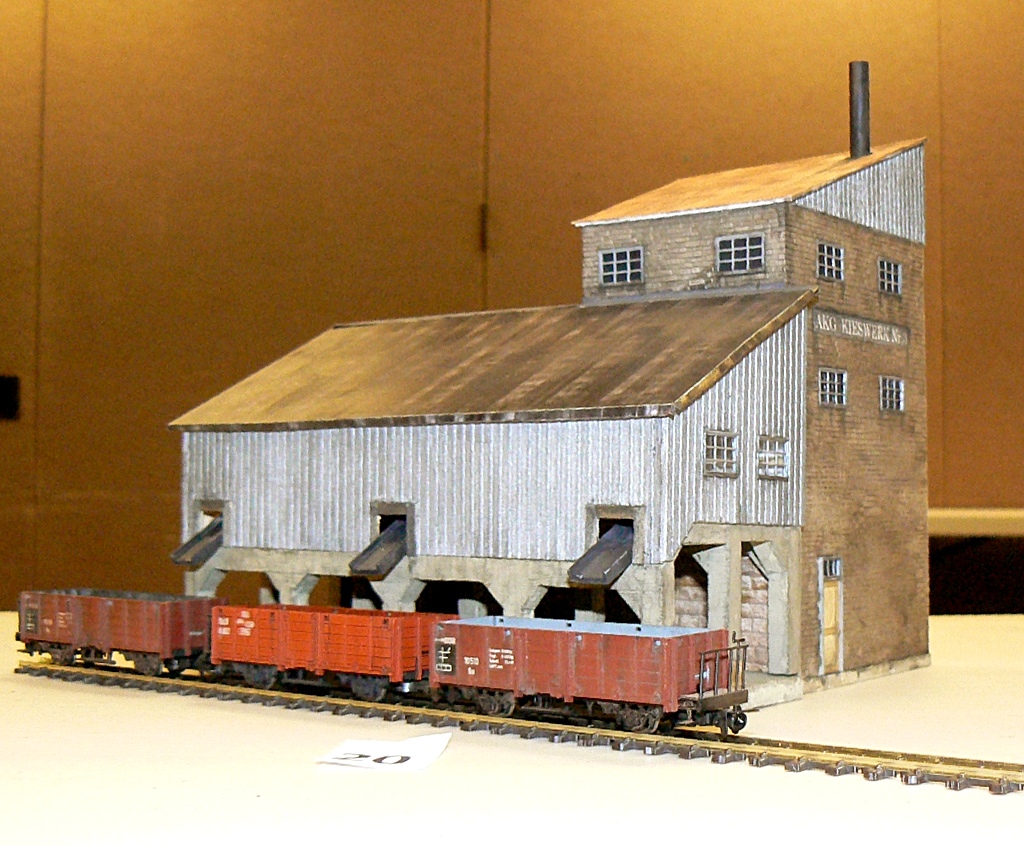
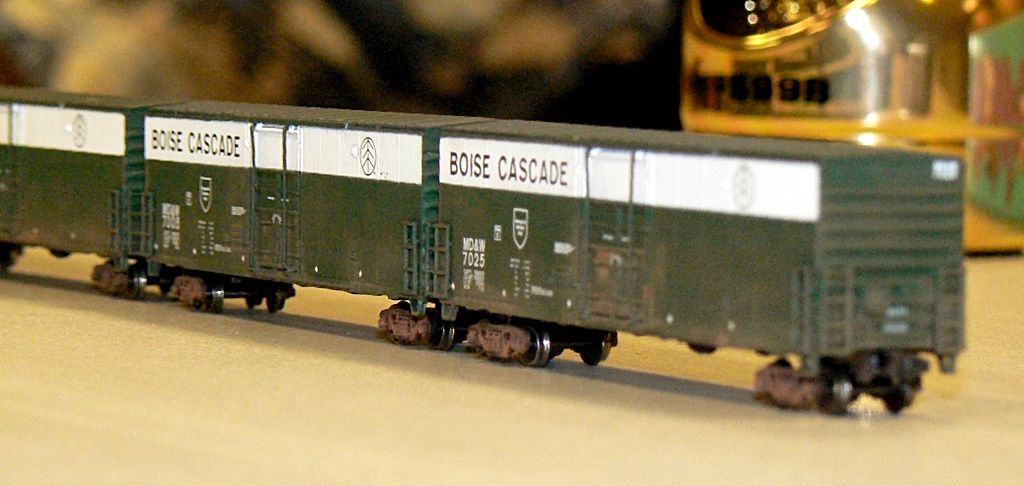
First up was John Miller with some old Varney tenders that had seen better days and his trials and tribulations on the effort to restore them to good condition. His biggest problem being that Bowser Mfg. was slow in responding to get things accomplished. His last comment was that it would have been better to switch to Diesel power. Joshua had three N scale reefers that he reworked extensively and as he said weathered too much. Kris Clancy had the good fortune to find a Sunset model Santa Fe 4-10-2 in an antique shop and was able to get it for a good price and it was in good running order. Walt Huston brought a Modeldiecast BN boxcar and Trueline Trains Boise Cascade boxcars highly weathered. Dale Kraus showed his AKG Kieswerk No 3 gravel tipple which was entirely scratch built; the sign was generated on the computer. He also had a gluing fixture by Riteway available at Mikro-Mark. Gene Swanson had a set of Varney locomotives that are up for grabs except for one that is going to be upgraded so it can be used at History Museum. The Model of the Month winner was Dale with his gravel tipple.

After the break Jim Clowers presented his clinic on how to get manufactures to make items that you like to have. He said that if you can get pictures, drawings and lots of information and send it to them they may be inclined to produce the item. The thing to do is take pictures from any angle, measure the item and produce a drawing or if you are lucky to get the actual drawing it is of great help. He showed a number of items that he was able to get made. Thank you Jim for a great clinic.

Next month clinic will be on the 13th of June at our usual place; Pierce County Library Admin. Bldg. the corner of 112th St. and Waller Rd and 7:30 PM.  Dale Kraus will present part 2 of his DCC clinic. See you there and bring company and or modelers.

tacoma2

tacoma3

tacoma4

tacoma6

AKG Kieswerk No 3 Dale Kraus, Model of the Month Winner

tacoma5

Skagit/Whidbey Clinic – May 8, 2013

Backdrops – A Four Person Tag-Team Approach – By Tom Buckingham

Photos by Al Frasch and Rich Blake

Four clinicians (Al Carter, Nick Muff, Al Frasch, and Cliff Aaker) took turns with different parts of the presentation.  Al Carter began by briefly describing the three options one has: Plain sky, photo or photo mural and a painted backdrop.

For the plain sky Al provided some photo examples of the improvement  accomplished simply by picking your favorite blue sky color and painting your backdrop with that color. The difference was dramatic and very simple.

Al Frasch then showed the improvement that can be had by using three different shades of blue. He painted a board with the darkest shade on the top and the lightest on the bottom.  Then with a dry roller he simply blended the three colors where each joined its neighbor.  The result was a very nice gradual increase from the darkest blue on top to the lightest blue on the bottom with no apparent “line” separating them.  He said he paints about five to six feet at a time and can go about fifty feet or so before he has to get another dry roller.

Al Frasch demonstrating blending techniques

Al Frasch demonstrating blending techniques

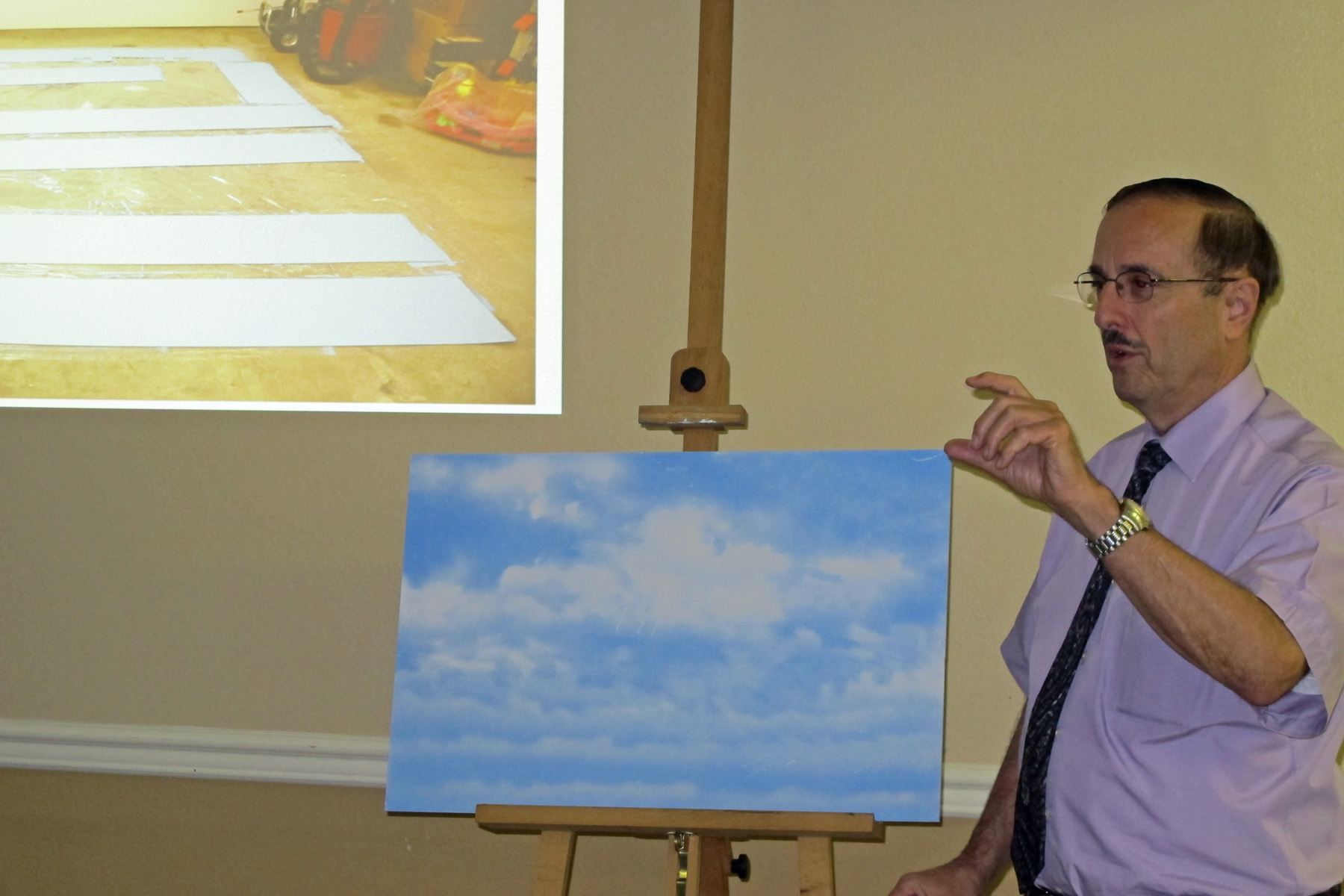
Nick Muff then talked about how he starts with a plain single color blue sky and then adds clouds.  As he researched the subject of adding clouds there seemed to be four popular methods: cloud stencils, hand painted clouds, misting with a spray paint to simulate clouds and using a sponge on a stick to in effect “blot” on the clouds.  His only comment about the latter method was that the end result looked like “sponges blotted on a blue sky” and were not what he was looking for.  Nick ended up using the cloud stencil method. He took pictures of clouds and projected them onlarge pieces of card stock and then outlined the clouds in the projected pictures. When he was done he cut them out and ended up with about a dozen or so different stencils.

Nick Muff showing a sample of his custom cloud stencils

Nick Muff showing a sample of his custom cloud stencils

He chose spray cans of Flat White Krylon because he liked the color and how fast the paint dried.  According to Nick the trick to getting realistic clouds is to hold the stencils about two inches away from your backdrop and spray mainly on the top edge of the stencil.  The result is a more defined top of the clouds and a “fuzzy” or less defined bottom.  As he gets to the bottom of the scene (that is the part representing what is the furthest away) he made the clouds smaller and in straighter lines as you would see if you were outdoors.

He passed on several secrets to realistic success—start with  a darker blue than you would probably otherwise use.  The blue has to be dark enough to see the white clouds. Start with a light mist and go heavier.  Once the cloud is on the backdrop it won’t get any less dense.  Flip your stencils end for end after a while to avoid “repeating” a cloud formation.  After all, clouds don’t look like carbon copies of each other.  Get a spray can “handle” so your finger doesn’t wear out.  And most importantly wear a respirator.  Nick had several photos of his process and a sample of his end result that was very realistic.

Al Carter then spoke about photo backdrops.  You may either buy them commercially (Backdrop Warehouse, and Scenic King) or make your own. To make your own, take some panoramic photos, and then using a photo program like Photoshop Elements remove any photo errors that may have crept in, like paralax error, etc.  The result can be printed commercially at Kinko’s or COSTCO,  for example.

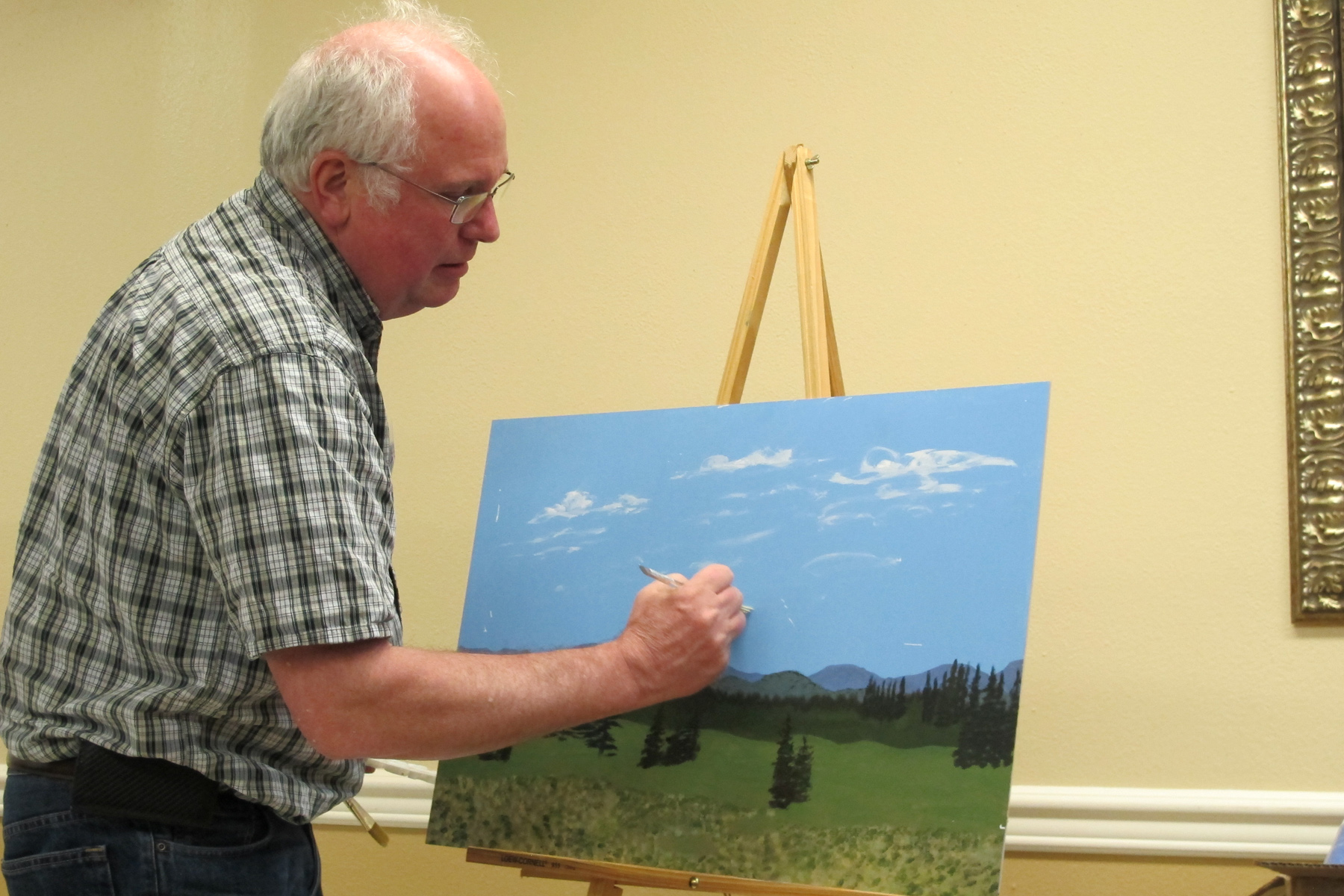
Finally, Al Carter and Cliff Aaker gave a live two ring circus show demonstrating how to paint trees by hand on your backdrop. Al dealt mostly with the far background trees using mostly very dark colors in the far background and then bringing them up to dark green and then lighter green as you come forward. He was mainly demonstrating the hills of trees that you see as you look off toward the mountains or hills. Cliff concentrated on the foreground trees. Using mostly a “fan brush” he demonstrated how quickly and easily one can paint realistic trees on your backdrop.

Al Carter showing a backdrop painted on the backside of sheet vinyl flooring

Al Carter showing a backdrop painted on the backside of sheet vinyl flooring

Cliff Aaker painting trees

Cliff Aaker painting trees

Both Al and Cliff had several tips for realism:  Have an example (a photo) nearby so that you don’t have to paint from memory.  Plan ahead—it is a lot easier to paint a back drop if you can stand at the wall than climbing over your layout to do it.  Make sure your “painted trees” are not larger than the actual scenery trees you have in the foreground.

Al wrapped up with some very amusing examples of the good, the bad and the ugly.

It was a very enjoyable clinic. There is nothing like seeing someone (in the case several someones) do something live. As Al Carter said: “If I can do it, so can you.”

Six Days to the End of Early Registration

Russ Segner

Spring Meet – Six Days and Counting

Saturday, May 11 is the last day for the low fare for the upcoming Spring Meet. If your reservation is made online by the 11th or received by snail mail by the 11th, you can still get on board for $20. After that, the price goes to $30 and lunch will not be included.

So, get on board and sign up now. Limited seating is almost full. Check the 4D Spring Meet website for details and to register.

PNR2014 Planning Meeting Open to All

Russ Segner

I am letting you know of a meeting to do some preliminary thinking and planning for the PNR Convention to be held in Seattle in the spring of 2014 and hosted by the 4th Division. Several Board members will also be there.

If you are interested in getting involved, please email me now and then show up at Mitzel’s at 11:00 this Saturday morning, May 4th, at Mitzel’s Restaurant in Kent. We will discuss possible dates, venues and leadership.

I have made my own list of possible leaders for the event, but would appreciate any suggestions you may have for other names to include. Thanks!

April Eastside Get-Together

Ed Liesse

Al1
Forty-five attendees were welcomed by host JJ Johnston to the Eastside Get-Together hoping to hear a presentation by the illustrious Al Carter, a former member of the group who opted for new surroundings after retirement and moved north. In fact, Al must have felt intimidated coming back for his presentation since he had several members of the Whidbey Island group with him! Bodyguards, perhaps! More on that later.

JJ did his usual introductions of notables including our MMRs CJ Riley, Max Maginness and Di Voss. There were several visitors in attendance that we hope will continue to join us. Announcements were made by Russ Segner about the upcoming Spring Meet at the Embassy Suites in Tukwila on Saturday, May 18 followed by Layout Tours on Sunday, May 19. You must attend the Meet to get the maps for the Layout Tours. The annual membership meeting will be held during the Meet.

Superintendent Ken Liesse had several announcements regarding 4D activities including the election of an Assistant Superintendent and two Directors (don’t forget to get your ballots mailed before the May 10 deadline!), and the need to keep your email address updated with the NMRA. More and more information from 4D, PNR and NMRA is being transmitted by email, so you don’t want to miss out. Email any changes to me, Ed Liesse. JJ also read a letter from the NMRA thanking the group for their $180 donation to the NMRA display at the CaliforniaStateRailroadMuseum.

MOTM

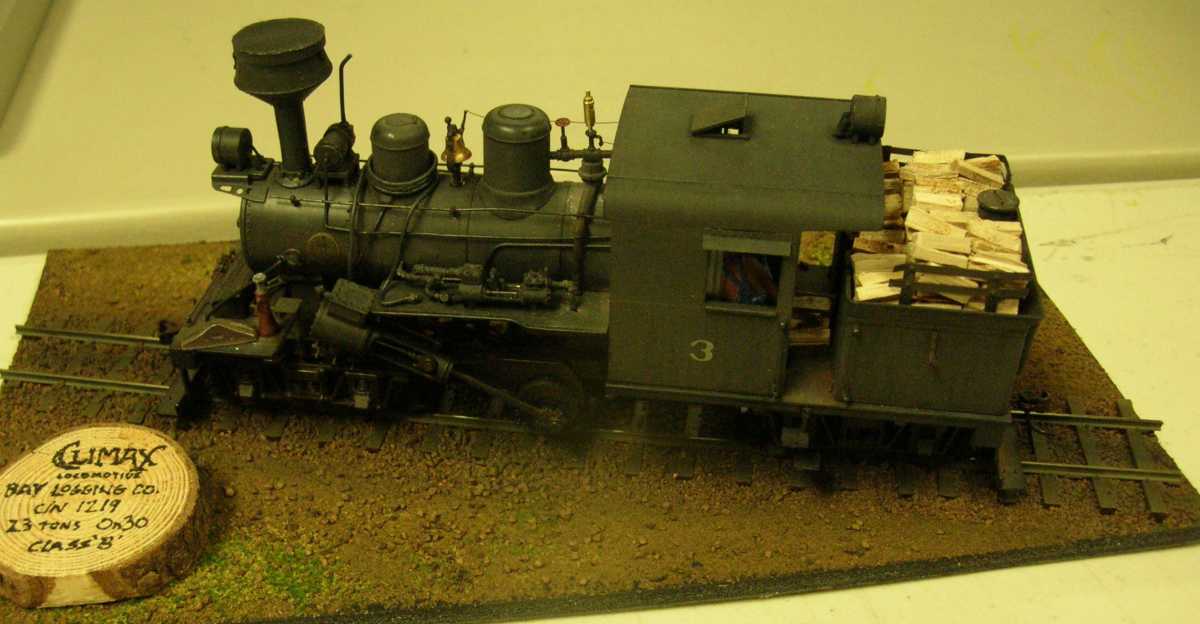
There were a number of entries in the model contest this month. Rich Blake, one of Al Carter’s entourage and chair of the Skagit Valley and Whidbey Clinic, took the honors with his greatly kit-bashed On30 Bachmann Climax engine.

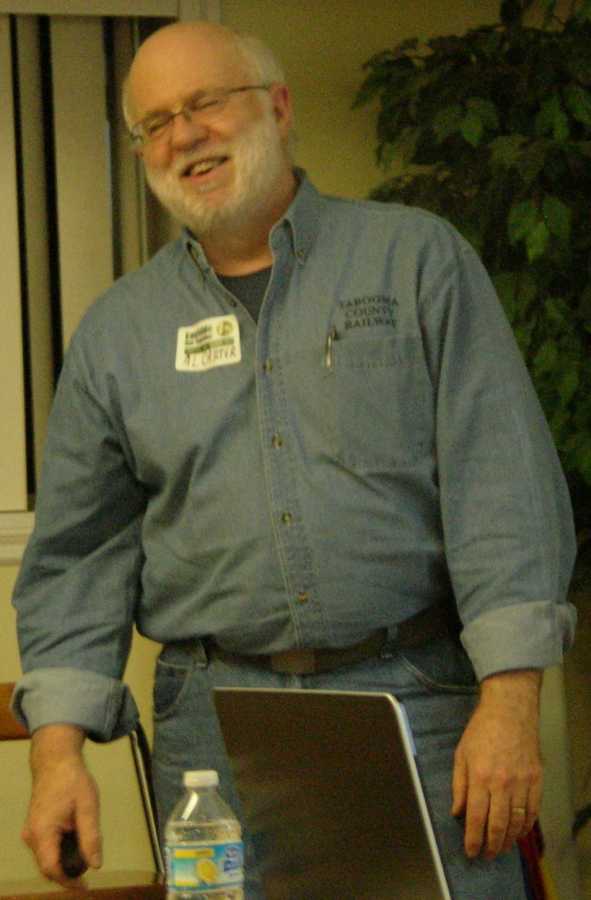
The feature of the evening was the presentation by Al Carter on “The Tabooma County Railway: Choosing a Private Road Name – Developing a Plausible History.” He explained how he created “Tabooma County” in Washington and developed his track plan based on materials and industries within that county and the surrounding ones. Throughout his entertaining presentation, he included some mini-clinics on how to do some of the effects he incorporated in his layout, such as streets, signs on buildings to look older and faded, using hollow-core doors as a layout base, etc. The presentation was well received even though there was a lot of good-natured ribbing between the presenter and the audience!

Al2

As usual, we had great door prizes, thanks to The Inside Gateway, recently moved to Woodinville. Steve Depolo gave us a box of half-off items, some with a $19 value, so don’t miss future door prize drawings!

We’ll gather again on Thursday, May 16 to hear a presentation by Mike O’Connell. We hope to see you there!

PNR 2014 Heading Our Way

By Ken Liesse

The NMRA National Convention will be held in Portland in 2015 with PNR’s 2nd Division playing host for that event. Because of that, 2nd Division asked to be relieved of their obligation to host the PNR convention next year. Anyone who has ever been involved with a National convention can certainly understand that request, knowing what’s involved in putting on something of that magnitude. 4th Division has stepped up and volunteered to take 2014 off 2nd Division’s hands, even though we know we’re already at least a year behind in planning for such an event. (2nd Division will take over 4th’s next PNR obligation in 2018.)

I’d like to thank the Board of Director’s for voting in favor of putting on next year’s convention, and I’d especially like to thank those who have already raised their hands and said “I can help.” Russ Segner has agreed to take on the role of Convention Chairman (or at least co-chair) and planning is underway. Now here’s where the rest of 4th Division comes in.

Putting on a convention requires several people in key roles and Russ needs to start putting his committee together. The following list shows just some of the positions that need to be filled in order for us to pull this off. If you’d like to get involved in any of these areas, contact Russ at russseg@gmail.com. Some positions have already been filled, but there will be a lot of opportunity to lend a hand and help the division. And remember, you can always earn Volunteer points by helping out.

  • Clinic Chair
  • Non-Rail Chair
  • Layout Tours Chair
  • Prototype Tours Chair
  • Publicity Chair
  • Program Chair
  • Banquet Chair
  • AV Equipment Chair/Coordinator/Clinic Support
  • Door Prize Chair
  • Webmaster
  • Security
  • Hotel liaison
  • Convention Advisor/Consultant

Seattle-North Clinic: Next Meeting, May 2, 2013

By Jeff Moorman

Join us on Thursday (May 2) for our next clinic. Our topic will be railroading in the 1930s.

Last month Tom K regaled us with a nice presentation on the Railway Express Agency (REA). Probably the overview of this organization is the opening paragraph of the Wikipedia article on the same:

The Railway Express Agency (REA) was a national monopoly set up by the United States federal government in 1917. Rail express services provided small package and parcel transportation using the extant railroad infrastructure much as UPS functions today using the road system. The United States government was concerned about the rapid, safe movement of parcels, money, and goods during World War I and REA was its solution to this problem. REA ceased operations in 1975, when its business model ceased to be viable due to the construction of the interstate highway system making the UPS business model cost less to the customers.

Tom’s father had worked for the REA for 35 years and Tom had lots of anecdotes with which to punctuate the discussion. There were railway-related express delivery companies in the U.S. back as 1839. And they flourished through the second half of the 19th century. By 1900 there were 4 principal such companies, three of which were consolidated into the government-run REA in 1917.

In 1927 the REA began an air express division and in 1929 the REA was purchased back from the government by a group of 86 railroads who owned it in proportion to their express traffic volume.

Often REA offices were co-located in depots/stations, but large cities had their own buildings. The REA office (warehouse, really) in Seattle was located SW of the King Street station. It was torn down to make room for the King Dome. It would have been in the east end of the north parking lot.

Tom could remember going there with his Dad. He can also remember his Dad sneaking him aboard a train or two where REA crews would sort packages between stations, much as the Postal crews did in their mail cars.

At its peak the REA had 45,000 employees and some 30,000 offices. It was said that during WWII the REA had the largest truck fleet in the United Sates. It was quite a large organization.

Remember, if you are modeling a period before about 1970, don’t forget to include the presence of the REA.

Thanks, Tom, for an entertaining and informational program.

Just two folks brought stuff for show and tell:

  • Bobj had a Milwaukee diesel, hopper, and caboose which he had used to practice his chalk weathering skills.
  • Tom K provided several pieces of REA memorabilia, including a nice HO delivery truck.
Bobj's Weathered Train

Bobj’s Weathered Train

REA Memorabilia

REA Memorabilia

Apr13 Tom 2

REA Truck Model

We meet at the Ronald United Methodist Church, 17839 Aurora Avenue North, Shoreline, WA, on the west side of Aurora (State Route 99) between 175th and 185th Streets, between the Cadillac dealer on the south and Deseret Industries to the north. Going southbound on Aurora, make a right-hand turn into the church driveway immediately after passing Deseret. The parking lot is at the rear of the church. For regular meetings, enter the lower, left side of the church from the rear lot.

Meetings are the first Thursday of each month, except July and August. In June we usually do a tour and we’ll talk about that on Thursday. Doors open around 7:00 PM and the program starts at 7:30.

Remember the next meeting is May 2. Hope to see you there or at least sometime on down the line.