Grab Iron Posts

Seattle-North – Washington and Idaho at Next Meeting on December 4, 2014

By Jeff Moorman, photos by Jeff Moorman

Next Clinic:

Thursday (December 4) is our next clinic meeting. Mike Bjork will present a PowerPoint on the Washington and Idaho Railway (WIR), from the perspective of both a former employee and a consulting engineer providing design and construction services. This railroad is a contemporary shortline and you can probably guess in which two states it operates.

Prior Clinic:

Our clinician last time was our own Dennis T who showed us how to use a smart phone as a wireless DDC throttle. But, it is not as simple as just whipping out your phone and taking over control of someone’s locomotive.

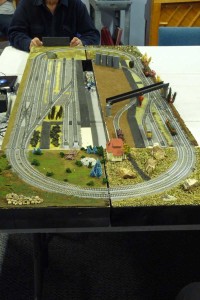
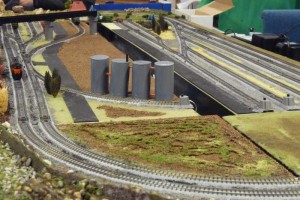
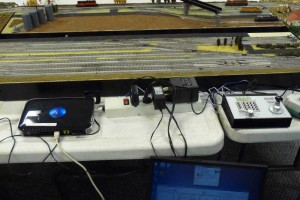
First you need some trains to run and a place to run them. Dennis provided this by setting up a little 6½’ by 2½’ T-TRAK oval in N scale.

Second you need the layout to be operated by DCC. Dennis uses a Digitrax system, but others would work provided they can be interfaced to a PC running JMRI software. I know this can also be done with NCE systems and there may be others.

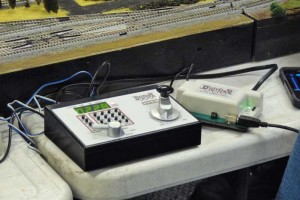
That computer interface to your DCC system is the next requirement. This is not the simple interface needed to program decoders, but rather a connection to the Digitrax LocalNet. Dennis used the Digitrax PR3 USB interface which also has a LocalNet connection.

Fourth that interface needs to be connected to a PC running JMRI software. Next that computer needs to be connected to a Wi-Fi network as does your smartphone.

And, finally, your smartphone needs to be running a JMRI compatible throttle app. Dennis used the WiThrottle Lite app. This is the free version of WiThrottle, and it runs on iPhones and iPods. There is a similar app called Engine Driver for Android devices.

Note that the wireless capability for this set-up utilizes a Wi-Fi network, not the phone’s Bluetooth or cell connection.

WiThrottle Lite has the basic controls, but you’ll need its commercial version for complex consisting. In some respects for new operators sliding your finger on the screen to change the throttle settings is more intuitive than a thumbwheel or speed buttons found on many DCC throttles.

Let’s face it – buying a smartphone in order to have a wireless throttle might be an expensive proposition. But if you already have the phone, and may only occasionally need a wireless throttle or throttles (like when the gang comes over for a little switching every other month) this may be just the ticket. Plus, there are ‘cool factor’ points to be won by pulling out your phone and running a train.

So, let’s review. In order to control a model railroad locomotive from your smartphone you need:

  • A smartphone with a JMRI-compatible throttle app
  • A wireless computer network, which supports a connection to both your smartphone and your computer
  • JMRI software running on the computer
  • An interface between the computer and your DCC system
  • A DCC system connected to a model RR layout
  • A DCC-equipped locomotive on the layout


It sounds complex, but you probably already have most of the components. It is mostly just a matter of hooking them all together.

Several attendees had previously downloaded a throttle app (or did so during the clinic) and all were all able to run locos via the infrastructure Dennis had set up.


T-TRAK Layout 1 of 2

T-TRAK Layout 1 of 2

T-TRAK Layout 2 of 2

T-TRAK Layout 2 of 2

DCC Control Unit and PC Interface

DCC Control Unit and PC Interface

More of the PC to DCC set up

More of the PC to DCC set up


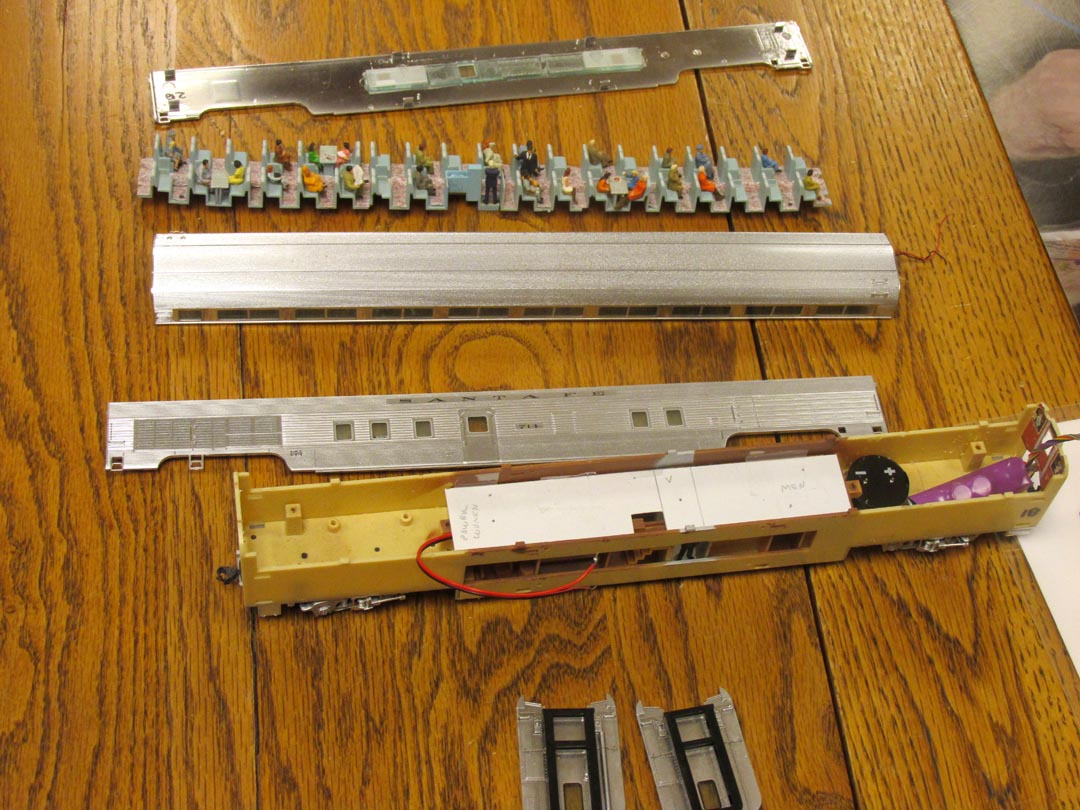
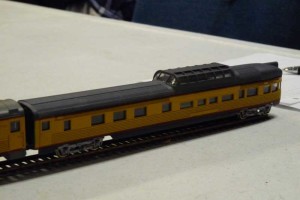
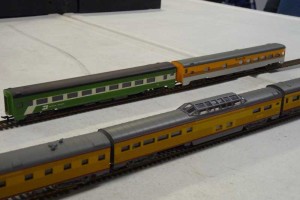
Show and tell started with a follow-on discussion about DCC in general and then about T-TRAK modules. Plus, Chris F had some more of his ongoing HO passenger car project to show us.

Chris' Passenger Cars 2 of 2

Chris’ Passenger Cars 2 of 2

Chris' Passenger Cars 1 of 2

Chris’ Passenger Cars 1 of 2


Directions: We meet at the Ronald United Methodist Church, 17839 Aurora Avenue North, Shoreline, WA. That is on the west side of Aurora (State Route 99) between 175th and 185th Streets and more specifically, between the Cadillac dealer on the south and Deseret Industries to the north. Going southbound on Aurora, make a right-hand turn into the church driveway immediately after passing the Deseret location. The parking lot is at the rear of the church. For regular meetings go up the steps to the main entrance. We meet in the Fireside Room which is immediately to the left inside the door.

Meetings are the first Thursday of each month, usually September – June. However in June we often do something different, so there may be no “regular” meeting. Doors open at 7:00 PM and the program starts at 7:30.

Remember the next regular evening meeting is December 4. Hope to see you there or at least sometime on down the line.

Skagit Valley and Whidbey Clinic’s Dr. Nick Muff Night

by Rich Thom, photos by Al Frasch and from Nick Muff Collection

Chairperson Rich Blake welcomed 33 attendees to the Skagit Valley and Whidbey Clinic’s third meeting of the season on Wednesday, November 12th. Rich was pleased to point out that several folks from the mainland, who are now regulars of the new Mt. Vernon Clinic, were in the audience tonight. Our two clinics are scheduled about two weeks apart each month, giving area modelers the opportunity to attend both if they wish. That idea seems to be a good one!

Also making the trip to the island were Jack Hamilton and Di Voss, devoting their entire day prior to the clinic to evaluating layouts, rolling stock, scenery, buildings, and even volunteer data, resulting in several NMRA AP awards being earned by SV & W modelers. Thanks, gentlemen, for taking the time and driving the distance year after year; it has really vitalized the AP program in our area. Jack described the AP program and how rewarding — and relatively easy — it is to accumulate points for your modeling, authoring, volunteering, and operations efforts. He noted that working towards the “car” award seemed to be a particularly common roadblock for some of our SV&W modelers, who otherwise were within shouting distance of earning their MMR (Master Model Railroader). As just one result of the day’s judging, Jack called Tom Hawkins to the front and presented him with his Golden Spike Award. Tom was one of the winners of a layout design competition run by Model Railroader magazine, and his layout was featured in the magazine.

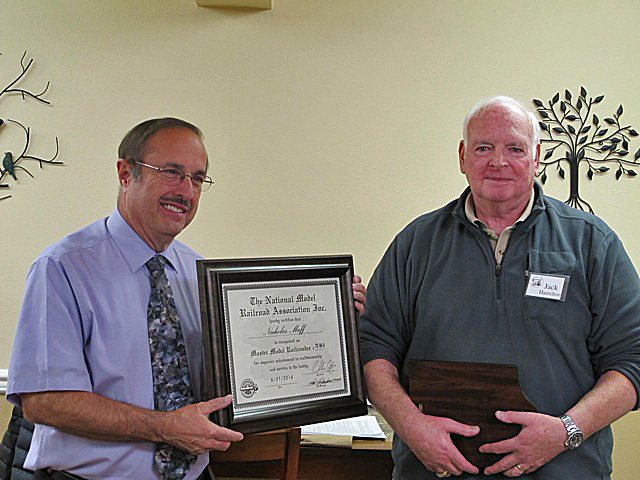
Next, as Rich Blake pointed out, it really was Dr. Nick Muff Night. Jack presented Nick with his MMR certificate and plaque, remarking that whenever he visited Nick’s layout, he returned home and contemplated taking a sledgehammer to his own. (Your reporter has had the same emotion!). If ever you are able to visit Nick’s world-class layout, simply look at the chandeliers in the Kansas City station and you will understand that sledgehammer urge.
Nick Muff Receives MMR from Jack Hamilton

Nick Muff Receives MMR from Jack Hamilton

Nick was also the presenter of the evening’s program, an historic collection of his still photographs and 8mm film of the West Side Lumber Company. Just as remarkable as the photos were the “vehicles” that Nick and two friends used to travel over the railroad, the entertaining stories about how they were built, and the adventures they shared on the rides. The vehicles? Homemade handcars — a series of three of them no less — each one significantly better than the last.

Nick visited the West Side many times between 1961-66; his earliest explorations in 1961-62, when he was 16, were the subject of tonight’s talk. The West Side’s 3-ft gauge railroad operations had been in gradual decline and finally were abandoned altogether in midyear 1961; only a single steamer, standard-gauge Heisler #3, continued working the mill in Tuolumne. After that, gyppo truck loggers brought timber down to the mill. However Pickering, who owned the West Side, stored the locos rather than scrapping them, and kept the track in place, too, just in case relying on the gyppos didn’t work out. The entire line was ripe for exploring by three keen teenagers.

Nick opened with slides shot in Tuolumne: the large mill operation; Heisler #3; some of the charming home-built cabeese; the gauntlet track at the log dump; and several of the Shays. The Shays were kept in immaculate condition, mechanically and in appearance, too; paint gleamed on most of them in Nick’s photos.

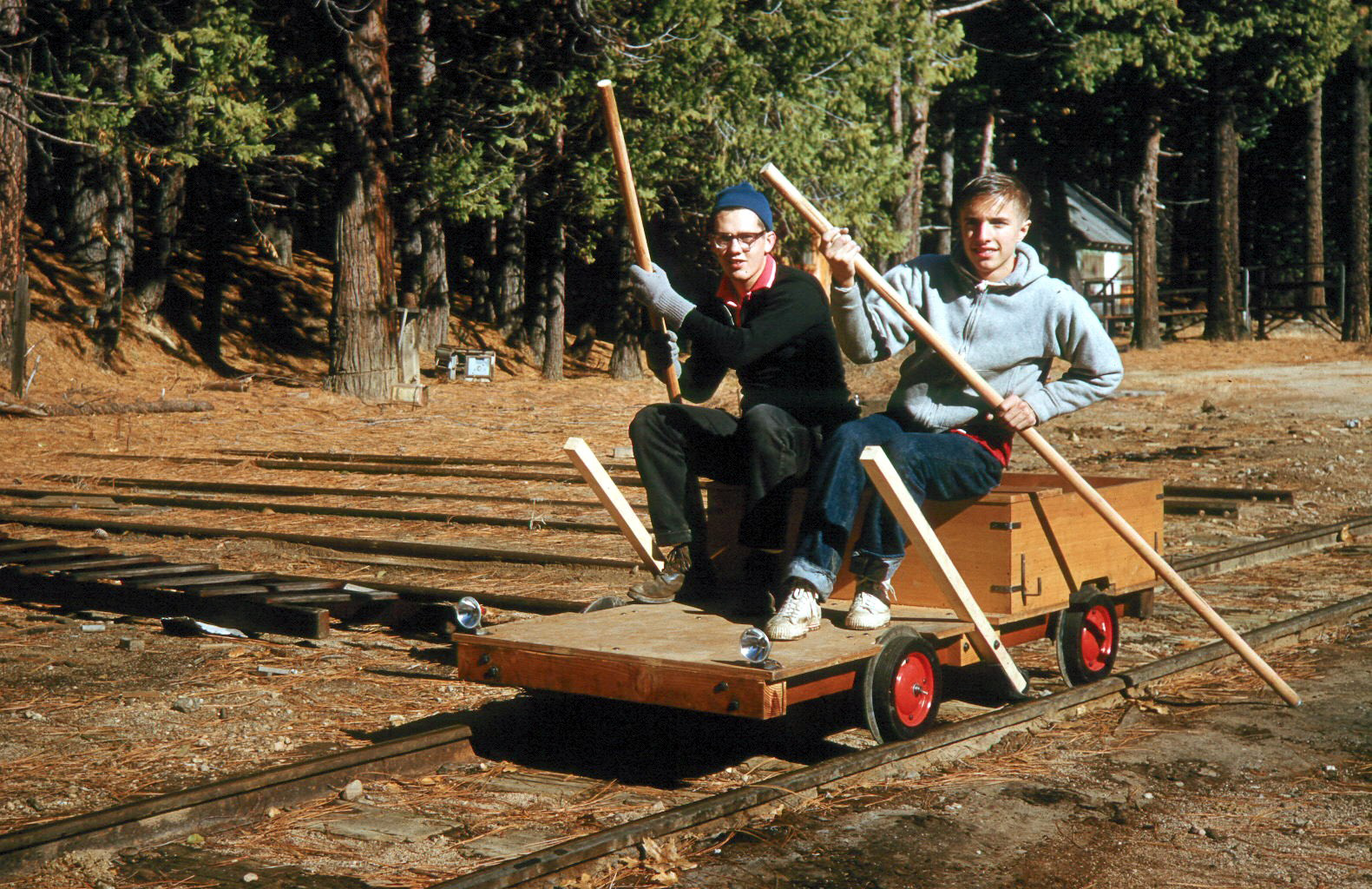
The boys hiked much of the line on their first forays, and soon realized that this was one long railroad! Camp 45 — the last camp built for railroad logging — was 56 miles from Tuolumne, and the main line at one time was 70 miles long. To speed things up, they built their first handcar — their “Car # 1.” It had no pump mechanism and was simply a platform, rope-pulled or sometimes “poled.” Its wheels had rubber tires, and those wheels were the biggest problem. The tread just wasn’t wide enough and the car constantly derailed. Nick said that the variations in gauge of the West Side’s rail, as light as 35-pound in places, were so large that any successful car needed 5-inch wide treads!
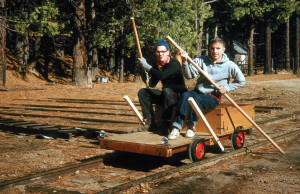
Camp 8, Car no. 1, Nov. 1961; Nick on right

Camp 8, Car no. 1, Nov. 1961; Nick on right

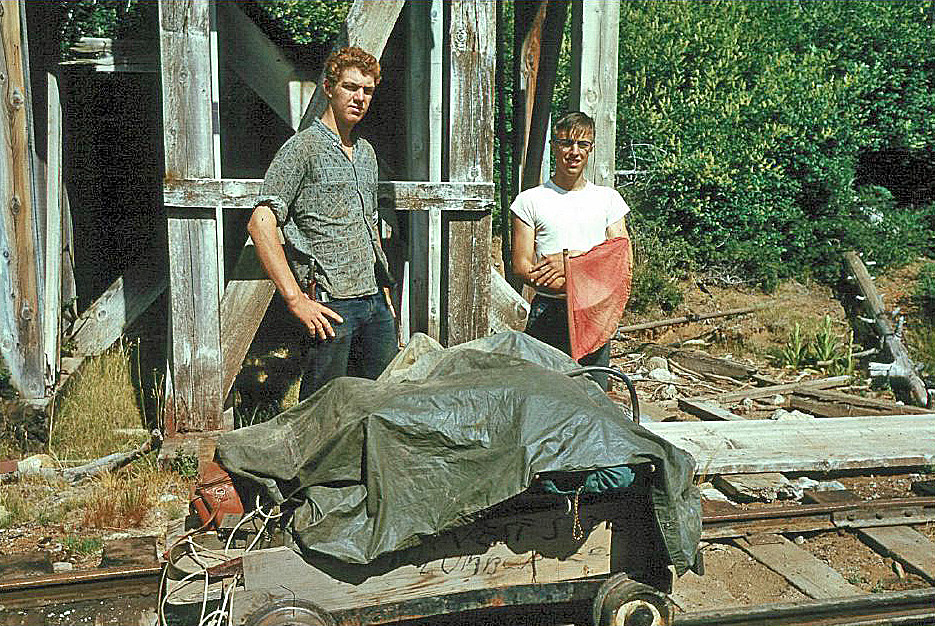
In 1962, Nick and his friends were at Clavey River bridge when they spotted a wheelset (it appeared to be from some sort of handcar) discarded near the track, and then another nearby. The axles weren’t quite true and wheel flanges had pieces missing but (as Nick put it) there was just enough of the flanges left to keep the wheels on the track. They found a steel frame that fit, and using some 2 x 12’s among the scrap they built a floor and other wood parts for their new Car #2, built entirely in the woods! With wider treads and sturdier all around, it was a clear improvement over #1. Intending to return to Tuolumne on their new creation, things went awry. A severe rainstorm came up quickly, necessitating a night spent on soaked bedrolls and, eventually, their rescue by the county Sheriff, who was not pleased.
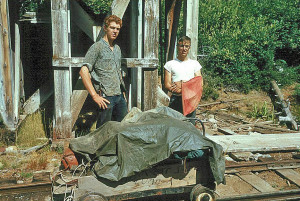
Deadwood Camp, June 1962, Car no. 2; Nick on right

Deadwood Camp, June 1962, Car no. 2; Nick on right

Undeterred, Car #2 was improved yet again with the addition of a 5 hp engine, and proudly lettered West Side #3. On it Nick and the others could now make the trip out to Camp 45 in style. But not without more adventure. Returning to Tuolumne, #3 had an unfortunate encounter with some 2 x 12’s which a farmer had used to “enhance” his cattle guards, the boys jumped off, and off went Car #3 too, picking up speed and outpacing its pursuers on the downhill grade into Tuolumne. Would the handcar (possibly on fire) crash into Tuolumne yard and get Nick and friends into some really serious trouble this time?

If you’d heard Nick’s talk, you’d know. If Nick ever gives this talk again at another clinic, a regional convention, or other gathering, make every effort to get there. You’ll enjoy it.
Tacoma Clinic

Al Babinsky

The Tacoma Clinic report is back after a couple month absences due to the writer having a hip replacement. It went well and now it is like the old days — it works like a champ. This report has information from last month’s clinic and this month’s clinic.

Last month’s clinic was attended by 42 modelers. The model of the month was won by Ken Levine with his Great Northern gondola, weathered, KD couplers and sprung trucks. The clinic was given by Paul Rising on removable loads. If these are the same type of loads as he built for PSMRE, they have magnet imbedded in the load which is used to remove the load.

This month’s clinic started on time as always and MMR Gene Swanson gave recognition to all the veterans. November is also the month where the clinic makes a donation to the Emergency Food Network with Helen McGovern accepting a check for $1250.00 from money collected during this year’s clinics. Jim Sabol read an email he received from Bob Edwards, a modeler in the Olympia area looking for contacts, and he replied telling him about the Olympia clinic.

The “What’s new at the Hobby Shop” segment was given by Bill Sandstorm from Tacoma Trains. Athearn had passenger cars and reefers, Wheel of Time with a Piggy pack stacker, Walthers had several buildings, MicroTrains an N scale freight train, Broadway Limited with NP coal hoppers.

The “Model of the Month” had Ken Levine with a couple of cars obtained at a swap meet, a Western Pacific box car and a gondola, which he weathered and upgraded. Chris Clancy with a find at an antique shop, a three-truck Heisler, a depot kit and three 4-wheel high-side coal gondolas. Dale Kraus with what he called cheap Maerklin Banana cars which he reworked and weathered. Chip showed a drawing of an N scale NW-2 with was manufactured on a 3D printer. Paul Vaughn with an On30 Y module with a station and store built from paper. Bob Ayer with a model of the First Lutheran Church which he scratchbuilt; the roof is made with Plastruct tile. Bob Ayer was the winner of the model of the month.

The clinic for this month was given by Gene Swanson and Brian Liesse and titled “ The making of a book”. The book was on Gene’s layout and what it took to do the photography. Brian demonstrated the equipment he used such as light sources, lenses and the cameras he used. It was a very interesting clinic and informative.

Next month clinic is of course “Dirty Santa” along with refreshments and other goodies. Please don’t forget to bring a wrapped present and mark it as to what scale it is. The clinic will be held at our usual place in the Pierce County Library Admin. Bldg. at the corner of 112th Street and Waller Road and the time is 7:30 PM. Hope to see you there and bring a friend, modeler or significant other.

Eastside Get-Together Reminder, John Morrison is Speaker

JJ Johnston

The Eastside Get-Together is this Thursday, November 20, 7:30 pm at the Bellevue Foursquare Church in Bellevue. Please remember this is the month we do our collection to raise funds to help a member of the church. These donations are our way of paying back the church for letting us use the room and kitchen at no charge to us throughout the year. The church even provides us coffee and supplies as well as a person to set up all the chairs and tables for us and put them back when we’re finished. In the past these donations have averaged about $25 per person so it is our hope those of us who can give will be generous in our support.

Internationally recognized modeler John Morrison will be our speaker for the evening. John’s title is “The Jungfraubahnen-Top Of Europe” about a group of rack railways climbing into the Bernese Alps. With grades of 25%, there are two different gauges, two types of rack systems and three electrical systems reaching the highest railway station in Europe. The station is in a cavern at the end of a tunnel. This unique information includes lots of photographs from John’s trip. He will also bring some of his large scale European locomotives which he builds and runs on his local large garden railroad.

Bring something to sell, have some coffee and fresh donuts, win a door prize and enter our Model of the Month to show us what you have been working on lately. There will be lots of fun and conversation. See you there, JJ.

Santa Train is Almost Here!

Peggy Barchi

Trains are selling out, but there’s still time to join the fun of this special holiday tradition in Snoqualmie at the Northwest Railway Museum, www.trainmuseum.org. If you would like more information about this year’s Santa Train or about the museum’s new steam program, please feel free to contact me, Peggy Barchi at 425-888-3030 Ext. 7203 or at peggy@trainmuseum.org.


Looking for a special way to meet Santa? Create special memories with a Santa Train excursion! Santa Train, at the Northwest Railway Museum in Snoqualmie, has been a holiday highlight for over 40 years. Beginning November 29, families can choose from eight dates and multiple trains to ride to a special visit with Santa Claus at the historic Snoqualmie Depot. During each two-hour holiday excursion, families will enjoy music, fresh-baked cookies from the coal-fired ovens of the museum’s historic Kitchen Car, hot cocoa and fresh coffee, a small gift for each child and of course a visit with jolly old Saint Nick. Santa Train excursions are available on November 29-30, December 6-7, December 13-14 and December 19, 20. There are seven hourly departures to choose from 9am to 3pm.

Santa Train tickets sell out, so don’t miss out. Tickets may be purchased online, in person at the Snoqualmie Depot (38625 SE King Street, Snoqualmie, WA 98065), or via telephone at 425-888-3030 x7202. Tickets are $20 per person for ages 2 and older. Purchasing tickets early is recommended to help assure that guests can get their preferred choice of date and time.

Visiting with Santa at Santa Train, Northwest Railway Museum

Visiting with Santa at Santa Train, Northwest Railway Museum

Roger Nulton published in NMRA Magazine

Robert L. Grove

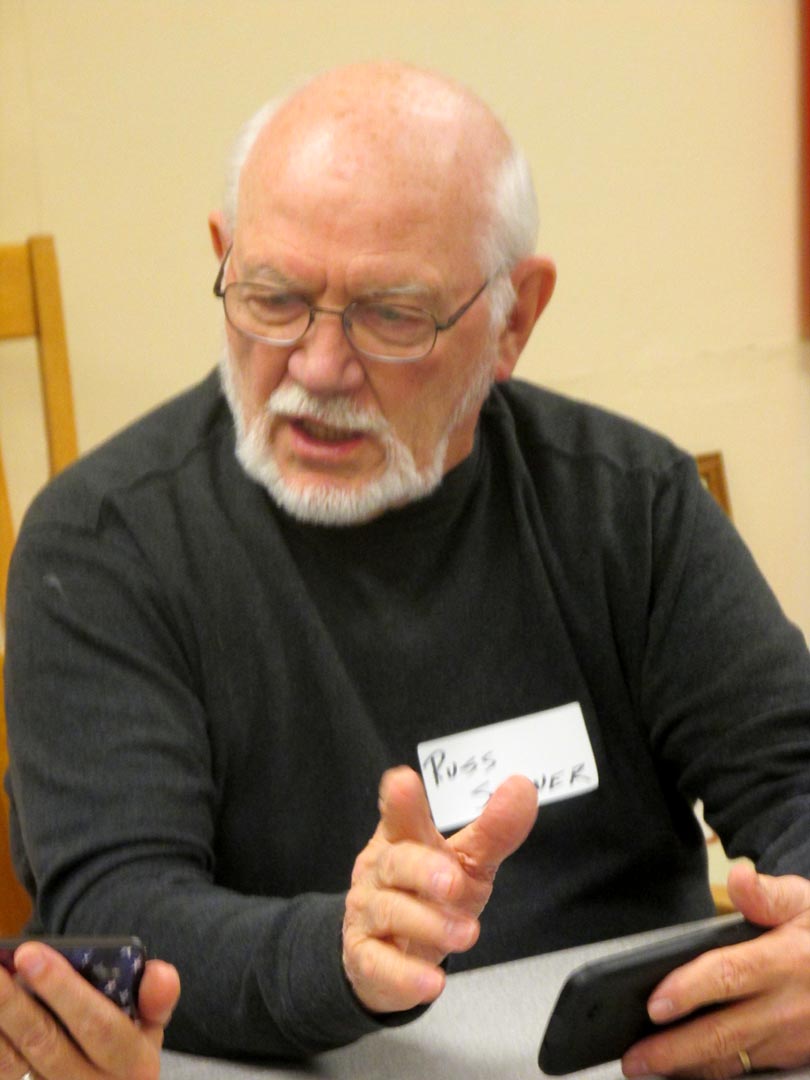
The November 2014 NMRA Magazine has a beautifully-done article on “Modeling an Autumn Forest Background” on Roger Nulton’s exceptionally well-detailed S scale Monon Railroad. Pages 28–35 show the development of an Indiana fall scene. Roger also practices 1:1 scale detail work on the DuPont Railroad restoration at the Snoqualmie Museum, led by Russ Segner.

Well done, Roger!

Calling All Volunteers For Pacific Science Center Show

David Yadock

Yes, the Pacific Science Center Show is just around the corner! Now is the time to reserve space in your busy schedule to help at this event. This show will need all kinds of volunteers. Volunteering at this show is a great way to help the model railroad community as well as helping promote a train show to the greater community of Seattle.

This event is the premier funding source for the 4D.

As noted on the 4D PSC web page, the show is Saturday January 17 through Monday January 19 (MLK weekend). We can use some assistance on Friday since exhibitor set-up will commence at 5 pm and last till 9 pm. On Saturday the show starts at 8:30 am and lasts till 6 pm. Sunday and Monday the show is from 9 am till 6 pm. After the show on Monday will be layout load out till 9 pm. This year will be critical for help since we will not have one of our load in/load out docks available.

Come join in on the fun. Be a model railroad ambassador to the community. Parking is free for the volunteers. Admission is free to the Pacific Science Center, so you can look at all the exhibits. As with last year, come see your fellow modelers struggle with dead sections of track! Be amazed at how slow locomotives move over dirty track! Learn that not all four legs of a module are of equal length, even though a tape measure says they are! Observe model railroad cars derail just like the real ones!

If you want to help email me at hi61izq@hotmail.com. Thank you.

Boeing Employees Model Railroad Club Swap Meet

BEMRRC

The Boeing Employees Model Railroad Club 35th Annual Swap Meet is being held Saturday, November 8th. Doors open at 9:30 AM until 4:00 PM. This is the Pacific Northwest’s oldest, largest, and best model railroad and railroadiana swap meet with 250 tables. The show is held at The Kent Commons Community Center, 525 Forth Ave N, Kent, WA 98032, on the corner of 4th and James Streets. Admission is $8. For more information contact swapmeet@bemrrc.com or visit http://www.bemrrc.com/.