Grab Iron Posts

Tacoma N Scalers

Bob Stafford, 4D Communications Director

The Tacoma N Scalers meet on the first Thursday of the month at the Fircrest Rec Center, 555 Contra Costa, Fircrest, WA at 7 PM. There is no meeting on January 1st. They will begin 2015 clinics Thursday night February 5th with a clinic titled “What I Got For Christmas and What I Am Going to Do With It”.

The March Clinic will be Thursday night March 5th, “How to Convert to Body Mounted Couplers”. Later in the year there will be clinics on laser structures, electronics, “EZ” trees, setting up operations, and more.

For more information about the activities of the Tacoma N Scalers contact Tom Todd at gntrains@yahoo.com, 360-349-1968, or Kurt Laidlaw at tccrailroad@gmail.com, 253-566-7042.

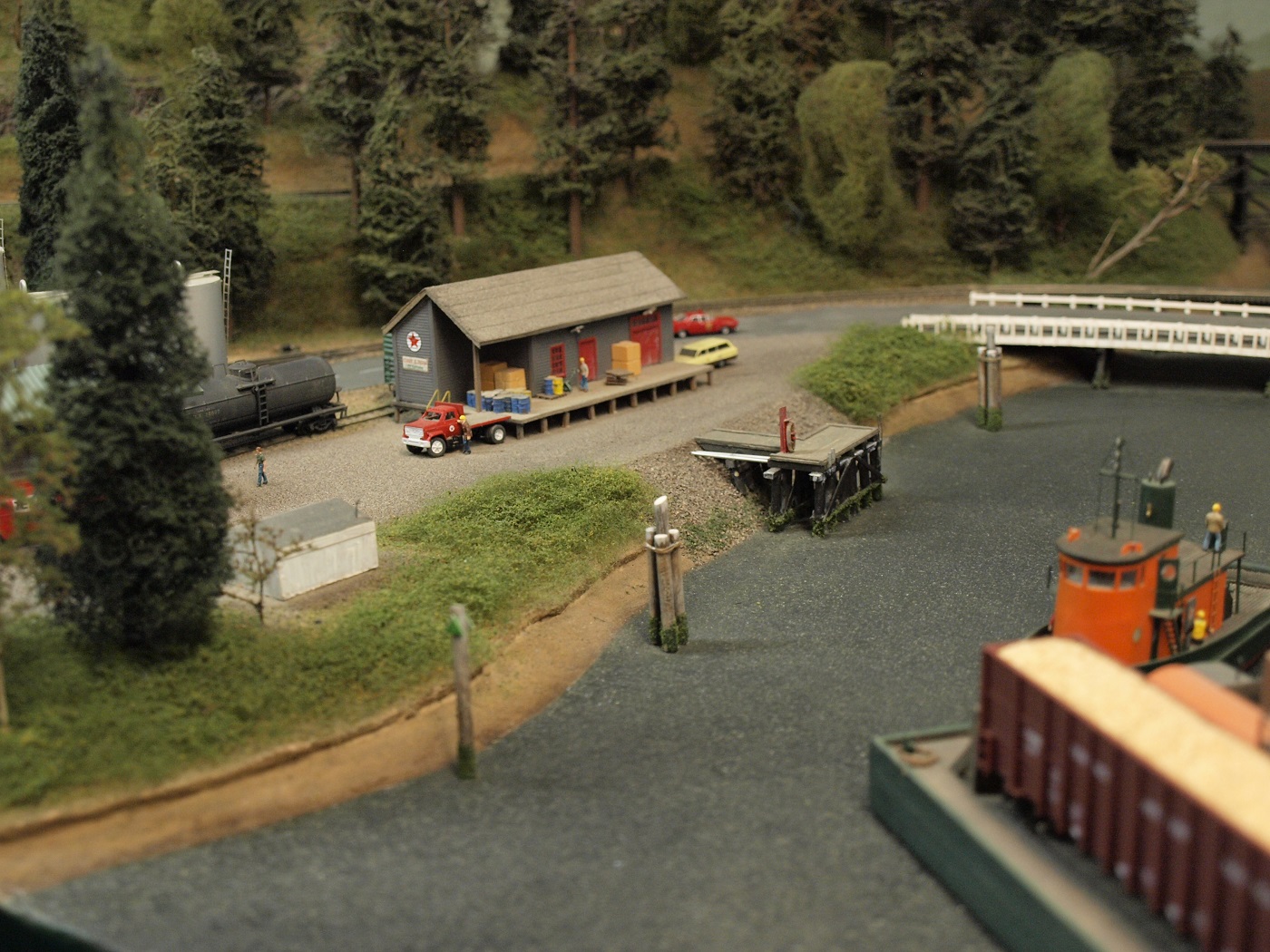
N scale modeling on Jim Younkins Mud Bay and Southern layout.


N Scale modeling by Jim Younkins. Bob Stafford Photo.

NMRA Booth Support at the WA State History Museum Model Train Festival

Bob Rorabaugh, 4th Division Membership Chairman

The annual Model Train Exhibit at the Washington State History Museum, Tacoma, Dec 21 to Jan 1 (closed the 24th and Christmas Day), is a wonderful opportunity for all of us who love the hobby and want to grow our ranks. If you plan to attend, would you linger at our NMRA booth for some intentional time? “Each one win one (a new member).” Be the “face” of the hobby and the NMRA. Engage passers-by, perhaps prepared to tell parents with children why you love this hobby.

Reasons to attend:

  1. It’s the holidays, and your local Sears store doesn’t have a railroad layout on display, but at this show, there’ll be a bunch of modular layouts.
  2. You’ve got kids in your world. They may be grandchildren, neighbors, a Sunday school class, etc. You can go to the Museum’s website and download a poster. Make the call to a teacher or some parents. Invite them to add this event to their holiday schedule!
  3. Just because you’d like to grow the NMRA, and would come just to share the booth experience.

Our association is 20,000 strong. Let’s have that many “owner’s reps.” I’m appealing especially to you who live within an hour of the Museum in the ol’ train station, downtown Tacoma. That’s from Seattle to Olympia, and places like Bothell, Puyallup, Snoqualmie, Bremerton, Shoreline, etc. Of course you can come from Mt. Vernon, Centralia and Port Townsend. Don’t be shy. I’ll see if I can get you into the museum for free, so bring your NMRA membership card and mention at the door that you’re serving our NMRA educational exhibit. If you must pay, then be sure to see the rest of this wonderful museum. There’s more to see than trains for you and those you invite.

Thanks for considering this request. Just don’t all come at once.

By the way, here’s my e-mail: rorabaugh@msn.com.

Eastside Get Together Report for November 2014

Ed Liesse, photos by Ed Liesse

JJ Johnston once again welcomed everyone to the Eastside Get Together and, following the script for our meetings, introduced the members of the 4th Division Board of Directors and the Master Model Railroaders (MMRs) in attendance. He then asked if we had any new attendees and Tom Keys from Seattle was welcomed to the group!

Announcements: Russ Segner, as chairman of the upcoming Sn3 Symposium, said they had 112 registration to date and that operating sessions are still available and, as 4th Division Superintendent, that the next Board of Directors meeting would be on Saturday, December 13 at Mitzel’s in Kent at 11:00 AM. 4D has a number of Fast Tracks turnout jigs available for loan to 4D members from the library and Russ is looking for someone to head the video library. David Yadock reminded us of the Pacific Science Center show, which is the 4D money-maker for the year. Volunteers are needed for the three days of the show and can get free parking and admission. Mike Kavanaugh said he has a small HO layout available, free, with trackwork and bridges but no scenery. Rick Jillard announced the availability of an 8’ x 24’ one piece layout in a garage with scenery and track plus car and engines.

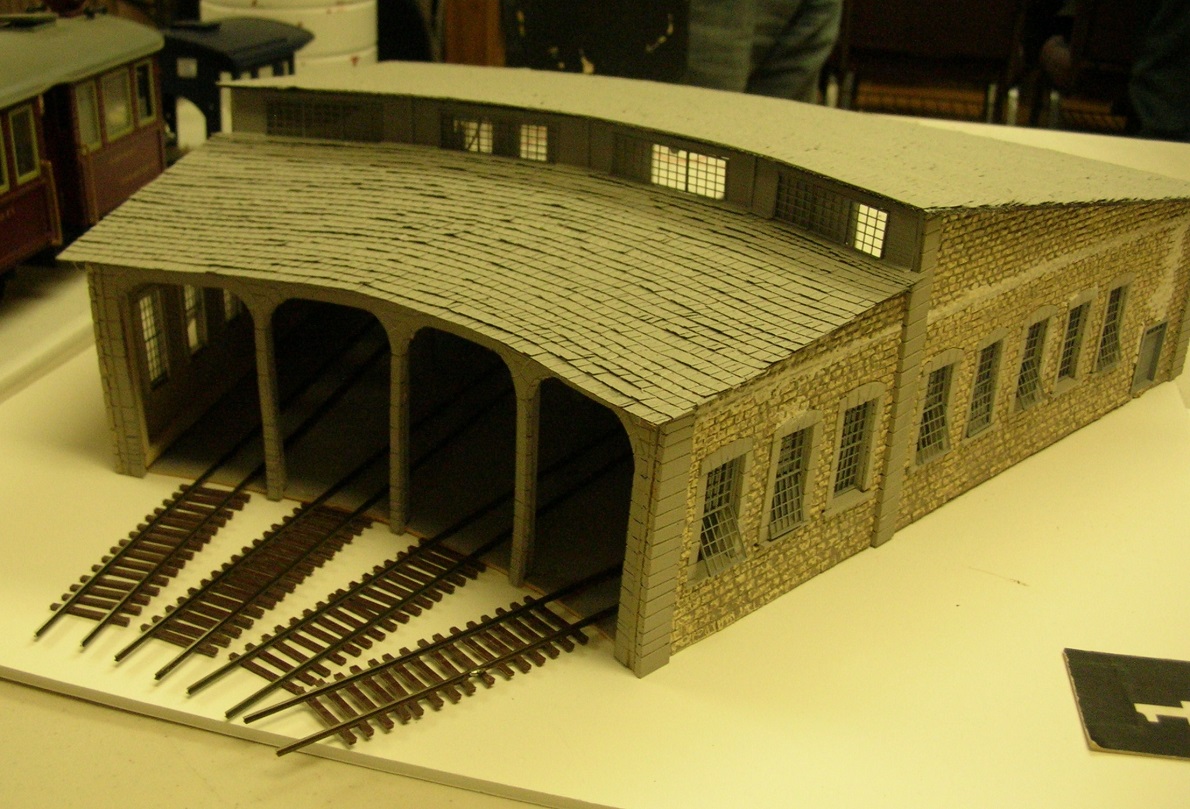
The Model of the Month featured David Yadock and CJ Turner. David brought a 4-stall roundhouse where he started using linoleum blocks for walls but changed to Chooch stone walls. The front walls are still carved from the linoleum block, however. Paper shingles are glued to the roof to resemble slate. The interior will be finished later but the lighting is already in place.

David Yadock's Roundhouse

David Yadock’s Roundhouse

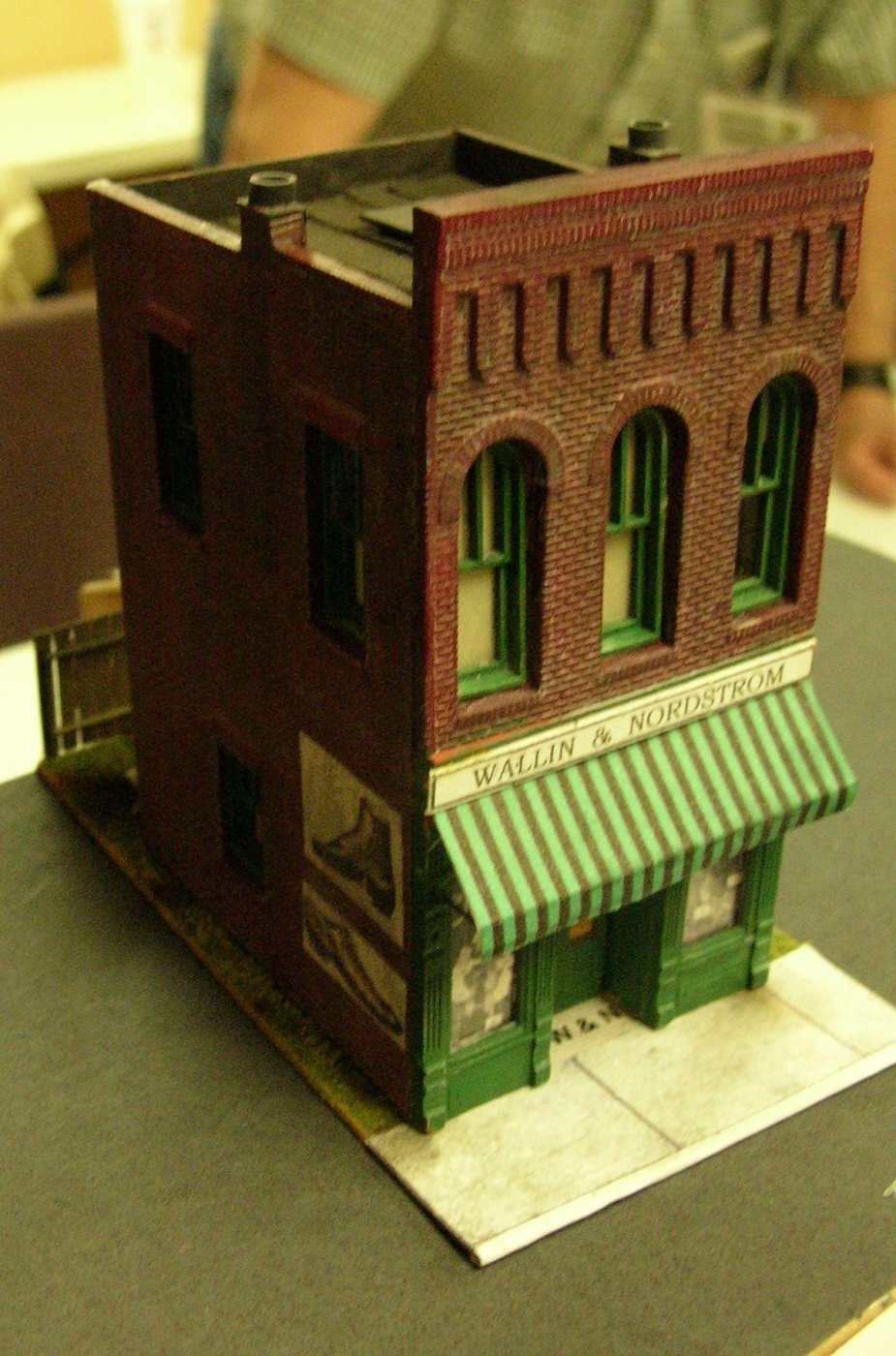
CJ Turner brought a DPM kit resembling a 1901 Nordstom store. The store is well detailed with window decorations and a warning from CJ to be careful of what was happening in the upper story front room! See CJ for the answer to that one!

CJ Turner's Original Nordstrom Store

CJ Turner’s Original Nordstrom Store

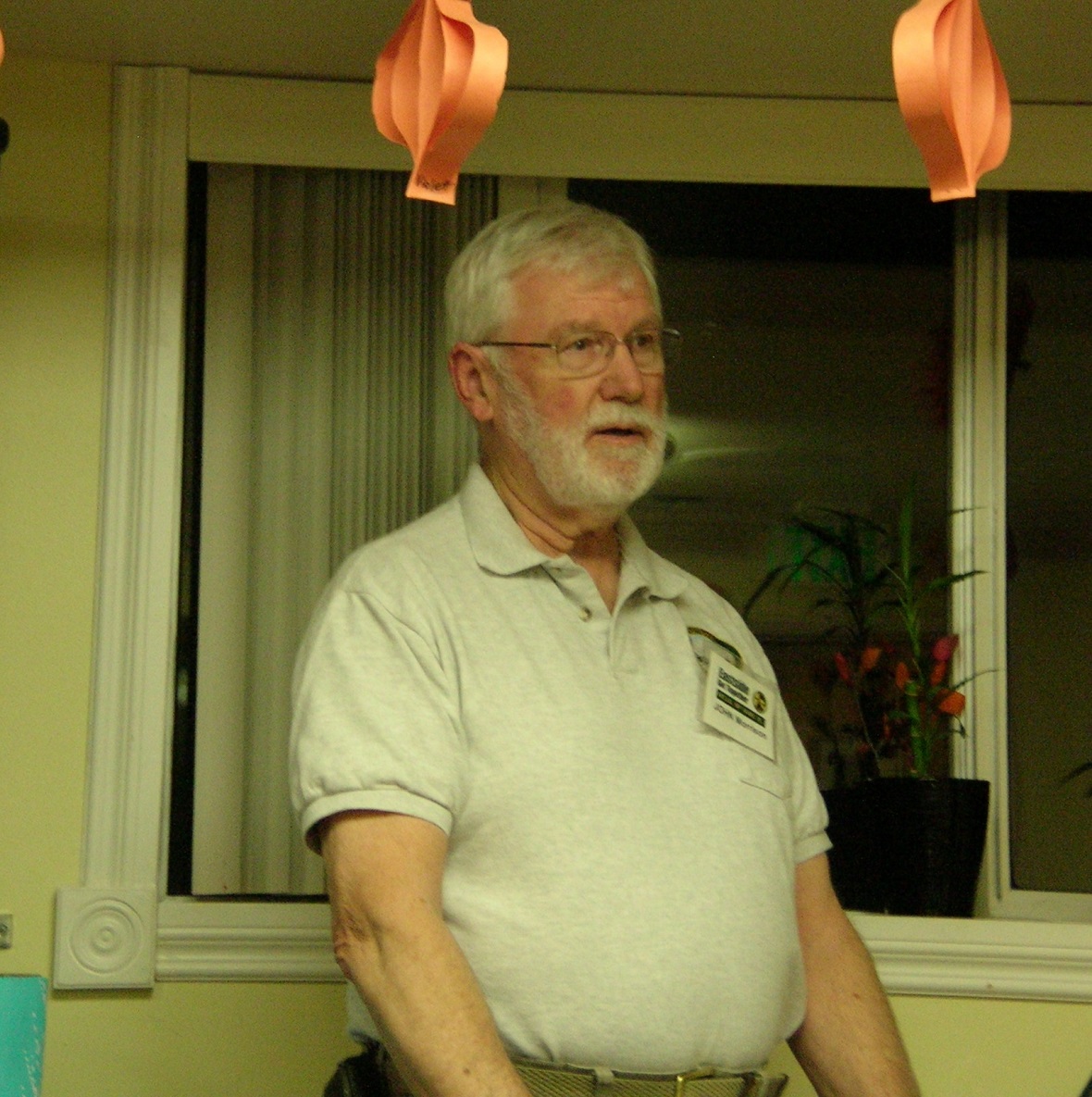
After our usual short break for refreshments JJ introduced John Morrison for a presentation on Swiss Rack Railroads. Because of the mountainous topography in Switzerland, most of the railroads traveling up in the higher elevations use a rack system to traverse steep grades. In addition, railroads in Switzerland are a mix of standard gauge and several different meter gauges. There are two main rack systems, the Riggenbach and the Strub, used mostly in the higher regions. The Strub rack is machined from rail. Various scenes in the presentation give a clear look at the differences between the two types. John also showed several charts of the different meter gauges in use.

John Morrison

John Morrison

CJ Turner was the winner of the Model of the Month.

The December Eastside Get Together will be on December 18. This will be a last opportunity to make our monetary contributions to help some needy members of the church have a merry Christmas! Instead of a presentation, we’ll celebrate with a “Dirty Santa gift exchange” (?). Come join us for some extra fun!

Santa Party at Eastside Get Together this Thursday

JJ Johnston

Reminder: Eastside Get Together meets this Thursday, December 18, 7:30 PM. Bring a wrapped gift for our annual “Dirty Santa Gift Exchange Party” and celebrate the Christmas season. There are free donuts along with free coffee. Yes, everyone can help themselves to free donuts compliments of the Eastside Get Together. Bring your Model of the Month and let us see what you’re doing.

Your Santa gift can be around $12 or so, and the rules will be reviewed at the beginning of the exchange. Please wrap your gift and put the scale or gauge on the outside so it can be seen easily.

Oh, by the way – congratulations to Jim Easley and his resident modelers at Emerald Heights in Redmond. They are celebrating the 10th anniversary of their garden railway which Jim started for them shortly after he became a resident. The work now includes 275 feet of track, a train barn, 6 bridges and trestles, 45 structures plus various flowers, trees and shrubs. Jim also has a railroad around his unit to show off his wonderful collection of Swiss (I think) locomotives and rolling stock.

Our annual collection for donations has gone extremely well this year. This collection assists a few church members in need as a way of paying back the church who gives us our space rent free and lets us use their coffee and condiments at no cost. Thanks to all of you who made a generous contribution. If you haven’t had a chance to donate yet, we will pass the hat around one more time at Thursday’s meeting.

See you on Thursday and hope you get a great treasure from Santa.

Skagit Valley and Whidbey Clinic, Making Windblown Trees, December 2014

Article and Photos by Rich Thom

December’s clinic featured an always-popular “Make-and-Take,” with Susan Gonzales leading the group through her process of making windblown trees. Susan’s technique is based on an article, “Windswept Trees from Natural Materials,” in the April 2013 issue of Model Railroader, but she shortened the process and used her own choices of materials, stains, etc.

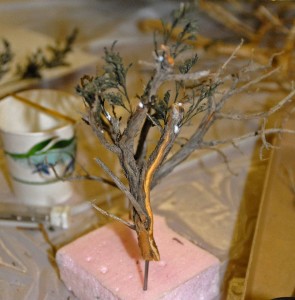
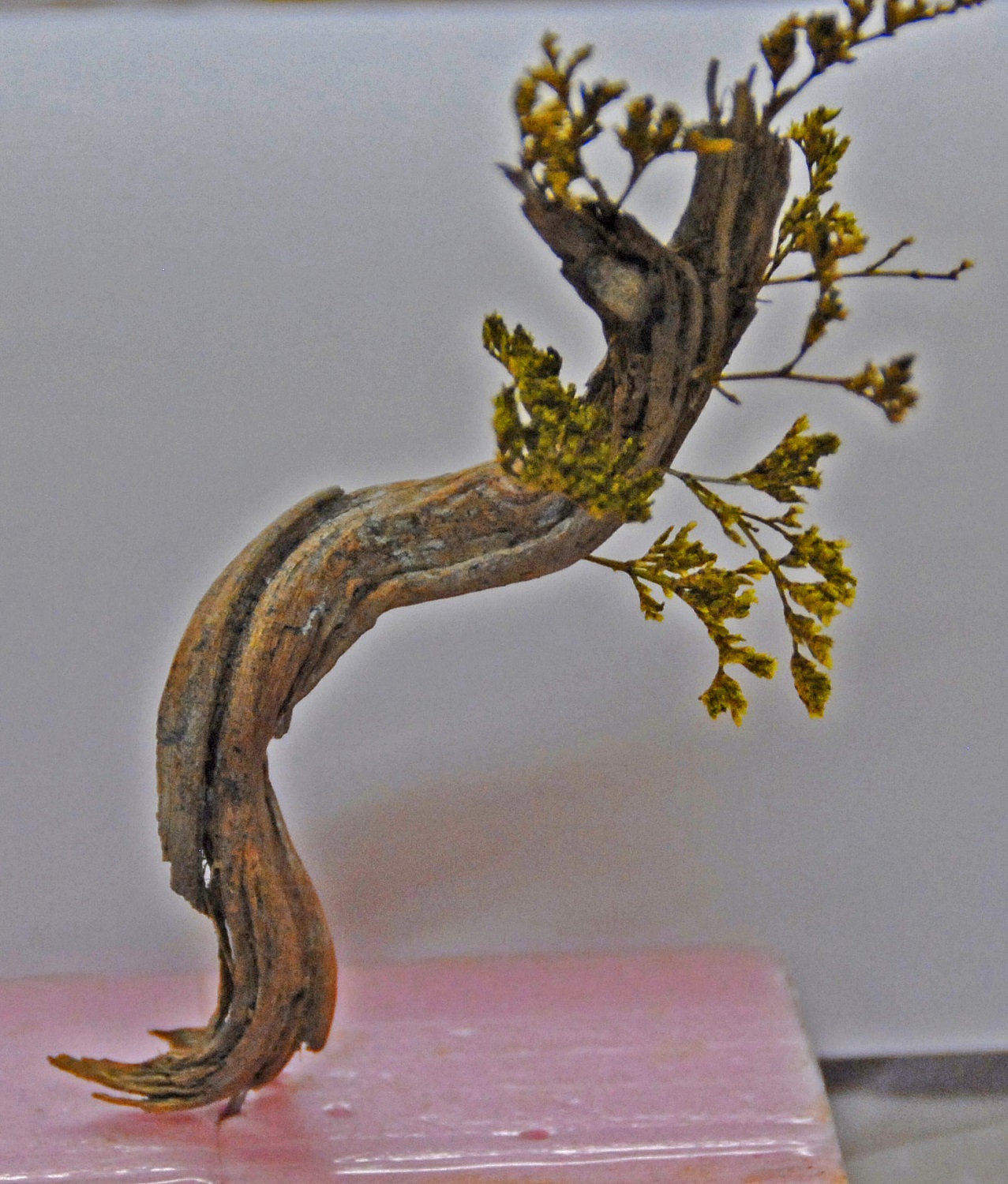
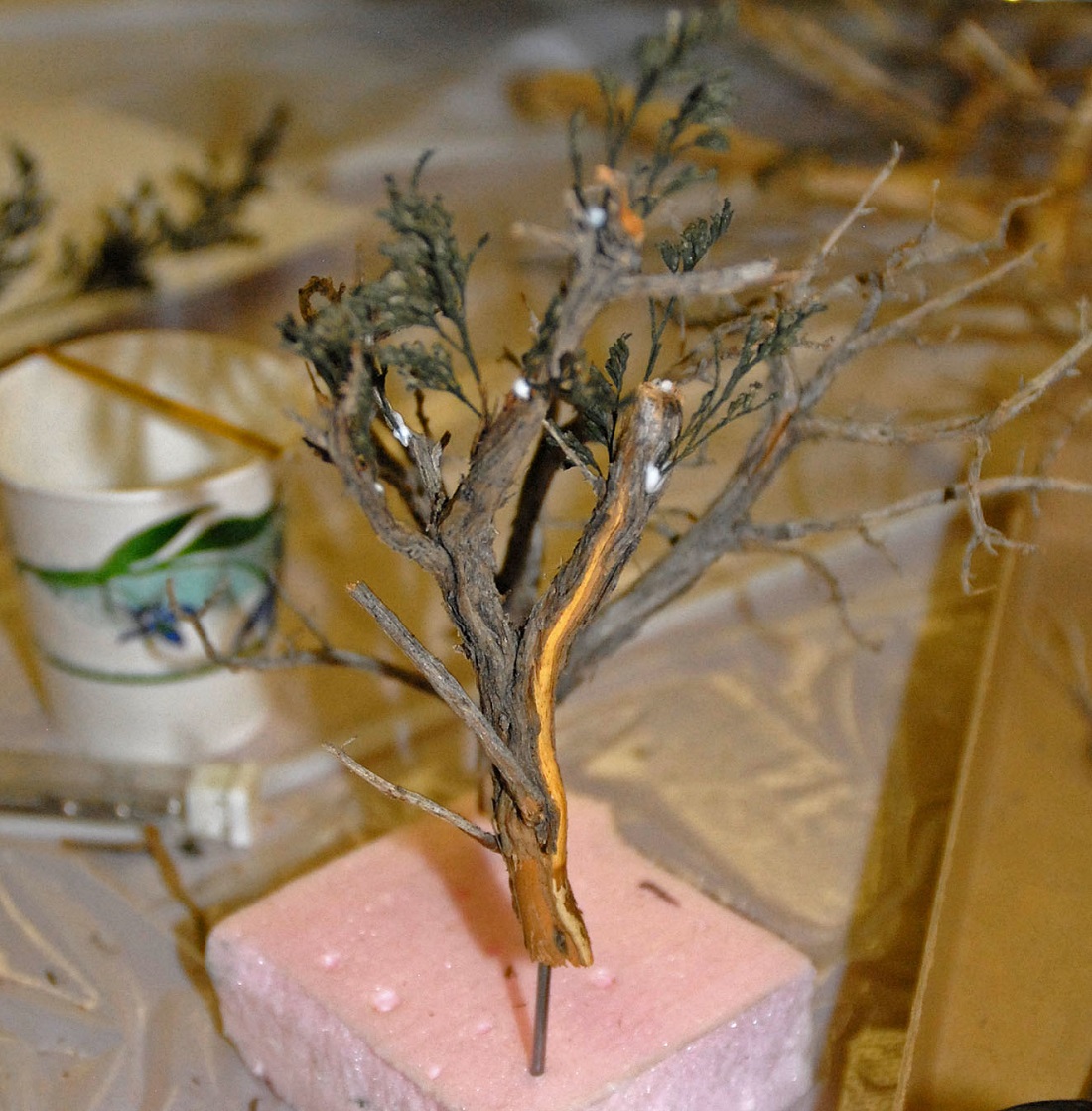
To inspire everyone for the evening’s tree-making, Susan brought a completed tree:
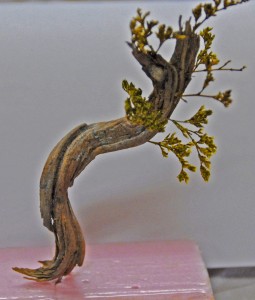
Fig 1 Example Tree Made by Susan Pre Clinic

In this example, sagebrush collected in eastern Washington was used for the trunk, and caspia for the branches. Other twigs you can find in the woods can also be used, but sagebrush produces especially fine windblown trees. The trunk has been stained and also weathered with gray washes. Having examined Susan’s tree, everyone had a chance to try their hand at creating an equally-gnarled tree. Susan brought a large supply of sagebrush and caspia to the clinic — more than five times enough in fact for everyone!
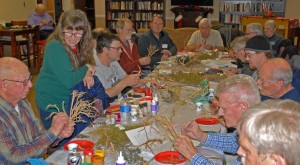
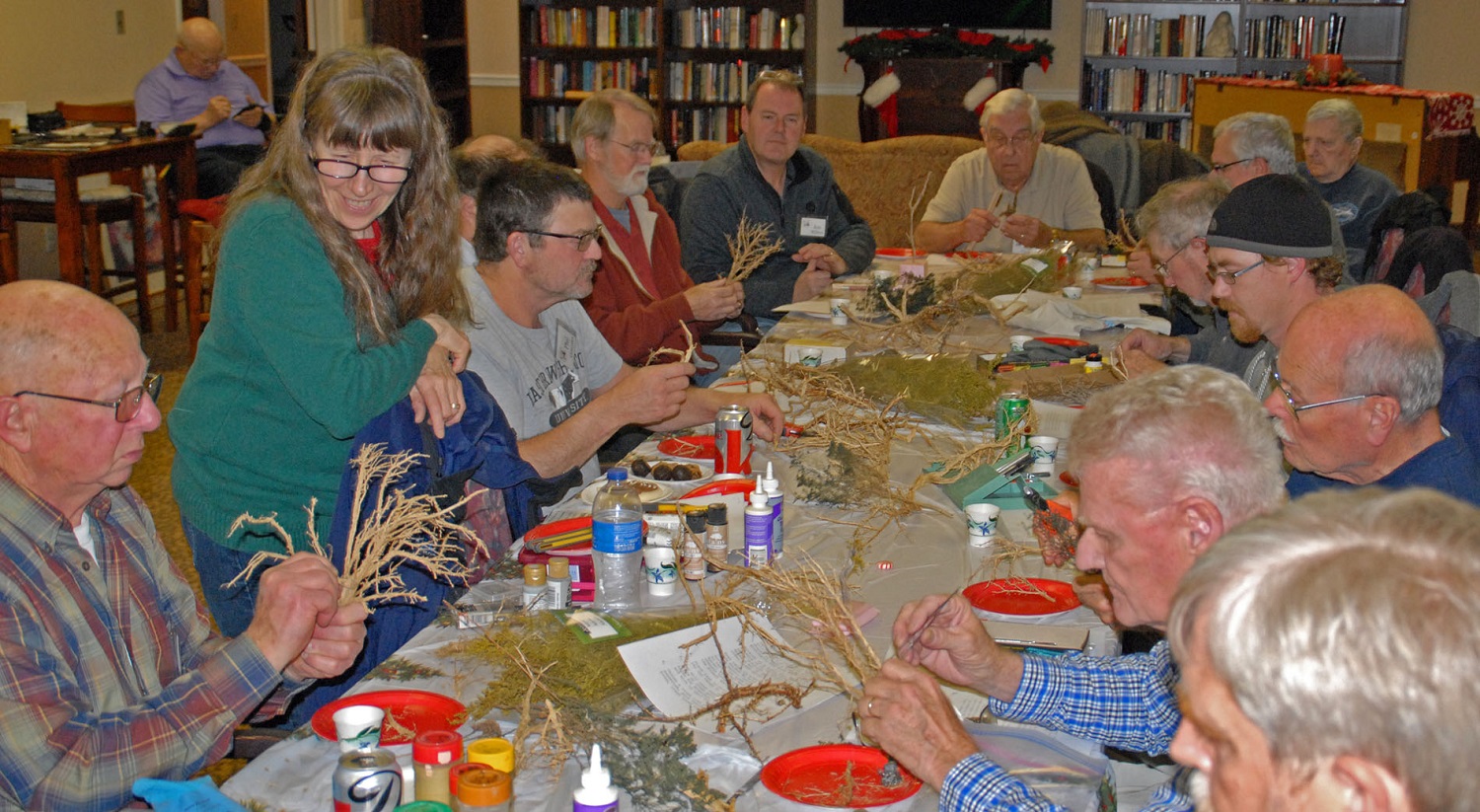
Susan Leads Tree Clinic

Susan Leads Tree Clinic

The first step in the process Susan did before the meeting (after gathering a quantity of sagebrush): bleaching the wood. She uses four 5-gallon buckets. The first is filled with a strong solution of bleach, and the other three with rinse water. The twigs are soaked in the bleach solution for one hour, then moved to bucket #2. The wood is swished around in the bucket and soaked for 20 to 30 minutes. This is repeated again in bucket #3, and then #4. The rinse water is changed frequently. Rinsing continues until all bleach odor is gone. The twigs are dried on a tarp or plastic sheeting, preferably outside. A sunny day is even better (good luck with that in western Washington!).

The next step is to “mine” the brush, searching for gnarled and / or curved or otherwise interesting-looking segments for the trunk of your tree. Cut, then pinch off excess branches to get the look you want. The size will obviously depend on your scale and whether it is to be a foreground or background tree. If it’s sagebrush, pick off any thorns. Clean off loose pieces with a wire brush. For a polished, wind-worn look, use 220-grit sandpaper on the trunk.

Color the trunk (optional) with a brown stain, gray washes, or both. Susan uses Folk Art brand maple and cherry stains (hard to find) but your favorites will work, too. She uses Folk Art dove gray and steel gray acrylics for the washes.

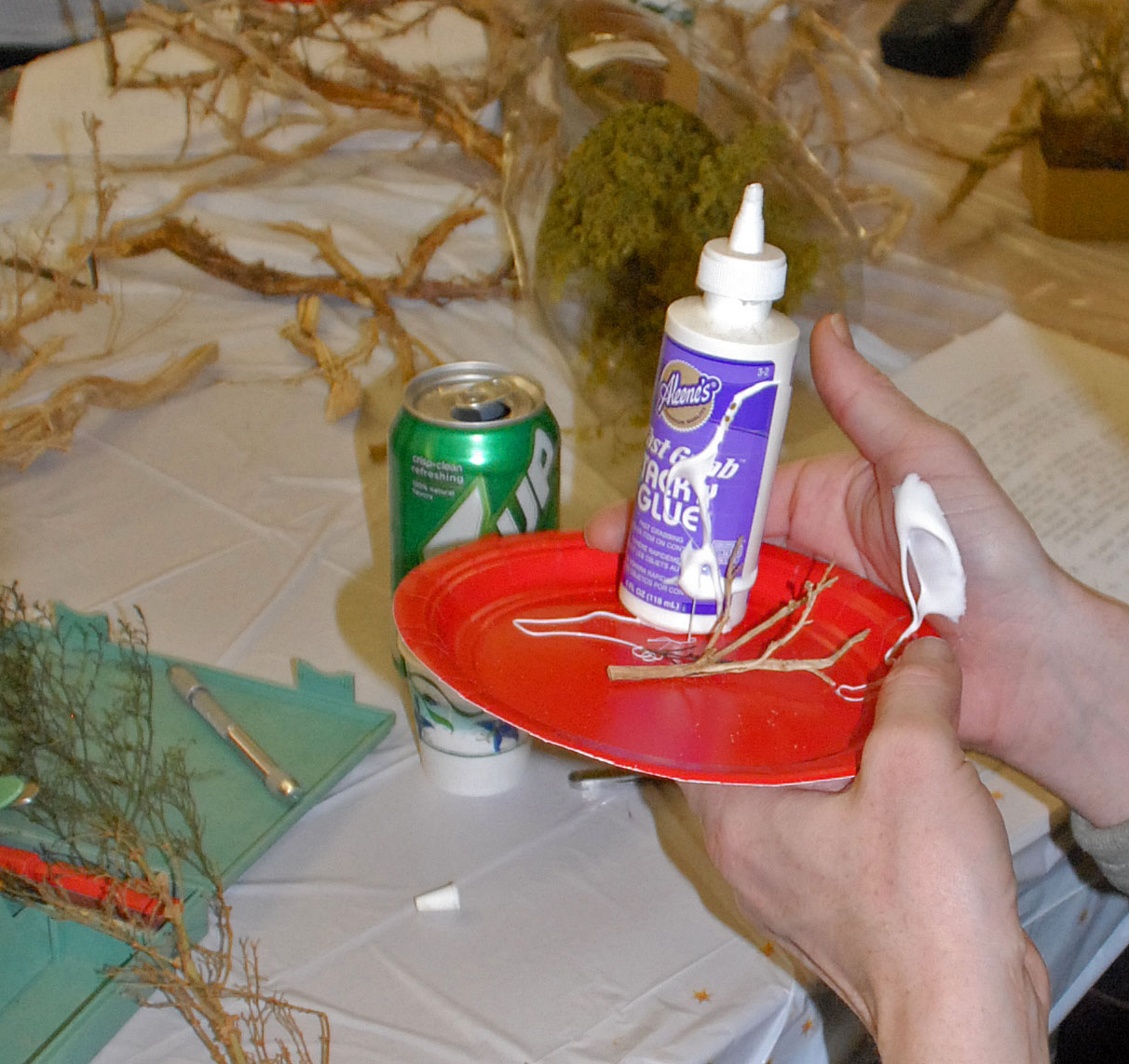
The next step is to drill or punch holes in the trunk for the caspia branches. After forming the holes, Susan uses a trick of putting T-pins in them to keep them open (and visible!) until you are ready to glue in the caspia. She uses Aleene’s fast grab or tacky white glue. One of our tree-builders discovered that you shouldn’t squeeze the glue bottle too hard.
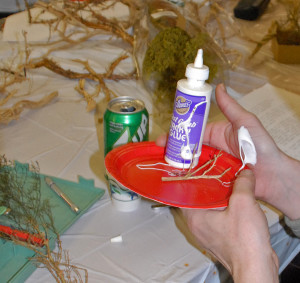
Results of Squeezing the Bottle Too Hard

Results of Squeezing the Bottle Too Hard

Ground foam may be added to the branches, also optional. As a final step, drill hole and glue in a planting pin at the bottom of the trunk

Everyone took home a windblown tree, such as these resulting from the evening’s labors:
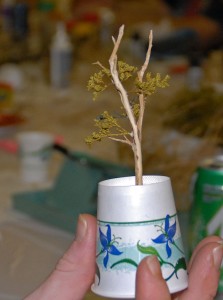
John Mann's Tree

John Mann’s Tree

Tom Hawkins' Tree

Tom Hawkins’ Tree

Thanks Susan for a fine clinic and inspiring us all to enhance our layouts with these unique trees.

Grab Iron E-mail Notifications and Welcome to New Members

Cliff Green

cliff_greenWelcome, new 4th Division NMRA members! I’ve completed updating the Grab Iron e-mail notification list with the new members from the last two months as well as members that have renewed and changed their e-mail addresses. Any time a Grab Iron blog post is created and published you will receive an e-mail notification.

As always, if you do not wish to receive these notifications, let me (Cliff, cliffg@codewrangler.net) know and I’ll be happy to remove you.

Over the last few weeks minor updates have been made to the 4th Div web site (www.4dpnr.com, mostly updating contact and clinic info). In upcoming months more significant updates will happen, including web templates that are more “responsive”, which means it handles smart phones and tablets in a more intelligent manner. More details in future Grab Iron posts.

There is a wealth of model railroading expertise available in this area, and a good place to encounter it is at one of the 4th Div clinics (see the 4D web site “Clinics” page for more info). I urge everyone to take advantage of it whenever possible. Most of the clinic organizers provide overviews and reports in the Grab Iron, but reading blog posts can’t compare to attending in person.

Happy holidays to everyone, and I hope you have time to do a bit of model railroading in addition to (or in conjunction with!) family and friend time.

Miniatur Wunderland in Hamburg, Germany

Al Lowe

Last year, I was lucky to spend a day at Miniatur Wunderland, one of the world’s great model railroads in Hamburg, Germany. This for-profit operation, which appears to be quite successful, was filled with people at €12 each (about $15). Unfortunate, I learned after I arrived that I could have taken a “backstage” tour. Remember that for when you visit!

I edited my hours of footage down to less than 20 minutes to make this brief video. (Be sure to click the “full screen” button in the lower-right corner to watch in high-definition.)

Tacoma Clinic

by Al Babinsky

MMR Gene Swanson opened the clinic on time as usual and dispensed with the usual announcements. The “Model of the Month” or “Bring and Brag” was held with several models being shown. We had 41 modelers attending this clinic, our “Dirty Santa” clinic.

Paul Vaughn brought two versions of molds, a hard rubber and a soft rubber mold. He explained the difference, which is the hard rubber mold is made to be used many times to create soft metal parts and the soft rubber is usually a one-time use.

Leo Scafturon brought a HO kit of Western Welding shop mounted on a corner module. The shop is complete with equipment welding hoses, shop personnel, forklifts, material, and a siding.

Chris Clancy brought some of his finds from antique shops including a gondola and an F7 A and B unit, all heavily weathered.

John Miller brought a Model Diecasting 0-6-0 with tender and a lengthy story of all the problems he addressed to make the model work properly. Very interesting.

Walt Huston brought a dual gauge track switch to show how the narrow gauge track diverged from the dual gauge track.

The “Model of the Month” winner was Leo Scafturon with his Western Welding module.

The next item on the agenda was our food, appreciated by all and attacked with great gusto. We then waited with anticipation for Dirty Santa to arrive which he did. As the program progressed many items switched hands and several modelers opened presents since someone had stolen theirs. Of special interest were a couple of power tools that seemed to change hands a number of times. The evening ended with the drawing of door prizes, enough for all attendees to receive one. The clinic was closed with the clinic committee singing “We Wish you a Merry Christmas and a Happy New Year.”

Our next clinic will at 7:30 PM on January 8th in our usual place, the Pierce County Library Admin. Bldg on the corner of 112th Street and Waller Road. The presenter is Steve Cox on the subject of Model and Prototype Roadbed. Hope to see you there in 2015.

I don’t know how many of you know about an online publication called Trackside Model Rail Roading (TSMRR), their website is: www.tracksidemodelrailroading.com. It is run by a husband and wife team. The reason that I’m mentioning this is that three members of the Tacoma Clinic have been published in that publication: Dale Kraus and his layout are in the November issue and Walt Huston and Al Babinsky are in the December issue. Each layout article has an embedded video to give you a rail fan tour. In order to view you must purchase it, the cost is $1.89 per issue or $14.99 for a year. Check it out you may like what you see.

From all of us to all of you Merry Christmas and a Happy New Year.

Mt. Vernon NMRA Clinic November Report

Roger Johnson / Photos by Roger Johnson

The November Mount Vernon clinic of the local Fourth Division, PNR, NMRA was attended by 22 folks, one of which was the 4th Division Superintendent, Russ Segner. Thank you, Russ, for taking the time and effort to battle the traffic from Newcastle to attend our clinic. You will always be welcome here.


Our distinguished visitor Russ Segner, 4th Div Superintendent

Our distinguished visitor Russ Segner, 4th Div Superintendent

The Mt Vernon Model Railroad Clinic is a NMRA sanctioned event with the 4th Division of NMRA providing a modest sum of seed money to help us get started. While NMRA membership is not required to attend the clinics, it was once again heartily encouraged. Please let Al Carter or Roger Johnson know if you wish to join the NMRA.

There were several announcements of upcoming events (editor added a couple):

  • The next Skagit Valley & Whidbey clinic December 10, 2014 will feature Susan Gonzales presenting “Make & Take Windswept Trees.” Email Rich Blake.
  • 15th Annual Model Train Festival at the Washington State History Museum, December 26, 2014 – January 1, 2015. Info at www.washingtonhistory.org/visit/wshm/eventsprograms/festivals/trainfest/
  • 4th Division’s 41st Annual Train Show at Pacific Science Center January 17-19, 2015. This is the divisions principal source of income for the year so support of the show will be appreciated. Contact: Jeff Moorman, 206-367-2377 or kb7rr@arrl.net
  • 24th Annual Model Train Show and Marketplace at the Evergreen State Fairgrounds in Monroe February 28 & March 1, 2015.
  • 30th Annual Sn3 Symposium in Bellevue April 16-18, 2015. Info at http://sn3symposium-2015.com/
  • 2015 NMRA National Convention “Portland Daylight Express” in Portland, OR August 23 – 29, 2015. Info at www.nmra2015portland.org

Other announcements included:

  • Marv Hall brought to our attention a paint chart by Microscale cross referencing most of the lost Floquil railroad colors to paints of several other manufacturers.
  • Mike Pettruzzelli brought several old Model Railroader magazines available for the taking.
  • Tom Buckingham brought newspapers for our perusal from the Grand Canyon Railway, brought back from his recent trip thereon.
  • Russ Segner reminded us of the restorations taking place at the Northwest Railway Museum in Snoqualmie. He also brought several railroad paintings recently donated to the 4th Division that are for sale (prices negotiable) to benefit the Division.

Our Show & Tell (or Bring & Brag) segment featured:

  • A disassembled Santa Fe passenger car in the process of being super detailed by Nick Muff. Included are carpeting, table Formica and seat back headrests all pattered after the real car, lower level constant lighting and a Tsunami rolling stock sound decoder to replicate the sound of the two diesel generators with which these cars were equipped
  • A scratch built gas station in progress by Al Carter, with excellent detailing in the office/waiting room. This building has special significance for Al as it was started for him by a fellow who has since died. When complete it will bear his name.
Nick Muff's passenger car detailing in process

Nick Muff’s passenger car detailing in process

Al Carter's service station interior detail

Al Carter’s service station interior detail


The Tool of the Month was silent this month. Hopefully it will have found its voice at the next clinic.

The evening’s presentation was a demonstration of casting rocks in geodesic foam by our own MMR (mistakenly noted as MRR in the earlier clinic reminder notice) Nick Muff. Over the course of an hour or so we watched as he prepared a mold, mixed the two part resin material, poured it into the mold, made sure it was evenly covered and eventually removed from the mold. The result is highly detailed rock castings that are very light weight and can be cut with scissors and, with some heat, can be reshaped to fit the specific intended space.

In addition to showing how to make the castings, he also demonstrated coloring techniques, starting with white artists’ gesso and then black tempera paint powder. When he first applied the dry powder to the casting it took on a somewhat uniform dark grey color. Next he misted the casting with water then washed much of the tempera from the high spots leaving the cracks and crevices in deep shadow. To this writer’s eye it was like magic—in seconds the casting had been changed from a pure white casting into what looked very much like a real rock cliff side. Further coloring with acrylic artists’ tube paints and a random dusting of greenery completes the look.

Nick uses and recommends the products of Bragdon Enterprises because, as he says “If you buy from Bragdon you not only get the materials—you also get Joel Bragdon” to answer questions and provide hints along the way, if needed. This writer would be remiss to not mention how entertaining Nick can be while educating us to new techniques and modeling tips. It is no wonder he has been designated as a Master Model Railroader! We are very lucky to have him as an active participant in our group.

Nick Muff's foam rock molding presentation materials laid out and ready

Nick Muff’s foam rock molding presentation materials laid out and ready

Nick Muff demonstrating foam rock molding

Nick Muff demonstrating foam rock molding


Nick Muff answers questions following his foam rock molding presentation

Nick Muff answers questions following his foam rock molding presentation

Jim Tartas explains his rock casting technique to Jon Wilbert

Jim Tartas explains his rock casting technique to Jon Wilbert


For future clinics, if the front door of the Senior Center is locked, entry will be through the rear door on the south (erroneously stated in an earlier report as west) side of the building which is kept open in the evening. This passes through a kitchen, then into the hallway. A sign will be posted at the correct door.

It was decided last month to not have a December Clinic (two days before the Christmas holiday). Therefore, our next clinic will be January 27, 2015 (fourth Tuesday) at 7:00 PM at the Mount Vernon Senior Canter. Roger Johnson will demonstrate how to put “Structures on a Diet,” reducing the footprint (and sometimes mass) of plastic building kits.