By Al Babinsky
Just a reminder that this month’s Tacoma Clinic will be on Thursday October 14 at 7:30 PM at our usual place in the Pierce County Library Office Bldg. on the corner of Waller Road and 112th Street. Hope to see you there.
Just a reminder that this month’s Tacoma Clinic will be on Thursday October 14 at 7:30 PM at our usual place in the Pierce County Library Office Bldg. on the corner of Waller Road and 112th Street. Hope to see you there.
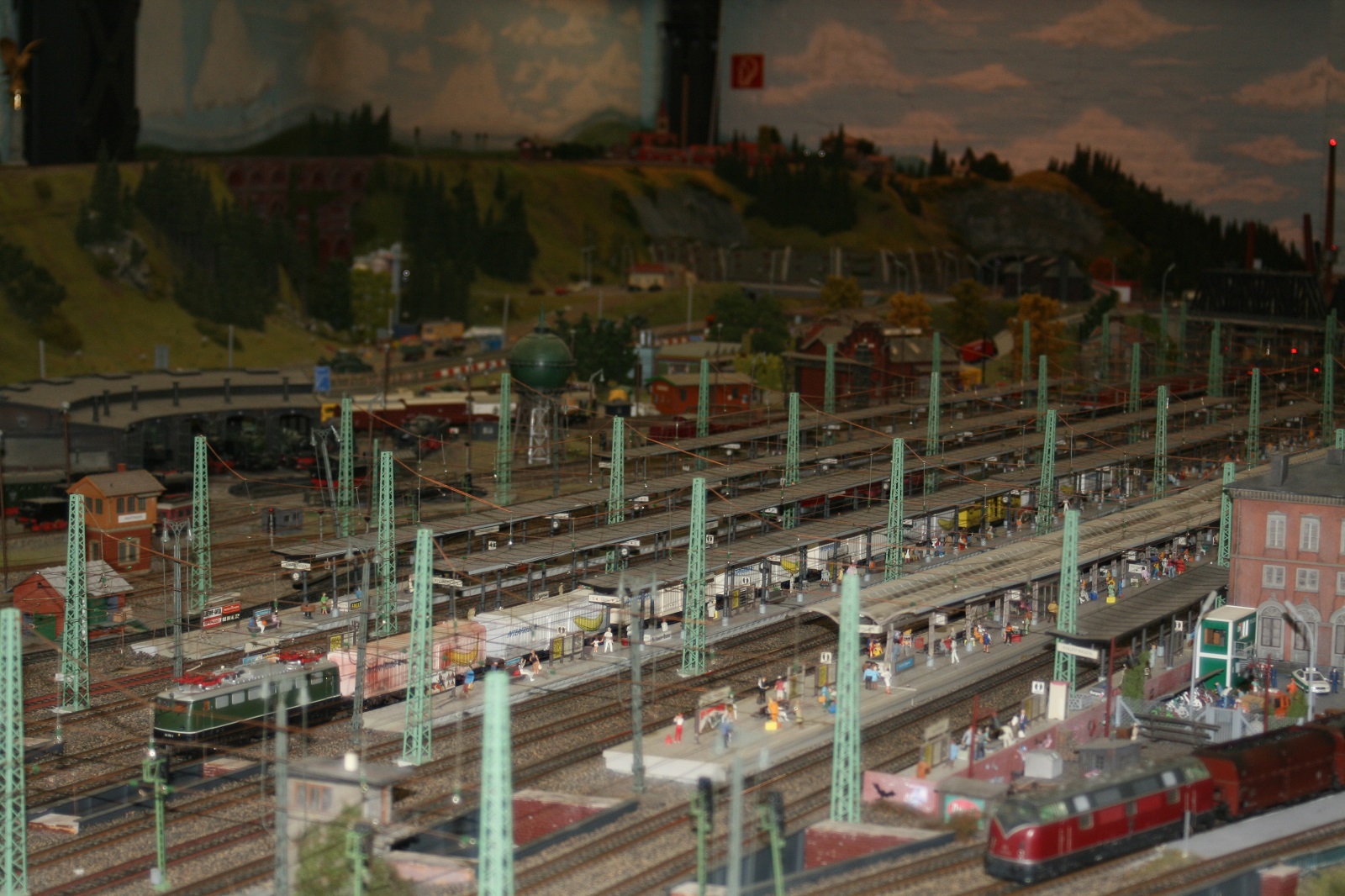
Miniature Wunderland Main Station
On my recent trip to Germany I spent a couple of extra days to stay in Hamburg to visit some of the sights, one of which was of course the Miniature Wunderland of You-Tube fame. The display is located in the Speicher district (Warehouse) of Hamburg, built at the end of the 19th century. It occupies the 3rd and 4th floor at one end and covers an area of 1150 square meters (app.10000 sq ft). At this time there are 7 theme areas with a total of 11 planned. The areas shown are Germany, Austria, Switzerland, Scandinavia and US, most of which is fantasy with some of the icons built as scale models and compressed to fit the space.
At this time there are 1,2000 m (7.5 miles) of track about 830 trains with 14,100 pieces of rolling stock. The longest train is 14.5 m (46 ft) long. There are 1,200 signals, 2,500 switches, 40 computers. About 300,000 lights, 200,000 figures, 215,000 trees and 5,500 vehicles. At the time I was there, the control room was manned by three persons who operated the layout. They operated the trains and vehicles which included emergency vehicles responding to fires. Scenes include a soccer stadium complete with 15,000 spectators and, of course, the two teams playing, an amphitheater complete with spectators, and a fair with its visitors.
The Swiss area extends from the 3rd floor to the 4th floor. From the 4th floor you can look down on the town and the walk down the stairs to the 3rd floor. While descending, you have the ability to look at scenes such as a below-ground station as you can find in many European cities. From the 3rd floor you can look up to the top of the mountain which is supposed to be the Matterhorn complete with cable cars. The major city on the layout is Hamburg with its icons and the Hauptbahnhof (Main Station).
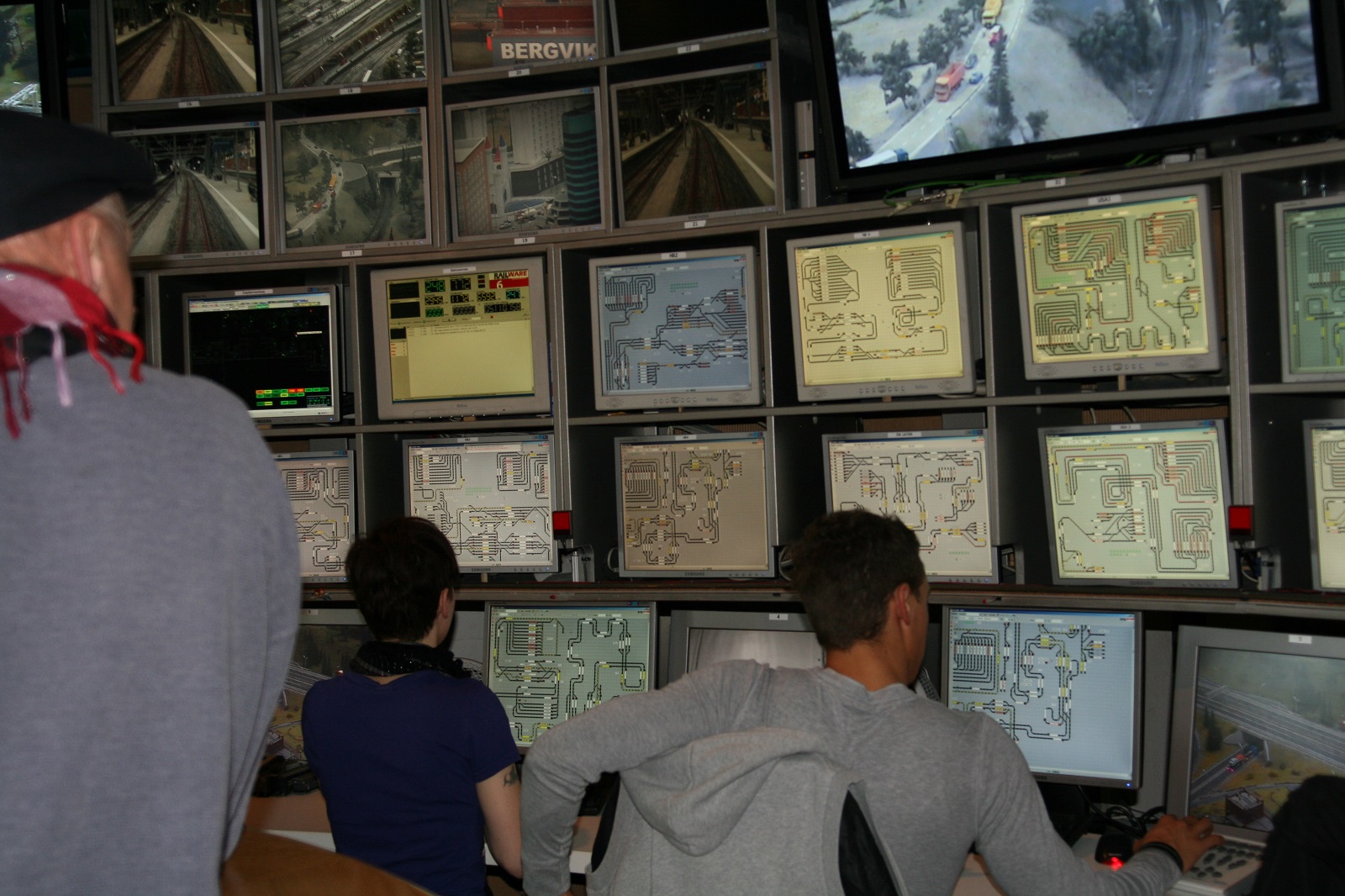
Miniature Wunderland Control Center
The two cities where you see the operating vehicles are Knuffingen and Hamburg as they travel on the roads and stop and start as traffic signals change. All vehicles have lights which operate they include signal lights and operating stoplights, the emergency vehicles have operating flashing blue lights, sirens, and do-da horns.
The Scandinavian section has a fjord with real water and several ships that remotely operated. It has a winter scene along with a mining operation, the underground portion of which can be viewed through glass panels. In the US area you can a see pueblo scene which changes into a high desert area around Las Vegas which represented by its casinos, a miniature Mt. Rushmore, Yosemite National Park with Half Dome, redwood trees, Cape Canaveral (Kennedy Space Center), Miami, and Key West with its overseas railway.
To my surprise there was a modern Puget Sound transportation item at the station, the commuter train called Sounder. I believe the longest train which operates on the layout is in the US section, a freight double-headed by Big Boys. The section under construction is the airport with most of the scenery, runway, taxi ways and terminal ramps finished. Some lights are installed a couple of buildings are there, no aircraft yet. All in all, a very well-built layout with all the tricks that are available to make it seem real. The lighting used fluorescent lights, white, blue, and red to simulate the 24-hour cycle from night to dawn, day and dusk back to night. I was there on Saturday, which was probably not the best day; I had to wait about 45 minutes to get in. The occupancy is limited to 600, which makes it very crowded and hard to take photos.
If Gene Swanson still has the June clinic spot open I would like to do a PowerPoint presentation of Miniature Wunderland. I have about 80 photos that I took and I also bought a DVD of the layout which is about 2 hours long, too long for the clinic so a presentation will have to do.
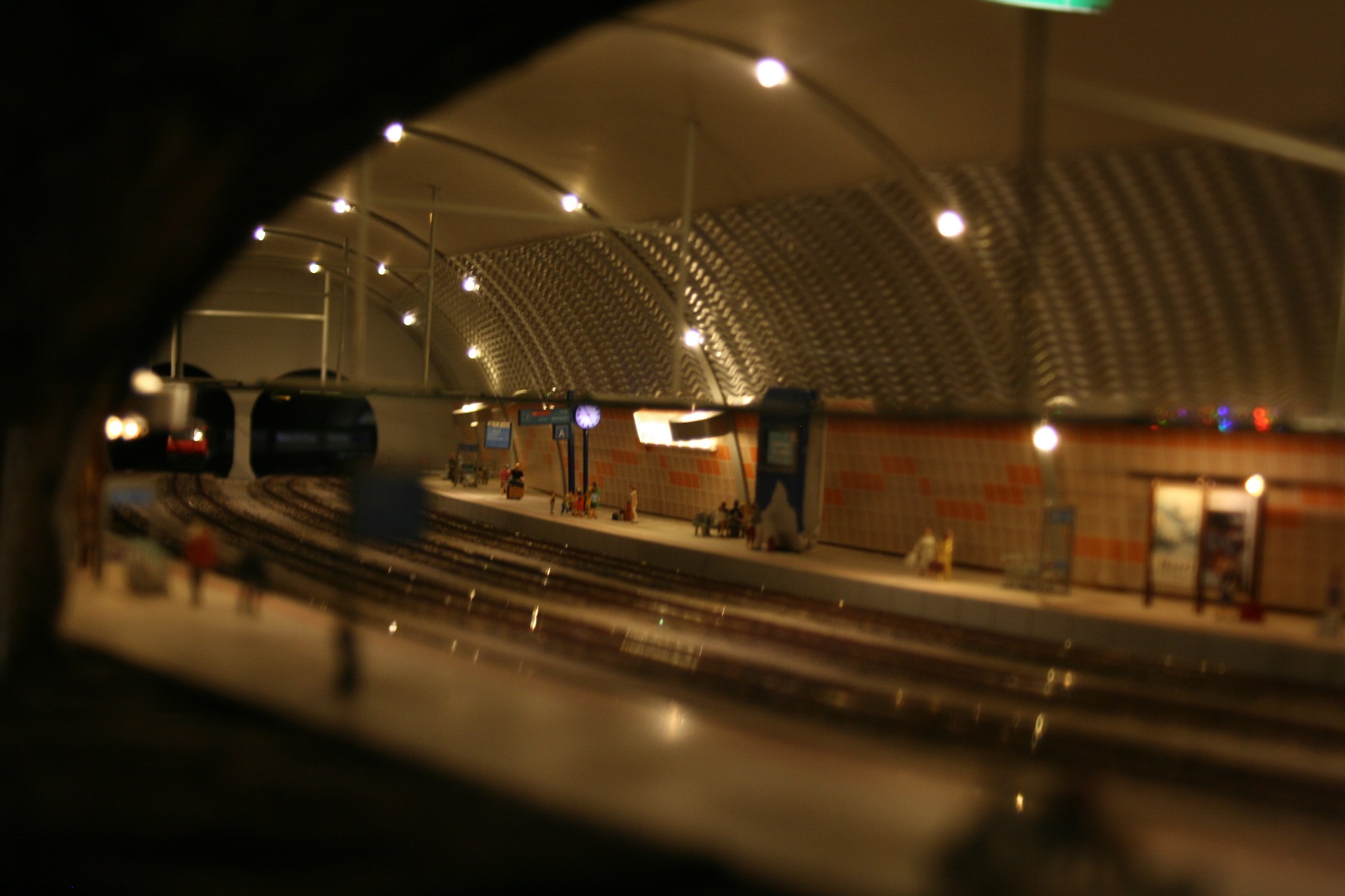
Miniature Wunderland Underground Station
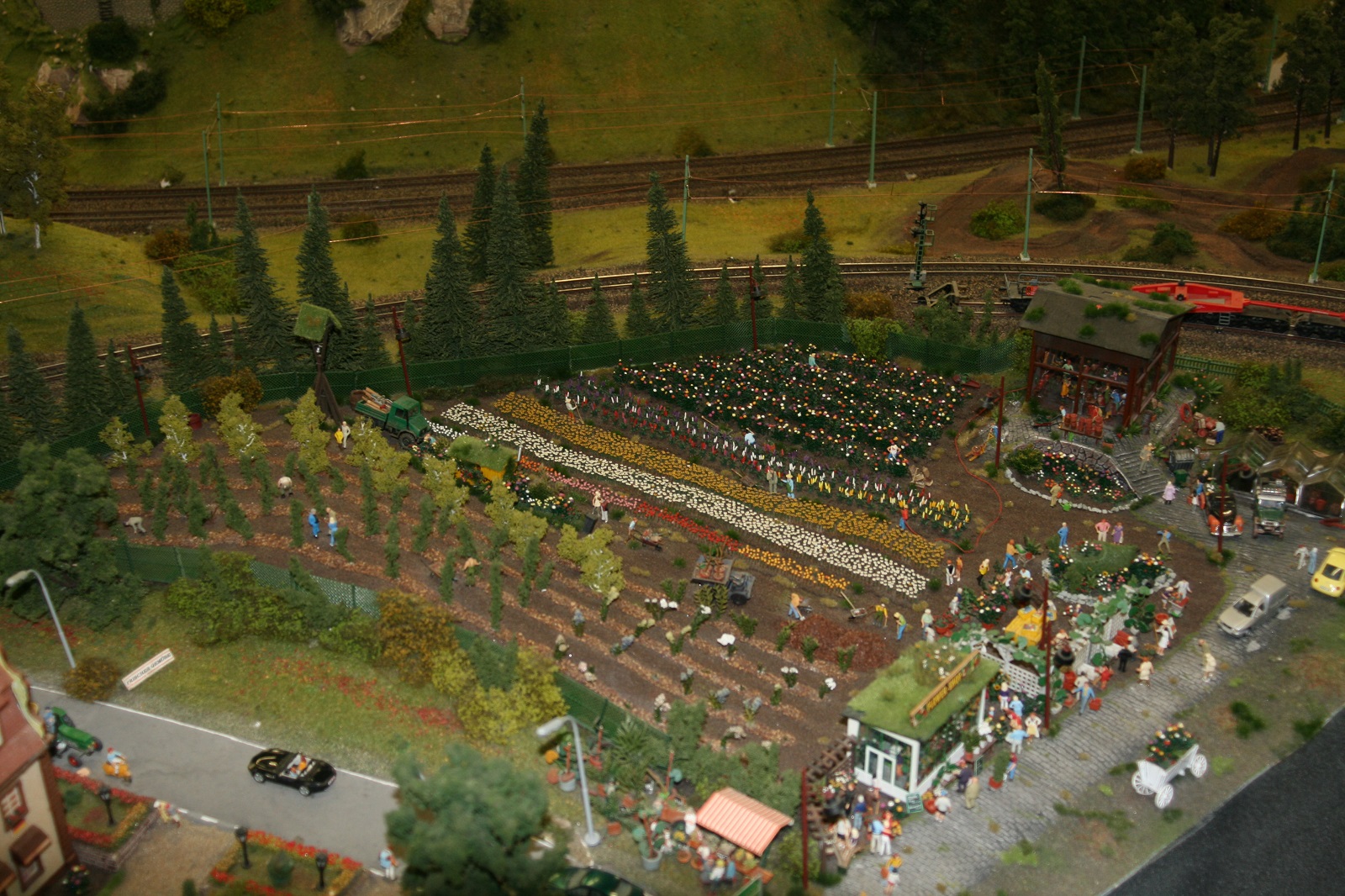
Miniature Wunderland Nursery Scene
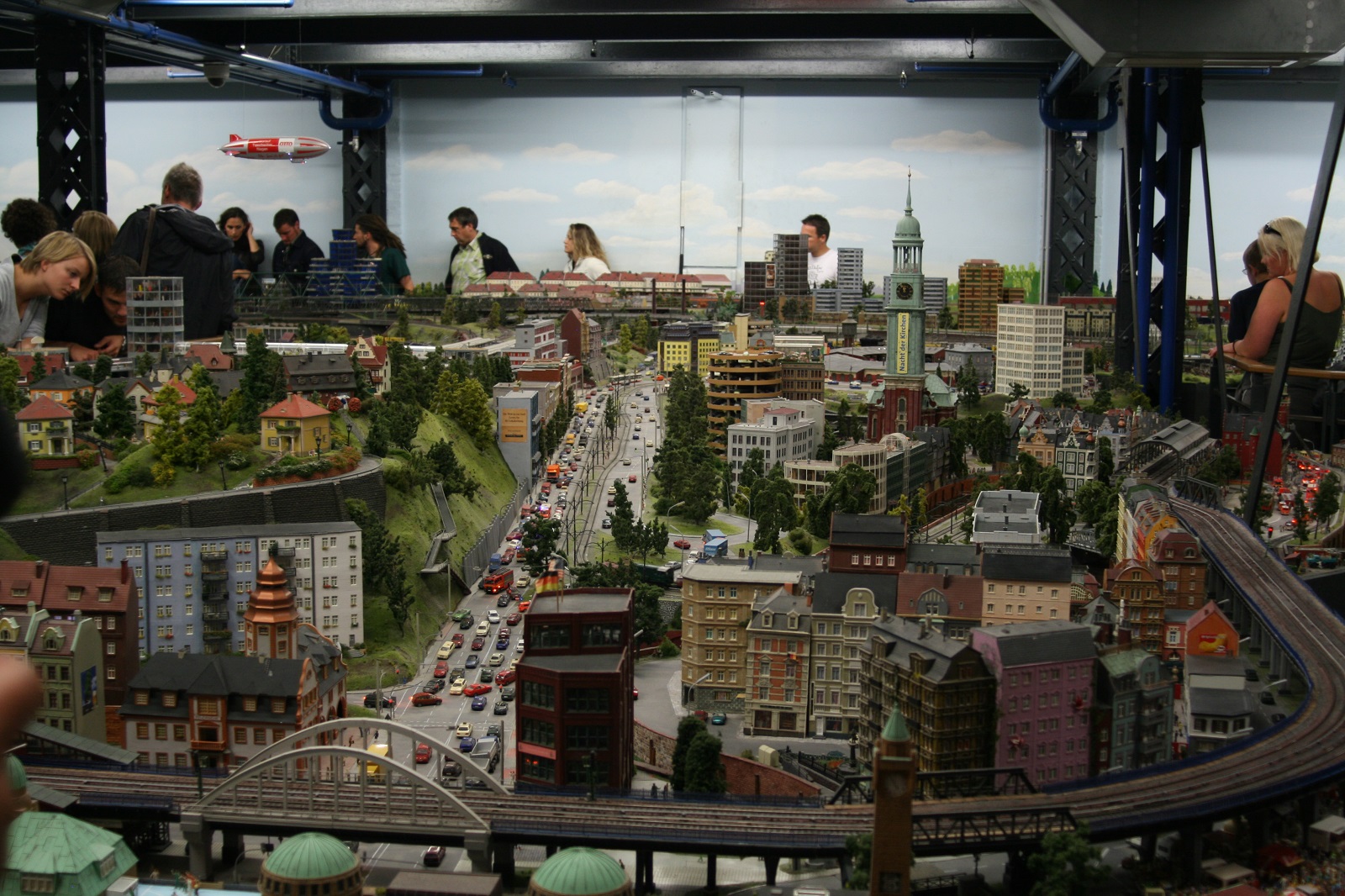
Miniature Wunderland City Scene
The Cherry Valley RailRoad & Pacific North Western Railway holds operating sessions on the second Saturday of each month. The November session will be on the 13th. Anyone interested in operating with us should contact me at tomenloe@aol.com or Steve Haas at steve.haas@comcast.net.
For those not familiar with these op sessions or the layout, the layout is 28’ x 42’, HO scale, set in 1954, NCE DCC, with operation by timetable & train order. The building opens at 10 AM, the session starts at noon, and we run until 4:30 PM. During the PNR convention, we had 14 guest operators; we normally run with 15 – 18.
There is no report for the September clinic since I was in Germany at that time and Gene forgot to give me the information. I will however write a small report with some photos from my visit to the Miniature Wunderland in Hamburg.
I have to let everyone know that the November 11th clinic will be at the Church for All Nations at 111 112th Street E. at the usual time of 7:30PM. The Pierce Couny Library Admin. Bldg. is closed due to Veterans Day. The church is on the same street as our normal location just past Pacific Ave. towards Tacoma. If you’re driving on Hwy 512 take the Pacific Ave exit from either direction and go to 112th Street E. which is south of Hwy 512 towards Parkland.
Before getting into consisting, one more step needs to be taken. To have a smoothly running consist, all of your locos should run at (about) the same speed for a given speed step. Exact matching may be theoretically possible, but is far too fussy for practical implementation. What we really need is for the locos to start together and run realistically without excessive “bucking.” Unless they all run at about the same speed the faster locos will drag or shove the slower ones, decreasing the tractive effort and causing the faster locos decoders to run hot. This is not a good idea.
To accomplish speed matching we need to use only three CV’s: CV2 (starting speed), CV5 (top speed), and CV6 (mid range speed). Assuming you have already slowed down your locos (DCC Demystified-3), follow the steps below for a “good enough” solution.
First, select the loco that starts at the lowest speed step (usually step 2). This will be used as a standard for comparing the others. Place this loco on a three-foot long (minimum) test track. This can be on your layout, but I prefer a separate track. Take another loco and temporarily give it the same address as the “standard.” Place the second loco on the test track about six inches from the standard, and start the locos. Adjust CV2 on the second loco until they both start at the same speed setting. To avoid having to take the “standard” loco off the track, simply tip it up on the far rail and place a sheet of paper under the wheels on the near side. Do this step for all your locos. Just doing this step will cure 80% of the problems that occur during consisting if you have already used CV’s 5 and 6 to slow down your steel steeds. If you are going to operate your RR before finishing the speed matching be SURE to return all locos to their primary addresses!!
That’s enough for one night … go take a break.
The next time you get ambitious, take the “standard” loco and one of the others and place them on your main line, about a foot apart. (If necessary, change the address of the second loco again.) Start ‘em up and go quickly to main line speed. Note if the second loco lags behind or catches up. Use the paper under the wheels trick to isolate the standard loco and, using Program on the Main, adjust CV5 on the other up or down. Check the two together again and change CV5 as needed. Repeat this drill with the other locos. Note here that they will NEVER run exactly at the same speed. Just get it close, as minor differences will not matter. Now, set CV6 to the mid-point between CVs 2 and 5. That will do it.
Before you quit, remember to reset the addresses of all your locos.
Karlsberg Hauptbahnhof
As an experiment in posting directly to the Grab Iron, Here are two “moments of implied action” at the Sudwest Deutsche Eisenbahn Verein Karlsberg yard.
In the First photo an 03 Pacific and an E13 1-C-1 await their scheduled departure times at the Karlsberg “ Hauptbahnhof” while an 0-8-0T drills the coach yard.
Karlsberg Engine Terminal
The second photo shows a class 18 light Pacific and A Class 41 Mikado nose to nose in the engine servicing facility, while to the left a small mogul is about to get it’s water tank filled (just as soon as someone climbs up and opens the hatch.) Final checks and lubrication is being done to the pacific and the mike, while the roundhouse super is making a point to the guy with the lube oil cart.
The Bremerton Westside Local Clinic was moved up to September 7 so that it would not interfere with the PNR conventions in Lynnwood the second week. October’s clinic will be back in it’s usual place the second Tuesday on the month which will be October 12, 2010. That evening Steve Avery will be presenting the clinic and the subject is still to be determined.
September’s clinic was presented by Peter Maitland on ‘Scale Color’. It was a subject that many of the seasoned painters hadn’t thought about. Color changes with distance. What may be bright up close will grey-out as it slides into the background. Who would think that the slightest dab of purple would gray the tone of yellow. And when Peter said slight he means slight. Green – red, blue – orange are the other colors on the color wheel and their opposites to think about when you are painting and are dealing with distance.
Like I mentioned earlier the next Westside Local Clinic in Bremerton will be on October 12 at the United Way Building of 4th Street, at 7pm. Hope to see you there.
On Wednesday, September 15, 2010, the 4D played host to the NMRA’s Pacific Northwest Region’s annual convention, Cascadian International 2010.
Held at the Embassy Suites in Lynnwood, CI2010 surprised everyone by attracting over 200 registrants who, by Friday evening, seemed settled in and enjoying the dozens of clinics, prototype tours, tours of local layouts, operating sessions, open houses, and many other activities.
One of my highlights was Friday’s “Mystery Tour,” arranged by 4D guru and convention prototype tour chair, Roger Ferris. Although we didn’t know what we were in for when we signed up, rumors spread and at least some of them proved to be true. Arriving in downtown Woodinville this morning, we were met by the owner of Eastside Freight Railroad, who loaded us onto his 1970 BN caboose pulled by an SW-1200 in beautiful spanking new EFRR livery. While some of us rode, others chased the train and staged many run-bys to the delight of all photographers present. Watch the video for a small taste of this 4-hour tour.
Meanwhile, back at convention HQ, hundreds of others learned, laughed and made new friends. Click any photo for a larger image.
There were 24 people gathered at the Summer Hill Retirement Community conference room on September 8th. We had a preliminary discussion of the next contest, which will be to construct a diorama featuring a scratch built dilapidated building. Steve Jaffrey, as winner of last year’s competition, was appointed project superintendant. Detailed contest rules will be distributed at a later date.
The featured speaker for the evening was Noel Holley, speaking on the topic, “Electrification on the Milwaukee Road”. He showed a very complete program of slides accompanied by a running commentary consisting of historical facts, statistics, personal experiences and interesting anecdotes. The Rocky Mountain Division of the Milwaukee Road was electrified for 59 years and was a world pioneer in electric operation. It ran from 1915 until 1974 with trains pulled by engines including GE Motors, Westinghouse Motors, Bipolars and Little Joes. Large brick substations converted 100,000 volts AC into 3,000 volts DC and fed it into the overhead wires. The electrification had a fascinating history. Noel visited the line several times from 1970 to 1973, and wrote a book called The Milwaukee Electrics, which was published in 1987 [with a 3rd edition in 2002]. He is an HO scale modeler and a fan of all of the railroads which ran in the Pacific Northwest. He has been a railroad fan since the age of one and an electric railroad fan since the age of three. He became a fan of overhead wire powered trains as a result of riding the last run of Portland’s Council Crest streetcar. His interest in steam railroad electrification began with pictures of the Great Northern and the Milwaukee Road in books. In high school, he scratch-built O-gauge interurban cars. In college, he switched to HO and began modeling heavy electrics. Noel has lived in Seattle since 1975 and calls it his home.
We will next meet on Wednesday, October 13th when Tom Hawkins will discuss “Designing and Painting Backdrops”.
The meeting was concluded with the usual drawing for several door prizes generously donated by Performance R/C Hobbies on Fairhaven Avenue in Burlington.