Grab Iron Posts

Skagit Valley and Whidbey Clinic

Gordon Garnhart

There were 27 people gathered at the Summer Hill Retirement Community conference room on November 10th. The meeting featured Roger Ferris conducting a Make ‘n Take session and Bobj Berger with an interesting array of estate sale items. But the start of the program was delayed because both of these gentlemen were caught in a traffic snarl due to a collision on Interstate 5.

John White opened the meeting, calling our attention to a very worthwhile program called “Heartbeat, Serving Wounded Warriors”. It was started a few years ago by Janice Buckley of Snohomish, Washington, to provide support for the spouses and families of our troops in Iraq and Afghanistan. The scope of the effort was recently expanded to help wounded veterans cope with their long recovery periods in veterans’ hospitals. At our last meeting the suggestion was made to furnish kits of railroad cars or structures to give them something interesting to do. At this meeting a further suggestion involved also supplying them with simple tool kits. These ideas were well received.
Steve Jaffrey presenting a finalized set rules for the upcoming scratch built Dilapidated Building Competition. Judging will take place at the June meeting next year.

Jack Tingstad spoke briefly about his annual Open House. Saturday and Sunday, November 27th and 28th, Jack will have his 10th annual Open House for the public at his Cloud City and Western HO layout in Coupeville at 508 Broadway. Admission is a can or two of food for the local food bank. Jack asked for volunteers to assist him with the many visitors that are expected.

Roger Ferris led a repeat of the very successful Make ‘n Take program he conducted in a clinic at the recent PNR convention in Lynnwood. There were many active participants painting cutting and gluing a small trestle for use over a culvert.

We will next meet on Wednesday, December 8th at the home of John White for “Wassail and Other Delights” on the Skagit Valley Eastern Railroad, an On30 layout serving logging and mining interests in a 1920s setting.

October NMRA InfoNet News

Al Lowe

Here’s what’s been going on at HQ recently:

  • Headquarters just completed an analysis of our RailPass Program to see how many RailPass members went on to become full NMRA members. The statistics show that, since January 1, 2009, a whopping 65% have “re-upped!” That’s just about 2 out of every 3 RailPass members who’ve stayed with us. From the time the RailPass program started in 2005, about 48% have renewed … again a great statistic.

    A lot of the credit for that retention goes to everyone in our Regions and Divisions. You’re making new members feel welcome, and you’re showing them the benefits of NMRA membership. So … THANKS!

  • Huge progress is being made with Diamond Club scanning. Craig Sutherland, the man in charge of the project, reports that they have about 500 sets of diesel loco plans (average size: 24″x30″). In addition, he and Stephen Priest brought about 50 boxes of photographs (with about 700 photos each) back to Historical Archives Services (the company doing the scanning) from our Kalmbach Memorial Library. They mentioned that there are a lot of black and white steam loco shots, some early diesel shots, and a lot of photos that caused these seasoned pros to say “wow.” Stephen called the collection “an unknown treasure.”

    We’re finding out that our archives are even more vast than we thought! So if you or your members haven’t made a donation yet, please do so so we can get these railroad treasures on the web … and eventually into your hands.

  • The Winter Board Meeting is being held concurrently with the Budget and Operations meetings this year in Las Vegas at the Palace Station Hotel (about 5 miles from the airport). The Budget and Operations meetings, which are by invitation only, begin on Tuesday, February 22 at 9 a.m. The Board Meeting runs from 9 to 5 (or later) on Wednesday, February 23, and 9 to 5 (or later) on Thursday, February 24. All NMRA members are welcome to attend.
  • As you probably read in the October of NMRA Magazine, the X2011 West NMRA Convention committee is making extensive use of social media to promote their Sacramento convention. Over the next several months they’ll be posting detailed information about layout and prototype tours, clinics, sights to see, and other pertinent facts. If you haven’t visited them on Facebook or signed up to follow them on Twitter, this is the perfect time to get your feet wet and see what the “social media” buzz is all about! Both Facebook and Twitter are free.

Next Seattle-North Clinic Nov 4

Jeff  Moorman

First, I must apologize for no write-up last month. My computer and my wireless home network have declared war on each other. I am not sure it will last, but we are currently in a state of cease fire.

The big news from September’s meeting was that I would be taking over as conductor of the Seattle-North “train.” For the record, I distinctly said that this was not “forever,” like many of the 4D volunteer jobs seem to be these days. Dennis Terpstra graciously volunteered to be the assistant conductor and the rest of the crew were willing to continue their assignments.

We talked a bit about what we did this summer, railroad-wise, that is. There were several museum and convention trips; and one bike trip over an old roadbed that seemed to be more detour than regular right of way. Roger regaled us with tales from the NMRA national convention in Milwaukee.

To prove that DCC is really getting quite easy Roger brought the components of HO DCC layout in a cardboard box about 16 by 16 by 4 inches! When you opened the box there were a couple of turnouts, a few pieces of straight track, a DCC equipped diesel switcher, a DCC controller, and precious few instructions except for the controller. As technically challenged as the Seattle-North crew can be at times it only took about 10 minutes to have things running. Now that is pretty easy! By the way, all the components in the box were from Bachmann.

Here’s what happened at the October meeting. After the usual announcements and introductions we discussed the recent Regional Convention in Lynnwood. All those that attended thought it was a worthwhile experience. I have run into a couple of modelers who skipped the banquet because they had no interest in concrete ties. To many that presentation was the highlight of the convention.

Next was a mystery contest in which three groups were given random pieces of plastic and asked to come up with a good use for them on a model railroad. Most of these “parts” came from packaging for HP commercial printer toner cartridges. The group led by CJ Riley won for their rather fanciful mail crane. Although the plastic disposable bridge abutments was in the running.

There was some interesting stuff on display for show and tell. Jim Bainbridge, owner of Sound and Northwestern LLC, showed us the firm’s first kit. It is a HO scale kit for a Sears catalog home called the Rodessa. Many attendees didn’t know that Sears sold these homes as 12 inch to the foot scale kits via their catalog in the early part of the last century. They offered lots of different designs. The buyer could order supplemental kits for luxuries, like indoor plumbing or electricity. Jim’s kit has over 200 pieces and looks pretty interesting. The only local retailer currently carrying it is North End Trains.

Next up was Chris Fife who showed some partially painted UP passenger equipment. Chris’ point was that there doesn’t appear to be a standard UP yellow. Even the prototype exhibits different shades, especially if it has been out in the weather for some time. Model-wise the shade is dependent on the primer color, plus the brand and thickness of the color coat. All agreed that the primer versus final shade ‘thing’ could be the subject for a nifty future clinic.

CJ Riley, MMR, brought along his “Two Stumps” diorama, which won awards at the recent Regional convention. Since we meet in a church, we were not subjected to the authentic outhouse odor CJ used at the convention, but he did show us how he did it. He did explain how this diorama was his attempt to do a model with scratch built everything, except (maybe) the odor.

Rob Jones completed this part of the meeting with a bunch of 30 year old color photos of railroading around Tacoma and the Northwest. My, how things have changed!

Lastly, we discussed what we’d like to see happened in future meetings. The group was open to having a couple of mini-clinics each month instead of one bigger presentation, although the latter remains an option. The group also wants to continue the practice of visiting layouts for the June meeting, but maybe not stay out so late.

There was a considerable amount of rhetoric around doing something physical at the meetings, as well as trying to recruit new members (especially young folks) into the hobby. Both ideas were deemed worthwhile, but there was no consensus on how they could be accomplished.

Modules were proposed as a way to work on something at the meetings, which could also be used as a display to assist recruitment. So, we are going to explore that at the next meeting. Are modules something the group should pursue? If so, what are the options? Which scale and standards best met the group’s goals?

If you have strong feeling on the module approach and/or want to persuade us to use a particular scheme, come to our November meeting.

I ran across the following quote, but it was not attributed to anyone. I have a little prize for the first Seattle-North Clinic attendee that can show me documented proof of who first came up with it. “The human brain is like a railroad freight car — guaranteed to have a certain capacity but often running empty.”

Next meeting is November 4 and the one after that is December 2. In November one of our attendees has promised us a mystery mini-clinic. Our other mini-clinic will be an exploration of various module types and whether they might serve as the basis for a group project. The Mart should be there and don’t forget to bring something for show and tell.

We meet at the Ronald United Methodist Church, 17839 Aurora Avenue North, Shoreline, WA. That is on the west side of Aurora (State Route 99) just north of 175th Street, between the Cadillac dealer and Deseret Industries. Meetings are the first Thursday of each month, except July and August. Enter the lower level of the church from the parking lot at the rear. Doors open around 7:00 PM, announcements at 7:15, and the program starts about 7:30. Hope to see you there or at least sometime on down the line.
DCC Demystified…Continued

Dale Kraus

Here are a few tips from Sandy Webster concerning decoder selection and use. 

I have used and liked the NCE DASR drop-in decoder on many of the old Atlas/Kato model Alco diesels (RS1, RS3, RSD5, RS11, RSD12, C424/5). I just discovered there is a drop-in decoder for the old Atlas/Roco model EMD diesels too, although it’s not labeled as such.  It’s the NCE BACH-DSL decoder made to replace the really basic decoder in Bachmann diesel like my FT’s. I bought them figuring I might use them in my FT’s. I decided to use them in something else and have been looking at various candidates. I decided to try an Atlas/Roco SD24 since I had a couple with the shells off due to body kitbashing.

It’s a no-brainer, just as simple as the DASR. All I had to do was cut the wires from the trucks to the motor, unsolder the motor contacts from the actual motor tabs and replace them with wires, cut the old headlight bulb tabs off the top of the original plastic strip to make it level, run the 6 wires up through holes on the decoder and solder them to six pads. Add the supplied LED’s in the proper location and you are done. The LED’s may need wires to extend them to the proper place and pay attention to the polarity instructions. Don’t panic, it’s a picture! This works on the GP38, GP40, SD24 and SD35. One of the best things, the list price on the decoder: $19.95.

Sometimes ya gotta ignore the labels and use the decoder that fits.

Tacoma Clinic

By Al Babinsky, Photos by Al Babinsky

Model of the Month Winner

MMR Gene Swanson opened the clinic by welcoming all. There were no newcomers present under the 46 attendees. Walt Houston reported that the Convention in Lynnwood was a great success and a number of our clinic attendees received awards and ribbons for their efforts.

Walt Houston was the recipient of the Golden Grab Iron Award and Ed Liesse and his wife gathered the Couple of the Year award.

Dave Faucett who won a few awards spoke briefly about why to be a member of the NMRA and what you get out of it. He met a number of people that were involved in the many different aspects of the Hobby and would otherwise not have known.

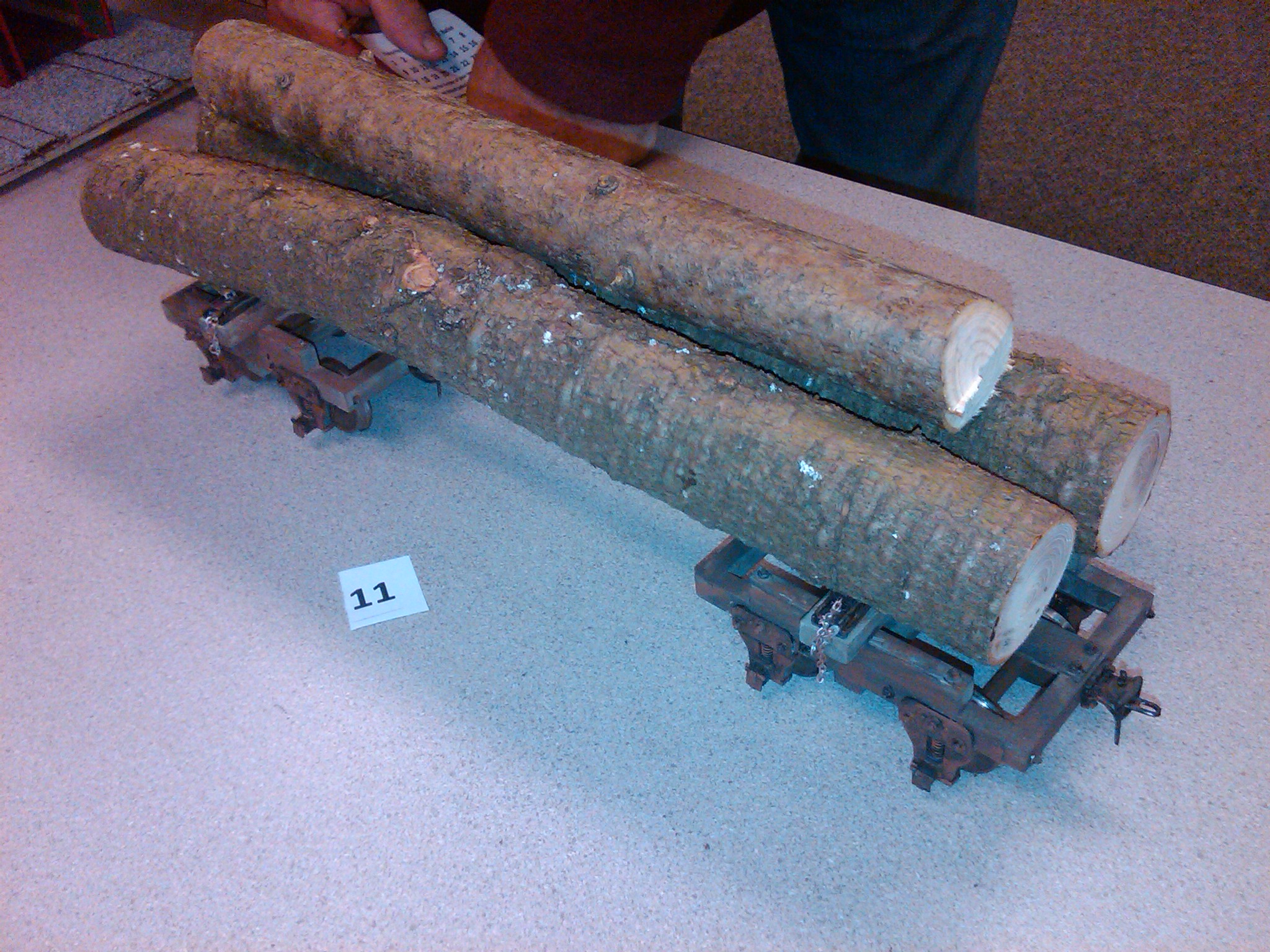
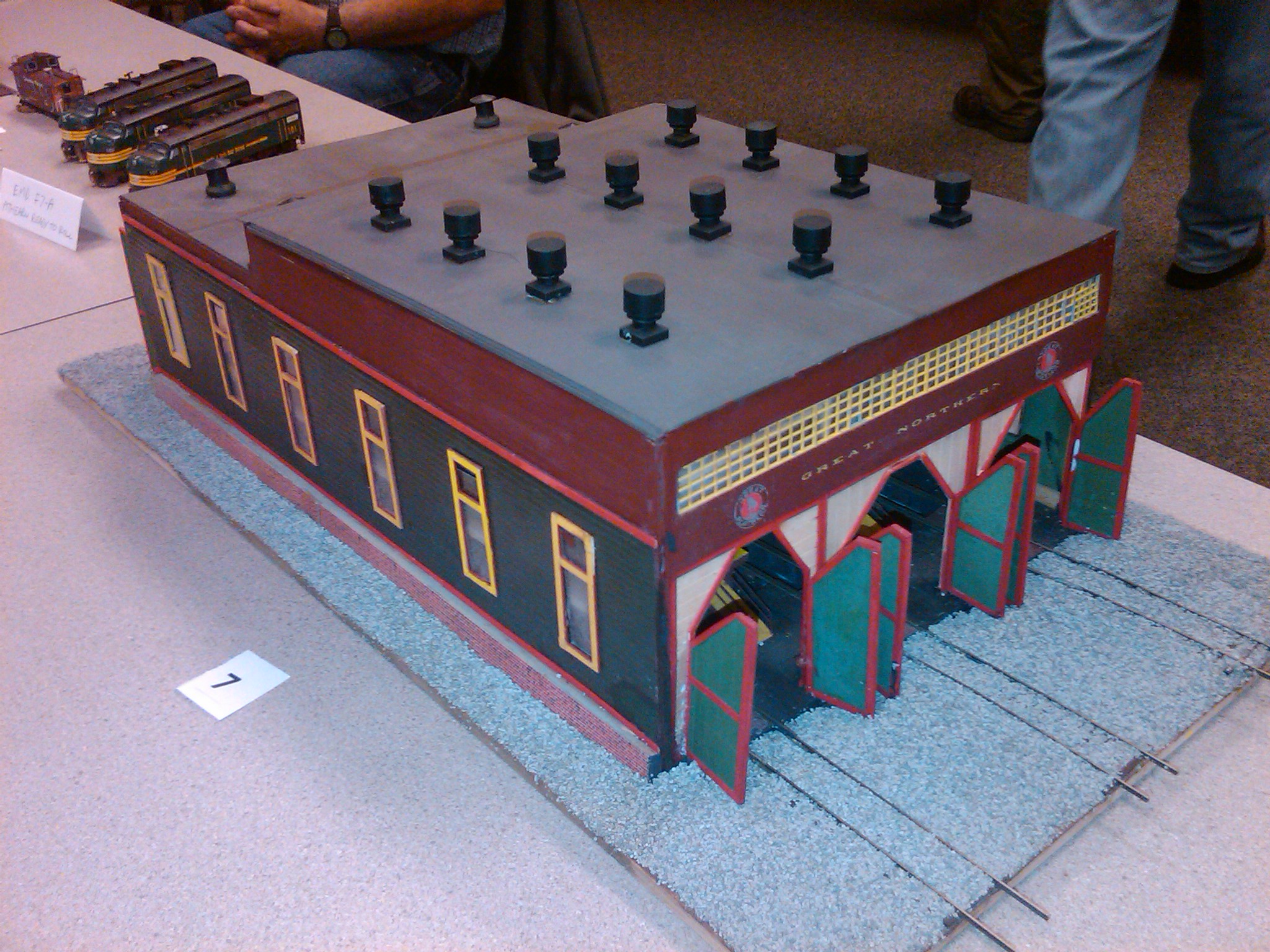
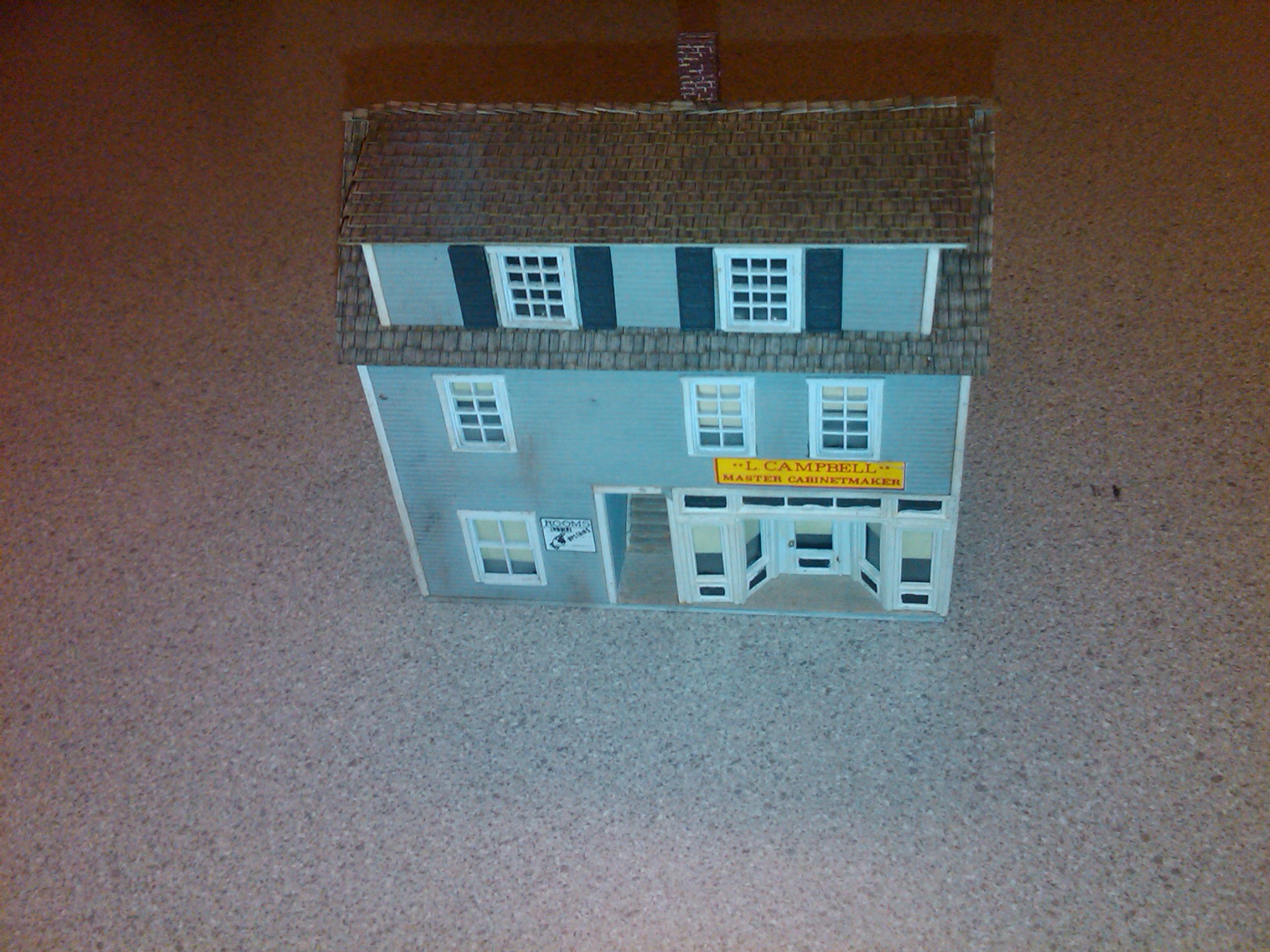
George Bourcier from Tacoma Trains presented “What’s new at the Hobby shop” which included new books, decals, hoppers, tank cars, and motive power. He also had several boxes of rolling stock from an Estate sale, they will be available in his store for any body to look at and purchase. Herb Buhl presented the Bring and Brag (Model of the month) which included several Diesel locomotives a boxcar, an engine facility, a G scale Ozark Miniatures logging disconnect, and a Builders in Scale water front structures building housing a law office and several businesses on the ground floor with rooms to rent on the upper floors. Dave Faucett won the model of the month with his Builders in Scale structure.

The clinic for the month was presented by Dale Kraus and was called Update on DCC. Dale demonstrated on how to set up locomotives with sound so that the engine would start and spool up prior to the locomotive moving. This was done by setting CV2 and CV3 with a high number and then using the consecutive thirds principle to get the correct setting. His next demonstration was on how to install a decoder in an older style Athearn. He cautioned that prior to closing up place the locomotive on a programming track to insure that there are no shorts or other problems and always use a programming track to check out your locomotives prior to use and changing the address.

Next month clinic will be at a different location due to the fact that November 11th is Veterans Day and the Library building is closed. The location for next month clinic is at the “Church for All Nations” at 111 112th Street at 7:30 PM. Park near the main entrance and the clinic is on the 2nd floor.

The clinic for next month is a Power Point presentation by Al Babinsky on the Miniature Wunderland in Hamburg, Germany, a fascinating display of automation and operation. Hope to see you there and bring friends and enjoy a great evening.


Skagit Valley and Whidbey Clinic

Gordon Garnhart

There were 22 people gathered at the Summer Hill Retirement Community conference room on October 13th. The meeting was started with Steve Jaffrey, as project superintendent, presenting a first draft and distributing copies of the rules for the upcoming scratch built structure competition. Finalized contest rules will be distributed at a later date.

Susan Gonzales distributed copies of the newly revised and updated list of books, annuals, catalogs, DVDs, handbooks, journals, magazines, VHS tapes and other literature that various members have in their personal libraries and have made available for others to use.

The featured speaker for the evening was John White, who repeated the talk he delivered at the banquet for the Pacific Northwest Regional Convention in September in Lynnwood, Washington. His subject, “Development of the Concrete Tie Market in North America”, was well prepared, well delivered and well received. His talk was accompanied by a series of very descriptive slides. This was a very personal story of John’s involvement with concrete ties from 1972 to 1999. This covers the period when there was no market for concrete ties until there were seven plants making nearly two million ties a year, three of which were owned by the company he founded. His presentation was a mixture of history and anecdotes of the challenges he faced to get the product accepted by some very skeptical railroads interlaced with additional details of production challenges with all new equipment. A lively question and answer period followed.

We will next meet on Wednesday, November 10th when Roger Ferris will bring some estate sale offerings and will also lead a Make & Take session.

The meeting was concluded with the usual drawing for several door prizes generously donated by Performance R/C Hobbies on Fairhaven Avenue in Burlington.

Eastside Get Together Meets Thursday, October 21

JJ Johnston

Meeting on Thursday, October 21, Bellevue Four Square Church.

We’re back in business. To kick off our next meeting after the summer hiatus and the Cascadian Convention, we are planning a blockbuster meeting. “TREES & MORE TREES” is our presentation and our sought after presenter is Charles Jackson. Charles will be showing us how to make incredible trees, he will demonstrate his tree making machine and he will share many new scenery products at unbelievable pricing. He’s also bringing from scenery products which he is donating as door prizes. You have this opportunity to see Charles’ presentation before anyone else in the area. That’s why the Eastside Get Together rocks.

AND, we’ll have the usual great array of activities including the Model of the Month, bring stuff for sale, free coffee and donuts, fabulous door prizes and a great time for all.

Miniature Wunderland

Al Babinsky

Miniature Wunderland Main Station

Miniature Wunderland Main Station

On my recent trip to Germany I spent a couple of extra days to stay in Hamburg to visit some of the sights, one of which was of course the Miniature Wunderland of You-Tube fame. The display is located in the Speicher district (Warehouse) of Hamburg, built at the end of the 19th century. It occupies the 3rd and 4th floor at one end and covers an area of 1150 square meters (app.10000 sq ft). At this time there are 7 theme areas with a total of 11 planned. The areas shown are Germany, Austria, Switzerland, Scandinavia and US, most of which is fantasy with some of the icons built as scale models and compressed to fit the space.

At this time there are 1,2000 m (7.5 miles) of track about 830 trains with 14,100 pieces of rolling stock. The longest train is 14.5 m (46 ft) long. There are 1,200 signals, 2,500 switches, 40 computers. About 300,000 lights, 200,000 figures, 215,000 trees and 5,500 vehicles. At the time I was there, the control room was manned by three persons who operated the layout. They operated the trains and vehicles which included emergency vehicles responding to fires. Scenes include a soccer stadium complete with 15,000 spectators and, of course, the two teams playing, an amphitheater complete with spectators, and a fair with its visitors.

The Swiss area extends from the 3rd floor to the 4th floor. From the 4th floor you can look down on the town and the walk down the stairs to the 3rd floor. While descending, you have the ability to look at scenes such as a below-ground station as you can find in many European cities. From the 3rd floor you can look up to the top of the mountain which is supposed to be the Matterhorn complete with cable cars. The major city on the layout is Hamburg with its icons and the Hauptbahnhof (Main Station).

Miniature Wunderland Control Center

Miniature Wunderland Control Center

The two cities where you see the operating vehicles are Knuffingen and Hamburg as they travel on the roads and stop and start as traffic signals change. All vehicles have lights which operate they include signal lights and operating stoplights, the emergency vehicles have operating flashing blue lights, sirens, and do-da horns.

The Scandinavian section has a fjord with real water and several ships that remotely operated. It has a winter scene along with a mining operation, the underground portion of which can be viewed through glass panels. In the US area you can a see pueblo scene which changes into a high desert area around Las Vegas which represented by its casinos, a miniature Mt. Rushmore, Yosemite  National Park with Half Dome, redwood trees, Cape Canaveral (Kennedy Space Center), Miami, and Key West with its overseas railway.

To my surprise there was a modern Puget Sound transportation item at the station, the commuter train called Sounder. I believe the longest train which operates on the layout is in the US section, a freight double-headed by Big Boys. The section under construction is the airport with most of the scenery, runway, taxi ways and terminal ramps finished. Some lights are installed a couple of buildings are there, no aircraft yet. All in all, a very well-built layout with all the tricks that are available to make it seem real. The lighting used fluorescent lights, white, blue, and red to simulate the 24-hour cycle from night to dawn, day and dusk back to night. I was there on Saturday, which was probably not the best day; I had to wait about 45 minutes to get in. The occupancy is limited to 600, which makes it very crowded and hard to take photos.

If Gene Swanson still has the June clinic spot open I would like to do a PowerPoint presentation of Miniature Wunderland. I have about 80 photos that I took and I also bought a DVD of the layout which is about 2 hours long, too long for the clinic so a presentation will have to do.

Miniature Wunderland Underground Station

Miniature Wunderland Underground Station

Miniature Wunderland Nursery Scene

Miniature Wunderland Nursery Scene

Miniature Wunderland City Scene

Miniature Wunderland City Scene